
India’s wholesale buffalo milk market is experiencing a sharp pricing shock, with Mumbai wholesale rates jumping 9.7% in a single day starting September 1, 2026, signaling broader cost pressures that will reshape dairy affordability across India’s growing middle class.
The September 1 Price Shock: What Just Changed in Indian Dairy
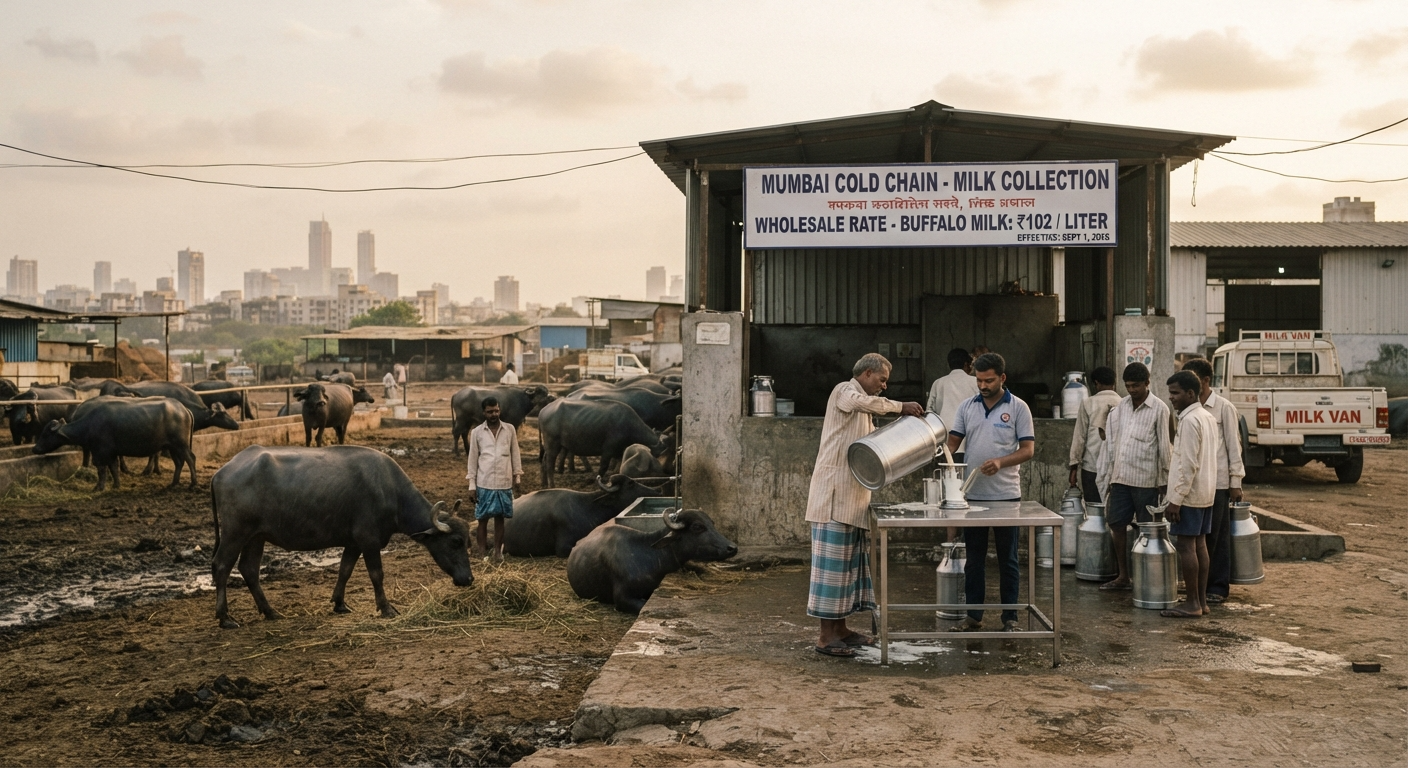
On September 1, 2026, Mumbai’s wholesale loose buffalo milk prices climbed from ₹93 per liter to ₹102 per liter. That ₹9 per liter increase isn’t a gradual market adjustment—it’s a structural reset triggered by accumulated input cost pressures that have been building throughout 2026.
To contextualize: a 9.7% wholesale price increase in a single day is not typical market volatility. It reflects a deliberate repricing by dairy producers and distributors who can no longer absorb rising costs at existing price points. This isn’t a supply shortage—it’s a margin crisis forcing immediate price transmission to wholesale markets.
For Mumbai specifically, this matters because the city represents India’s largest consumption cluster for packaged and loose dairy products. Mumbai’s wholesale market sets the pricing tone for:
- Retail and packaged milk brands selling across Western India
- Regional dairy cooperatives benchmarking their procurement strategies
- Hotel, restaurant, and institutional buyers adjusting food costs
- Bulk industrial dairy users (confectionery, bakery, ice cream manufacturers)
Why Buffalo Milk, Not Cow Milk? India’s Dairy Hierarchy
India’s dairy market operates on a two-tier structure, and buffalo milk occupies the premium tier:
Buffalo Milk Economics
- Higher fat content (6-7% vs. cow milk 3-4%) means higher yield for yogurt, ghee, and paneer production
- Superior shelf life due to natural composition, preferred for institutional and commercial use
- Pricing premium typically 15-25% above cow milk wholesale prices
- Regional concentration in Northern and Western India, where buffalo herds dominate
The buffalo milk focus matters because it suggests institutional and commercial buyers are feeling the squeeze first, not retail consumers. When wholesale loose milk (unpackaged, sold to bulk processors) spikes, it signals pressure in the value-added dairy chain before it reaches retail shelves.
Why This Matters More Than It Appears
India produces roughly 230 million tons of milk annually, with buffalo milk representing approximately 55% of output. A wholesale price increase in buffalo milk doesn’t just affect loose milk sales—it cascades through:
- Paneer production (the primary value-added product for buffalo milk)
- Ghee and clarified butter manufacturing
- Yogurt and dairy dessert production
- Institutional food services (schools, hospitals, military canteens)
The Input Cost Crisis: What’s Driving This Repricing
The September 1 price increase is explicitly tied to rising input costs, which have been compressing dairy farmer margins throughout 2026. In India’s dairy sector, input costs break down into:
1. Fodder and Feed Costs (40-50% of production cost)
- Concentrate feed inflation: Soy, groundnut cake, and maize prices have risen 12-18% year-over-year in 2026
- Green fodder scarcity: Monsoon patterns affected forage availability, forcing farmers to purchase supplemental feed
- Transportation costs: Diesel prices and logistics have increased, raising the cost of sourcing feed from surplus to deficit regions
2. Labor and Service Costs (15-20%)
- Veterinary services: Medicines, vaccines, and professional care costs up 10-15%
- Labor availability: Increasing labor costs in rural India, particularly for specialized dairy work
- Cooling and storage infrastructure: Electricity costs rising, impacting cold chain maintenance
3. Healthcare and Genetics (10-15%)
- Animal healthcare inflation: Antibiotic and vaccine costs rising
- Genetic improvement programs: Cost of high-yield breeding stock and semen increasing
- Mastitis and disease management: Preventive healthcare becoming more expensive
4. Financial and Operational Costs (5-10%)
- Interest rates: Higher borrowing costs for dairy farmers
- Insurance and compliance: Regulatory requirements increasing operational expenses
- Technology and tracking: Real-time milk quality testing and digital payment systems adding costs
The math is simple: When your costs rise 12-18% and wholesale prices lag, margins compress. Farmers stop absorbing losses and prices reset. That reset happened September 1.
The Producer Squeeze: Why Farmers Are Forcing This Price Increase
Indian dairy farmers operate under two structural constraints:
Constraint 1: Inelastic Supply
Dairy farmers can’t quickly adjust herd size or production volume. Buffalo milk production responds slowly to price signals (18-24 month lag from breeding to production). This means:
- Price increases don’t immediately boost supply
- Farmers with existing herds have no choice but to produce
- But they won’t absorb losses indefinitely
Constraint 2: Limited Value-Chain Bargaining Power
Dairy farmers in India typically operate through:
- Cooperative dairy unions (AMUL, Parag, Britannia supply chains)
- Private dairy procurement systems (franchise-based milk collection)
- Direct retail sales (limited to local markets)
Cooperatives have been transparent about cost pressures, and private dairies have tightened procurement. When procurement channels tighten and costs rise, loose milk wholesale prices become the release valve.
The result: The ₹9 per liter increase reflects farmer collective action (whether coordinated or organic) to restore profitability to minimum acceptable levels.
Regional Implications: Tamil Nadu and the Spread
Tamil Nadu’s parallel increase in procurement prices to farmers (announced simultaneously) is significant because it confirms the price reset is nationwide, not Mumbai-specific.
Tamil Nadu has different dairy dynamics than Western India:
- Larger cow milk base (buffalo less dominant)
- Stronger cooperative system (Tamil Nadu Cooperative Milk Producers Federation)
- Institutional buyer concentration (dairy state for Indian defense, institutional supply)
If both buffalo-dominant regions (Western India) and mixed dairy regions (Tamil Nadu) are raising prices simultaneously, the triggering factor is truly structural—not localized supply shock or regional input inflation.
The Global Context: Emerging Market Dairy Pressures
This price move mirrors dynamics in other emerging market dairy sectors:
Similar Pressures Globally
- Brazil: Dairy costs rising 8-12% in 2026 due to feed commodity inflation
- Mexico: Milk price increases announced to manage input cost pressures
- Southeast Asia: Rising labor and energy costs compressing dairy margins
- Sub-Saharan Africa: Structural feed cost increases affecting producer economics
India’s 9.7% wholesale price increase, while large, is consistent with global emerging-market dairy cost pressures. This is not an India-specific anomaly—it’s a symptom of global commodity and energy cost dynamics affecting dairy economics globally.
Impact on Indian Consumers: Who Bears the Cost?
The price increase flows through different consumer segments at different speeds:
Segment 1: Packaged Milk Consumers (Immediate Impact, 2-4 weeks)
- Amul, Parag, Britannia milk brands will likely increase retail prices by ₹2-4 per liter within 2-4 weeks
- Middle and upper-income urban consumers will see shelf price increases reflected in weekly shopping
- Price sensitivity: Limited, due to inelasticity of demand for essential nutrition
Segment 2: Loose Milk Consumers (Immediate Impact, <1 week)
- Direct-from-dairy retail (milkmen and local vendors) will raise prices immediately
- Lower-income consumers feel impact first, lack brand loyalty buffer
- Price sensitivity: High—may shift to packaged alternatives or reduce consumption
Segment 3: Value-Added Dairy Consumers (Lagged Impact, 4-8 weeks)
- Paneer, ghee, yogurt prices will increase as manufacturers adjust input costs
- Restaurant and institutional buyers will raise menu prices gradually
- Impact: Broader but less visible than milk price increases
Segment 4: Ultra-Low-Income Consumers (Most Vulnerable)
- Affordability crisis: For households spending 5-10% of income on dairy, a 10% price increase is significant
- Nutritional impact: May reduce dairy consumption, affecting child nutrition in lower-income groups
- Policy risk: Government may face pressure for dairy price controls or subsidies
The Tamil Nadu Connection: Broader Supply Chain Implications
Tamil Nadu’s coordinated procurement price increase matters because it suggests:
Dairy Cooperative Alignment
Tamil Nadu has more mature cooperative structures than many Indian states. If TCMPF and related cooperatives are raising farmer prices, this signals:
- Coordination across regions on input cost response
- Potential bottleneck in milk supply if prices don’t follow
- Risk of supply constraints if retail prices lag wholesale increases
Institutional Buyer Exposure
Tamil Nadu supplies significant volumes to:
- Military and government institutions (subsidized schemes)
- School mid-day meal programs (dairy component)
- Urban lower-income subsidies (some states provide dairy support)
Price increases in Tamil Nadu procurement could trigger policy adjustments in government dairy subsidy programs.
Timeline: When Does This Cascade Through Retail?
Based on typical dairy supply chain lags in India:
Week 1 (Sept 1-7):
- Wholesale loose milk prices absorb ₹9 per liter increase
- Dairy procurement centers adjust inventory decisions
Weeks 2-3 (Sept 8-21):
- Packaged milk brands begin adjusting retail prices (₹2-4 per liter increases)
- Loose milk retailers raise local prices
- Early price transmission to consumers
Weeks 4-8 (Sept 22 – Oct 31):
- Value-added products (paneer, ghee) adjust prices
- Restaurant and institutional menus updated
- Full cascade through retail and food service
Months 2-3 (Nov-Dec):
- Demand destruction evident in consumption data
- Potential consumer shift to alternatives (plant-based, reduced consumption)
- Government response (subsidies, price controls) may emerge
Producer Margin Recovery: Is This Sustainable?
The key question: Will the ₹9 per liter increase actually restore farmer margins, or is it temporary relief?
The answer depends on whether input costs stabilize:
If Input Costs Stabilize
- Farmer margins improve in Q4 2026 and beyond
- Wholesale prices hold at ₹102+ per liter
- Retail prices stick at increased levels
- Outcome: New equilibrium established
If Input Costs Continue Rising
- Farmers face margin pressure again within 2-3 months
- Further price increases likely in Q4 2026 or Q1 2027
- Retail pricing becomes chronic issue
- Outcome: Ongoing price pressure with multiple adjustments
If Input Costs Decline (Unlikely but Possible)
- Farmers capture windfall margins briefly
- Wholesale prices decline in Q4 or Q1
- Consumers benefit from falling prices
- Outcome: Temporary spike, not structural change
Most likely scenario: Input costs remain elevated but don’t accelerate. The ₹102 per liter price becomes the new floor, with potential for 5-10% additional increases if cost pressures persist through Q4.
What This Signals About India’s Dairy Future
The September 1 price shock reveals structural dynamics in India’s dairy sector:
Signal 1: Producer Bargaining Power Is Rising
Farmers and cooperatives have enough market power to force price resets when margins collapse. This suggests consolidation and cooperative strength are increasing.
Signal 2: Commodity Cost Shocks Are Transmitting Faster
The immediate wholesale price response (within weeks of cost pressures) shows faster price discovery than India’s dairy market exhibited historically. This reflects better information flow and less fragmentation.
Signal 3: Inflation Risk Is Real for Low-Income Consumers
If dairy prices increase 10% and don’t reverse, lower-income Indian households face genuine cost-of-living pressure that governments will struggle to address through subsidies alone.
Signal 4: Global Commodity Exposure Is Growing
India’s dairy sector is increasingly exposed to global feed, energy, and input costs. Localized supply shocks matter less than global commodity dynamics.
FAQ: Understanding India’s Dairy Price Dynamics
Q: Why did the price increase happen on September 1 specifically, not gradually? A: Dairy wholesale markets often reset on monthly boundaries due to billing cycles, cooperative procurement schedules, and contractual renegotiations. September 1 represents a fiscal and calendar reset point. Accumulated pressure from input costs throughout August likely triggered coordinated repricing at the month boundary.
Q: Is ₹102 per liter expensive by global standards? A: No. At current exchange rates (₹83-85 per USD), ₹102 per liter equals approximately $1.20-1.23 per liter. Global buffalo milk wholesale prices range $1.30-1.80 per liter in developed markets. India remains competitive globally, even at ₹102.
Q: Will packaged milk brands absorb the cost or pass it to consumers? A: Most likely they’ll split the impact 50-50: absorbing some margin pressure initially, then passing 50-70% of the cost increase to consumers within 4-8 weeks. Brands with strong positions will absorb more; budget brands will pass through faster.
Q: How does this affect India’s dairy export competitiveness? A: Negatively. India is a net dairy exporter (milk powder, ghee, butter), and higher domestic prices reduce export margins. Dairy exports may contract in Q4 2026 if international prices don’t rise proportionally.
Q: Could the government impose price controls on milk? A: Possibly, but unlikely at wholesale level. Retail milk price controls are periodic policy tools in some states, but are generally ineffective and create supply distortions. Central government is more likely to provide subsidy support for school nutrition programs and lower-income subsidies rather than price controls.
Q: Will dairy consumption decline in India due to price increases? A: Modestly. Dairy demand in India is relatively inelastic (essential nutrition), but lower-income consumers will reduce consumption by 5-10% if prices hold. Upper-income consumption is unaffected.
Q: How does buffalo milk price compare to cow milk after this increase? A: Buffalo milk at ₹102 likely trades at a 15-20% premium to cow milk. Cow milk is probably around ₹80-85 per liter at wholesale, making the buffalo-to-cow ratio approximately 1.2x. This premium reflects buffalo milk’s higher fat content and value for paneer production.
Q: Is this price increase permanent or temporary? A: Likely permanent unless input costs decline significantly. The ₹102 price reflects sustainable production costs at current input levels. If input costs decline, prices might fall, but they’re unlikely to return to ₹93 without global commodity deflation.
Q: How much of the ₹9 increase goes to farmers vs. distributors? A: Typically 60-70% flows to producers and 30-40% is retained by cooperatives and distributors as margin. So farmers see approximately ₹5.50-6.00 of the ₹9 per liter increase, improving their margins from production cost compression.
Q: Will other Indian states follow with price increases? A: Yes. If input costs are nationwide (which they are), other dairy-producing states (Rajasthan, Haryana, Uttar Pradesh, Gujarat) will announce similar increases within 1-3 weeks. Regional variation will exist based on local input costs and cooperative structures.
Q: How does this affect paneer and ghee prices? A: Both will increase 8-12% within 4-8 weeks. Paneer is 80% buffalo milk cost, so a 9.7% wholesale price increase flows through to roughly 7-8% retail paneer price increase. Ghee production uses lower-cost milk, so the impact is more muted (4-6% increase).
Q: Is India’s dairy inflation related to global dairy prices? A: Partially. Input cost inflation (feed, energy, labor) is global. But India’s dairy prices are also driven by local factors: monsoon patterns, regional herd health, cooperative procurement cycles, and government subsidy programs. The ₹9 increase is primarily local cost-driven, not global price-driven.
Sources & Publication Note: This analysis synthesizes reporting from Sunday Guardian Live (August 31, 2026) and contextualizes developments within India’s dairy supply chain structure. Current milk pricing data, state-level procurement information, and dairy cost data are available through the National Dairy Development Board (NDDB), state dairy corporation websites, and commodity market reporting.