
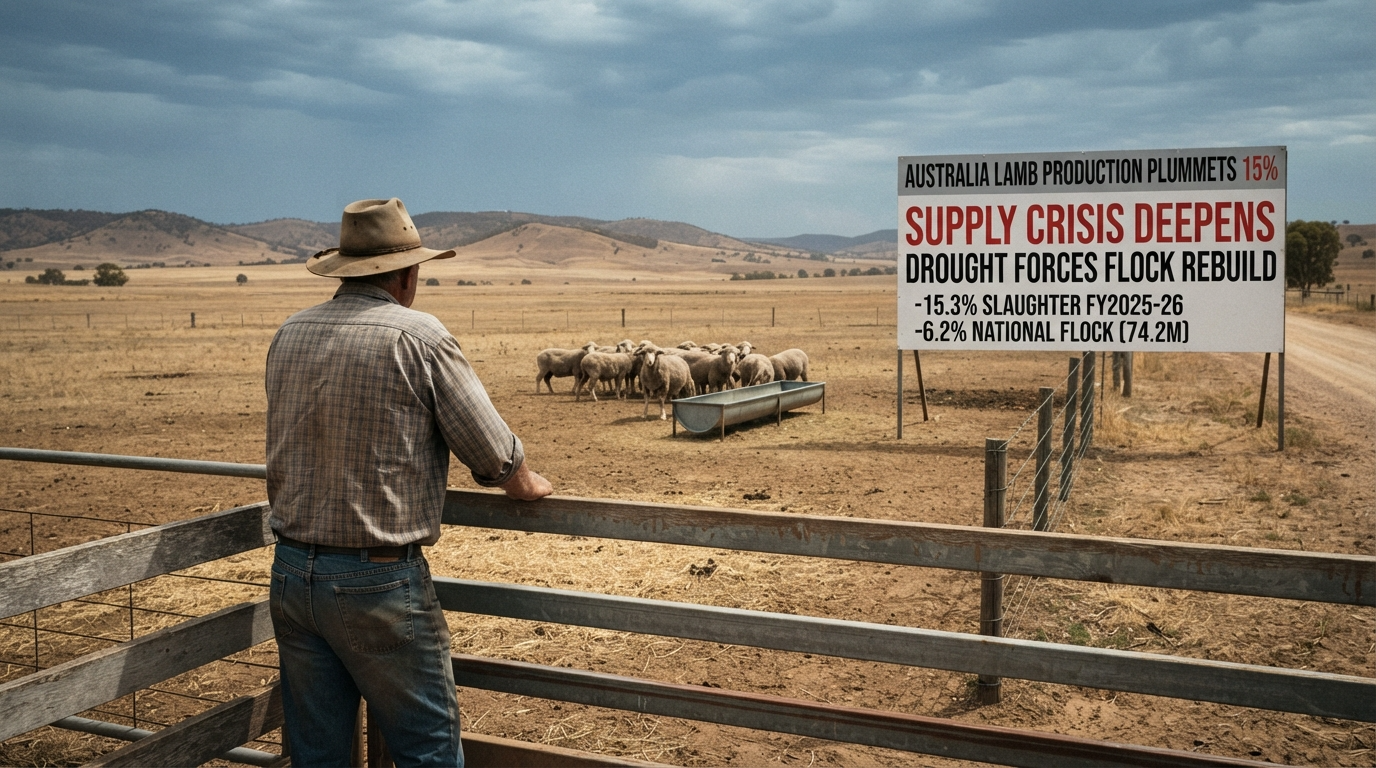

Australian lamb production collapsed during FY2025-26, with slaughter down 15.3% to 22.075 million head and production declining 11.2% to 554,658 tonnes. The June quarter saw even sharper weakness (21.6% slaughter decline). Despite record carcase weights offsetting volume loss, the trend is unmistakably negative: MLA forecasts another 10% production decline in 2026. Three consecutive years of below-average rainfall across southern regions, combined with elevated prior turnoff and beginning flock rebuild phase, are tightening global sheepmeat supply—supported further by New Zealand’s concurrent flock contraction.
Table of Contents
FY2025-26 Production Collapse: -15.3% Slaughter, -11.2% Output
Australia’s sheepmeat industry delivered sharply negative results for the financial year ended June 30, 2026, according to official data from the Australian Bureau of Statistics (ABS) released by Meat & Livestock Australia (MLA):
FY2025-26 Production Snapshot:
- Lamb Slaughter: 22.075 million head, down 15.3% year-on-year
- Lamb Production: 554,658 tonnes carcase weight, down 11.2% YoY
- Production Ranking: 4th-largest year on record despite declines (held up by record carcase weights)
- Sheep Slaughter: 8.045 million head, down 31.5% YoY (mutton crisis)
- Mutton Production: 209,865 tonnes, down 28.8% YoY
Context on the Ranking: Despite the 11.2% production decline, FY2025-26 remained the fourth-largest lamb production year on record—a testament to the cumulative productivity gains (genetic improvements, feed systems, carcase weights) that have characterized Australia’s sheep sector for the past 15 years. However, this ranking disguises a sharp directional trend: production is now moving downward after peaking in 2024-25.
MLA Senior Market Information Analyst Emiliano Diaz noted: “The lamb sector is producing fewer animals than a year ago, but record carcase weights have helped offset some of the decline in slaughter numbers.” This statement captures the tension at the heart of the Australian lamb industry in 2026: production support is now dependent on animal weight gains, not volume growth.
June Quarter Particularly Weak: -21.6% Slaughter YoY
Quarterly data reveals a particularly sharp contraction in the final quarter of FY2025-26:
- June Q Lamb Slaughter: 5.286 million head, down 21.6% year-on-year
- June Q Lamb Production: 140,995 tonnes, down 15.7% YoY
- June Q National Lamb Carcase Weight (Record): 26.7 kg/head
- June Q Sheep (Mutton) Slaughter: 1.334 million head, down 46.9% YoY
- June Q Mutton Production: 34,205 tonnes, down 43.1% YoY (lowest since June 2021)
The June quarter weakness was dramatic. A 21.6% year-on-year slaughter decline signals that supply tightening accelerated significantly in the final quarter of the financial year. Producers were increasingly retaining breeding stock rather than turning off animals for slaughter—the hallmark of a flock rebuilding phase.
Mutton Situation Critical: The June quarter mutton collapse (46.9% slaughter decline, 43.1% production decline) reveals the structural damage from prior years of heavy ewe turnoff. With fewer breeding ewes in the national flock and elevated turnoff over the past 2-3 years, the pool of older sheep available for slaughter has evaporated. Mutton production hit its lowest level since June 2021—a five-year low.
Record Carcase Weights Offsetting Volume Decline
A remarkable feature of the FY2025-26 contraction is that production decline (11.2%) was significantly less severe than slaughter decline (15.3%). This 4-point gap reflects one factor: record lamb carcase weights.
Carcase Weight Trajectory: The national average lamb carcase weight reached a record 26.7 kg/head in the June quarter. This represents the culmination of a multi-year trend toward heavier animals:
- FY2024-25: Lamb carcase weights elevated due to grain feeding and selective breeding for meat yield
- FY2025-26: Continued weight gains despite lower throughput, reflecting processor demand for heavier stock and genetic gains in the flock
- 2026 Forecast: MLA projects average lamb carcase weights will lift to 24.6 kg/head in 2026, supported by genetic improvement, grain feeding and processor demand
Why This Matters: Heavier carcase weights are a temporary buffer against volume loss—but they cannot indefinitely offset declining animal numbers. There are biological limits to how heavy a lamb can grow before feed conversion efficiency declines and producers face economic diminishing returns. The record carcase weights of FY2025-26 likely represent a peak; future production declines cannot rely on this buffer.
⚠️ CRITICAL: Carcase weight gains are masking the severity of the underlying supply crisis. Once animals reach biological weight ceilings, further production declines will accelerate sharply.
National Sheep Flock Contracting Sharply: Down 6.2% to 74.2M Head
The fundamental driver of production collapse is the national sheep flock contraction:
Flock Size as of June 2025 (end of FY2025-26): 74.2 million head, down 6.2% year-on-year.
This represents three consecutive years of flock decline. After peaking in prior decades, the national sheep flock has been in sustained contraction since 2023:
- FY2024-25: Flock contracted due to below-average seasonal conditions and elevated turnoff
- FY2025-26: Further 6.2% contraction reflecting continued seasonal pressure and ongoing high turnoff rates
- FY2026-27 Forecast: MLA estimates the flock will continue declining 2.7% to 67.1 million head by June 2026
Flock Composition Shift: A critical change is now underway: producers are transitioning from a destocking phase (heavy turnoff) to a rebuilding phase (retaining breeding ewes). This shift is visible in the sharp June quarter declines—producers held back ewes for breeding rather than marketing them for slaughter.
The implication: slaughter will remain depressed through FY2026-27 and potentially into FY2027-28, as retained breeding stock takes 5-7 months to produce lambs. This structural headwind will dominate lamb supply for the next 12-24 months.
Three Years of Below-Average Seasonal Conditions Driving Contraction
The primary culprit behind flock contraction is weather. MLA documentation identifies three consecutive years of below-average rainfall and seasonal stress across key southern production regions:
Drought-Affected Regions:
- Victoria
- South Australia
- Southern New South Wales
- Tasmania
These four regions represent the core of Australia’s sheep production base—temperate zones with reliable feed systems that support intensive grazing and lamb production. Three consecutive years of below-average seasonal conditions have:
- Reduced pasture availability and forage quality, increasing producer costs to maintain animals
- Forced producers to reduce breeding stock retention and increase turnoff of ewes ahead of schedule
- Created uncertainty about when drought will break, depressing producer confidence in rebuilding investments
- Pushed soil moisture and pasture conditions under pressure even after late summer relief in some areas
Why Producers Liquidated Flocks: The economic calculus for ranchers during prolonged drought is brutal: feed costs rise while animal condition declines and market prices remain uncertain. Rather than pay high feed costs to maintain breeding stock through poor seasons, many producers elected to sell breeding ewes and reduce flock size. This “survival liquidation” has left the national flock much smaller than it would be without the drought.
Rebuild Phase Beginning, But Slowly: Even as drought conditions persist in some regions, producers are beginning flock rebuild—but cautiously. Improved lambing results and increased ewe retention in recent producer surveys suggest confidence is growing, but rebuilding will be gradual given continued seasonal uncertainty.
Mutton Production Crisis: Lowest Levels Since FY2022
While lamb production receives most attention, the mutton crisis reveals the severity of the underlying flock stress:
FY2025-26 Mutton Production:
- Sheep Slaughter: 8.045 million head, down 31.5% year-on-year (sharpest decline since FY2022)
- Mutton Production: 209,865 tonnes, down 28.8% YoY
- June Q Sheep Slaughter: 1.334 million head, down 46.9% YoY
- June Q Mutton Production: 34,205 tonnes, down 43.1% YoY (lowest since June 2021)
Why Mutton Collapsed: Mutton comes from older sheep—ewes and wethers culled from breeding flocks or retired after productive years. Three years of heavy ewe turnoff (due to drought and destocking) depleted the pool of mature breeding ewes available for future turnoff. Without breeding ewes in the system, there are no older animals to harvest as mutton.
The June quarter mutton collapse (46.9% down YoY) demonstrates that the flock is now so tight that producers are retaining every productive ewe possible. The mutton market will remain extremely constrained through FY2026-27.
Global Mutton Scarcity: Australia and New Zealand together account for ~80% of global sheepmeat exports. Mutton from both countries is used in specialized markets (foodservice, processed meat, ethnic cuisines). Mutton scarcity will elevate pricing for importers dependent on this product.
2026 Forecast: Further 10% Lamb Decline Expected (~537K Tonnes)
MLA’s latest sheep industry projections for 2026 (released March 2026) forecast continued contraction despite productivity gains:
2026 Lamb Production Forecast:
- Lamb Slaughter: 21.86 million head, down 11% from 2025 (following 6.9% estimated decline in 2025)
- Lamb Production: ~537,000 tonnes carcase weight, down 10% from 2026 (FY2025-26 was ~554,658 tonnes)
- Forecast Ranking: Still among stronger production years on record due to continued carcase weight gains (estimated 24.6 kg/head average)
2026 Mutton Forecast (Even Worse): Mutton slaughter is expected to contract more sharply, falling 30% to 7.14 million head, as producers retain breeding stock where possible. Mutton production will decline 29% in 2026—reflecting the continued tightness in the available pool of mature sheep.
What This Means for Exporters and Buyers: Australia will have at least two consecutive years (2026 and 2027) of declining lamb production. Combined with New Zealand’s concurrent flock contraction, global sheepmeat supply will remain severely constrained through the next 24 months at minimum.
The bright spot: MLA projects that genetic gains, improved feeding systems, and processor demand for heavier stock will continue supporting carcase weights, moderating the production decline. However, MLA Senior Analyst Diaz cautioned: “While lamb turnoff is forecast to be lower in 2026, improvements in genetics, feeding systems and carcase weights mean production remains relatively resilient by historical standards.” The operative word is “relatively”—production is still declining in absolute terms.
Global Sheepmeat Supply Tight (New Zealand Also Contracting)
Australia’s supply crisis is compounded by simultaneous tightening in the Southern Hemisphere’s other major sheepmeat exporter: New Zealand.
New Zealand Supply Status: New Zealand’s sheep flock has been contracting for decades, from 39.3 million head in 2003 to a record low of 24.4 million in 2023. While improved North Island conditions may support modest rebuilding, the flock remains structurally small. New Zealand exports over 90% of its lamb and mutton production—any decline in NZ production directly reduces global supply.
Global Export Concentration: Australia and New Zealand together account for over 80% of global sheepmeat exports. Combined flock contractions in both countries mean global supply will be severely constrained through 2026-27.
Price Implications: UK research from AHDB (Agriculture and Horticulture Development Board) confirms: “Global sheep meat markets remain subdued as Australia and New Zealand enter a phase of flock rebuilding, sustaining historically high prices across these key export regions.” Tight supply = elevated prices. This dynamic will persist as long as both countries are in flock rebuilding mode (likely 18-36 months).
Market Share Opportunities: The UK market provides a case study: New Zealand’s lamb exports to the UK have fallen from 70,040 tonnes average in the 2010s to 46,412 tonnes in 2024. Australia has captured much of the gap, increasing its UK market share. Similar dynamics are playing out in other regions—Australia is gaining share as NZ contracts, but aggregate global supply is still tightening.
Market Implications & Buyer Strategies
The tightening in Australian and global sheepmeat supply creates acute challenges for international buyers:
BUYER ACTION ITEMS — IMMEDIATE PRIORITY:
- Lock Supply Agreements NOW: Secure long-term supply contracts at current pricing levels. Once buyers recognize the magnitude of the supply shortage (which is still spreading through the market), pricing will firm substantially. Early commitment is critical.
- Budget for Price Premiums: Expect sheepmeat prices to trade at 10-15% premiums above historical norms through Q4 2026–Q1 2027, reflecting supply scarcity. Price softening is unlikely given global tightness.
- Diversify Sourcing: Reduce single-country exposure by developing supply relationships with:
- New Zealand: Small volumes but quality premium
- Uruguay: Smaller export volumes but reliable supply
- Argentina: Emerging sheepmeat exporter with capacity to grow
- Mutton Sourcing Strategy: Mutton availability from Australia is severely constrained. Source mutton from NZ and lesser-known suppliers (Uruguay, Argentina, India) now, or plan for mutton menu reductions through 2027.
- Live Sheep Imports (Middle East): Australia’s live sheep exports are also declining amid flock tightness. Buyers dependent on live animal imports to Middle East markets should secure alternative supply or plan for delivery delays.
- Product Specification Review: Work with suppliers to optimize product specs (trim levels, packaging formats) toward higher-margin items. With tight supply, premium products command better pricing than commodity cuts.
Export Market Status
Australia’s Key Sheepmeat Export Markets (2025):
- China: 119,163 tonnes sheepmeat ($934 million); largest volume destination, but mutton-heavy (prices under pressure)
- United States: 99,773 tonnes sheepmeat ($1.58 billion); largest value market, primarily lamb (higher prices per unit)
- Malaysia & UAE: Major Asian markets for processed and live categories
- Canada: Exports up 26% YoY to 14,000+ tonnes in 2025 (seventh-largest market, growing)
Export Pricing Trends: MLA data shows that despite strong sheepmeat flows to China, the value of exports to China fell notably in 2024-2025 as Chinese foodservice operators shifted from lamb to mutton due to price pressure. This shift will reverse in 2026-27 as tight supply supports lamb pricing. US market remains stable and high-value, with increasing lamb placement in casual ethnic cuisines.
Processing Sector Stress
Tighter sheep and lamb supply is already creating stress on Australia’s processing sector. Several southern processing regions recorded notably softer throughput in recent quarters. Processors are adapting by:
- Increasing focus on export-grade product to maximize revenue per animal
- Adjusting production schedules to match lower supply availability
- Investing in value-added processing to capture margin from limited supply
Processing capacity may become a constraint if supply tightens beyond current forecasts. Buyers should monitor processor health and capacity utilization.
Sources & References
| Source | URL | Publication Date |
|---|---|---|
| Meat & Livestock Australia – Beef production smashes records as lamb and mutton production slows | https://www.mla.com.au/news-and-events/industry-news/beef-production-smashes-records-as-lamb-and-mutton-production-slows-in-financial-year-2025-26/ | August 27, 2026 |
| Beef Central – Beef production smashes records as lamb and mutton slows | https://www.beefcentral.com/news/beef-production-smashes-records-as-lamb-and-mutton-slows-in-financial-year-2025-26/ | August 27, 2026 |
| Farmers Weekly (NZ) – Record year for Australian beef production | https://www.farmersweekly.co.nz/markets/sheep-and-beef-markets/record-year-for-australian-beef-production/ | August 26, 2026 |
| Sheep Central – Heavier lamb carcases moderate impact of slaughter decline | https://www.sheepcentral.com/heavier-lamb-carcases-moderate-impact-of-slaughter-decline/ | August 27, 2026 |
| Mirage News – Record Beef Boom, Lamb, Mutton Production Slows 2025-26 | https://www.miragenews.com/record-beef-boom-lamb-mutton-production-slows-1730172/ | August 27, 2026 |
| MLA – Tighter supply expected as national sheep flock set to decline in 2026 | https://www.mla.com.au/news-and-events/industry-news/tighter-supply-expected-as-national-sheep-flock-set-to-decline-in-2026-mla-sheep-industry-projections-2026/ | March 27, 2026 |
| MLA – Industry projections 2026 – Australian sheep | https://www.mla.com.au/globalassets/mla-corporate/prices–markets/documents/trends–analysis/sheep-projections/march-2026_mla-australian-sheep-industry-projections_260326_final.pdf | March 26, 2026 |
| Sheep Central – Sheep flock to fall to 67.1m with less lamb and mutton output | https://www.sheepcentral.com/sheep-flock-to-fall-to-67-1m-with-less-lamb-and-mutton-output/ | March 27, 2026 |
| Mirage News – Sheep Flock Shrinks: Tighter Supply by 2026 | https://www.miragenews.com/sheep-flock-shrinks-tighter-supply-by-2026-1645601/ | March 27, 2026 |
| Queensland Country Life – Strong growth in Australian sheepmeat export value worldwide | https://www.queenslandcountrylife.com.au/story/9175850/strong-growth-in-australian-sheepmeat-export-value-worldwide/ | February 17, 2026 |
| Farm Weekly (WA) – Strong growth in Australian sheepmeat export value worldwide | https://www.farmweekly.com.au/story/9175850/strong-growth-in-australian-sheepmeat-export-value-worldwide/ | February 17, 2026 |
| Stock Journal (SA) – Strong growth in Australian sheepmeat export value worldwide | https://www.stockjournal.com.au/story/9175850/strong-growth-in-australian-sheepmeat-export-value-worldwide/ | February 17, 2026 |
| MLA – MLA’s 2026 global market snapshots | https://www.mla.com.au/news-and-events/industry-news/mlas-2026-global-market-snapshots/ | 2026 |
| AHDB – Tighter supply and firm demand keep Southern Hemisphere sheep meat prices elevated | https://ahdb.org.uk/news/tighter-supply-and-firm-demand-keep-southern-hemisphere-sheep-meat-prices-elevated-lamb-market-update | 2026 |
| MLA – New Zealand sheep production set to fall | https://www.mla.com.au/news-and-events/industry-news/new-zealand-sheep-production-set-to-fall/ | 2026 |
| Episode 3 – Sheepmeat export update December 2025 | https://episode3.net/livestock/sheepmeat-export-update-december-2025/ | January 8, 2026 |
Frequently Asked Questions (FAQ)
❓ How bad is the Australian lamb production collapse?
Lamb slaughter fell 15.3% to 22.075 million head in FY2025-26. Lamb production declined 11.2% to 554,658 tonnes. The June quarter was even worse: 21.6% slaughter decline. Despite being the 4th-largest production year on record (due to record carcase weights), the directional trend is sharply negative.
❓ Why is production declining more slowly than slaughter?
Record lamb carcase weights. The June quarter reached a record 26.7 kg per head—the heaviest lambs ever processed. Heavier animals partially offset lower slaughter volumes. However, this is a temporary buffer. Once animals reach biological weight ceilings, further declines will accelerate.
❓ What’s driving the production collapse?
Three consecutive years of below-average rainfall in Victoria, South Australia, southern NSW, and Tasmania. Drought has forced producers to reduce breeding flock retention and sell breeding ewes. The national sheep flock fell 6.2% to 74.2 million head in FY2025-26, and MLA forecasts another 2.7% decline to 67.1 million in 2026.
❓ What’s happening to mutton?
Mutton production collapsed 28.8% in FY2025-26 to 209,865 tonnes—lowest levels since FY2022. The June quarter saw mutton slaughter down 46.9% YoY. Three years of heavy ewe turnoff (due to drought destocking) has depleted the pool of mature sheep available for mutton. Mutton will remain severely constrained through 2027.
❓ What does MLA forecast for 2026?
Further decline: lamb slaughter down 11% to 21.86 million head, lamb production down 10% to ~537,000 tonnes. Mutton will fall 30%. Despite ongoing carcase weight gains (24.6 kg average forecast), absolute production continues declining. Producers are now in flock rebuilding phase—slaughter will remain depressed for 12-24 months.
❓ Is New Zealand in similar trouble?
Yes. New Zealand’s flock remains at historically low levels and continues contracting. While improved North Island conditions may support modest rebuilding, NZ production will remain constrained. Australia and New Zealand together account for 80%+ of global sheepmeat exports—both contracting simultaneously creates a global supply crisis.
❓ What does this mean for sheepmeat prices?
Tight supply supports elevated pricing. UK research confirms global markets are “sustaining historically high prices.” Buyers should expect 10-15% premiums above historical norms through Q4 2026–Q1 2027. Price softening is unlikely given persistent global tightness.
❓ Which markets import the most Australian lamb?
USA (primary lamb destination, $1.58 billion value in 2025) and China (largest volume at 119,163 tonnes, but mutton-heavy and lower value). Other major markets: Malaysia, UAE, Canada (growing +26% YoY). US market is stable and high-value; Chinese market is volatile due to mutton-driven pricing.
❓ What should buyers do?
(1) Lock supply agreements NOW before market recognizes shortage, (2) Budget 10-15% price premiums through Q1 2027, (3) Diversify sourcing to NZ, Uruguay, Argentina to reduce Australian single-country exposure, (4) Plan for mutton scarcity or secure non-Australian sources, (5) Optimize product specs toward higher-margin items to maximize revenue from limited supply.
❓ When will supply tighten most?
Already tight and worsening through 2026-27. June quarter weakness (21.6% slaughter decline) signals flock rebuild is underway. Slaughter will remain depressed for 12-24 months as producers retain breeding ewes. Supply won’t normalize until 2028-29 at the earliest, once rebuilt flocks mature and reach productivity.
❓ Could drought break and reverse this?
Improved seasonal conditions would help, but rebuilding a national flock takes years. Even with better rainfall, producers cannot instantly increase from 74.2M to 85M+ head. The rebuild is structural and slow. Supply will remain constrained for 18-36 months minimum regardless of weather improvement.