
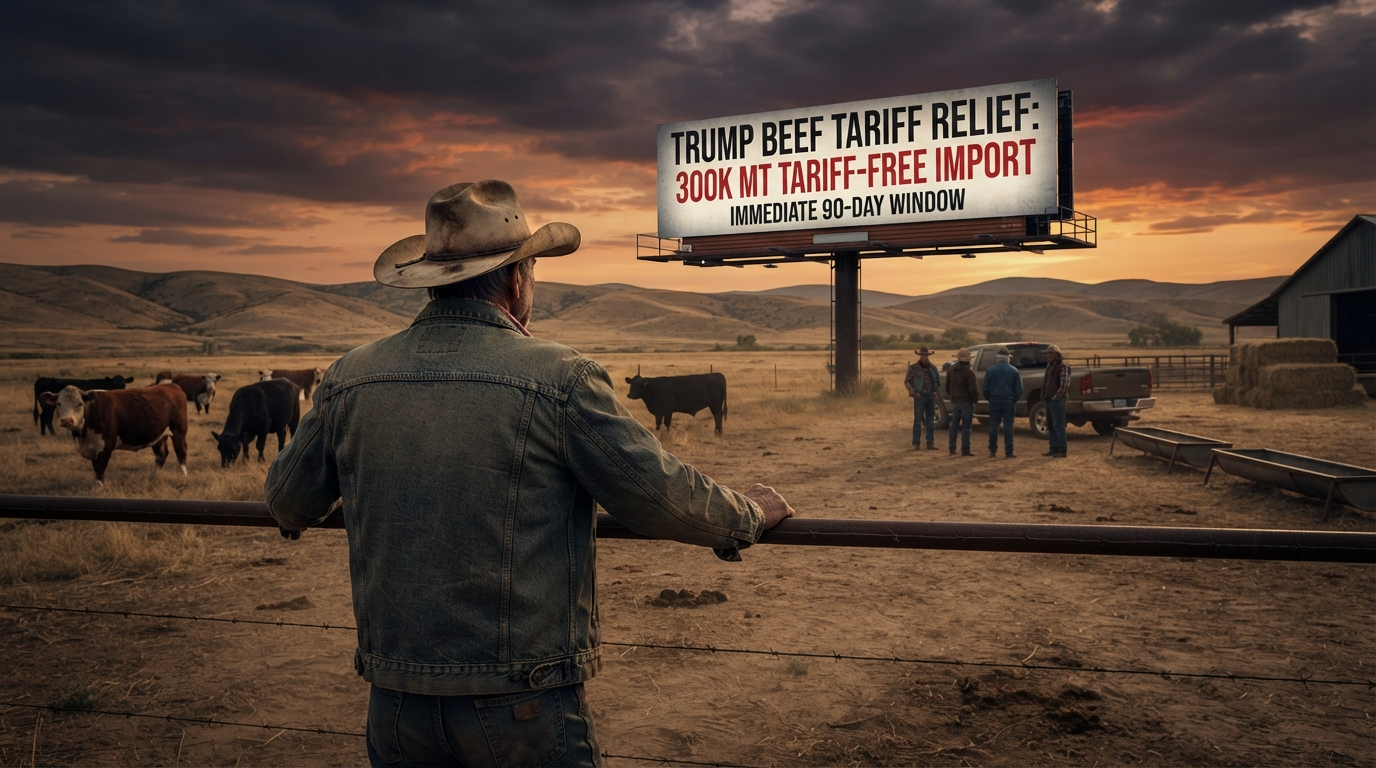

President Trump announced tariff relief allowing up to 300,000 metric tons of ground beef to be imported tariff-free for 90 days with a stated commitment that beef will be sold at 25% below current market prices. The announcement immediately drew sharp backlash from Republican senators, the National Cattlemen’s Beef Association, and industry leaders who warn it will devastate ranchers and undermine herd rebuilding efforts.
Table of Contents
Trump’s Tariff Relief Announcement: What Was Said
On Friday, August 21, 2026, President Donald Trump posted to Truth Social announcing a “deal” to lower ground beef prices for American consumers. His statement read:
“Today, I concluded a deal to substantially lower the price of ground beef for working American families. For the next 90 days, the United States will allow up to 300,000 metric tons of product for ground beef to be imported with no out of quota tariff. We have a commitment that this beef will be sold at 25 percent below current market prices. This deal will reduce prices for Americans while giving space for our Great American Beef Herd to grow again.”
The announcement framed the policy as a consumer price relief measure ahead of November’s midterm elections, while claiming it would simultaneously give American ranchers “space” to rebuild cattle herds. A White House official confirmed that President Trump will formally sign an executive order on the matter within two weeks.
The stated rationale: ground beef prices averaging $6.88 per pound in July 2026 (a record high) have strained American families’ budgets and become a political liability for Republicans ahead of November elections.
Policy Details: 90 Days, 300K MT, 26.4% Tariff Waived
The policy allows foreign beef exporters to ship up to 300,000 metric tons of ground beef (or raw product for ground beef) into the United States for 90 days without paying the “out-of-quota tariff” normally applied when import volumes exceed established tariff-rate quotas.
What Is the Out-of-Quota Tariff?
The US maintains a two-tier beef import system: a tariff-rate quota (TRQ) with lower tariff rates (typically 4.4% for fresh/frozen beef), and an out-of-quota rate applied to volumes exceeding the quota limit. The out-of-quota tariff is 26.4% ad valorem (a percentage of product value)—designed to protect domestic producers by making imported beef substantially more expensive than domestically-produced product.
Trump’s executive order waives this 26.4% tariff on the 300,000 MT of ground beef imports for 90 days, effectively allowing foreign producers to bypass tariff protections that normally make US domestic beef more price-competitive.
Timeline and Finalization: While announced Friday (August 21), the executive order will not be formally signed for approximately two weeks, meaning implementation could begin in early September 2026. The 90-day window would extend through approximately November-December 2026.
Previous Argentine Beef Precedent: In February 2026, Trump signed a proclamation temporarily increasing Argentina’s tariff-rate quota for lean beef trimmings by 80,000 metric tons per year (divided into quarterly tranches of 20,000 MT each). That move also drew rancher backlash but operated at a smaller scale than the current 300,000 MT ground beef relief.
US Beef Supply Crisis: Why This Timing Matters
To understand the controversy around Trump’s tariff relief, context on US beef supply is critical:
The Cattle Herd Crisis:
- Current Herd Size: 86.2 million head (January 2026)—lowest since 1951 (75 years ago)
- Beef Cow Inventory: 27.6 million head—lowest since 1961
- Historical Context: Peak cattle herd in 1975 was ~130 million head; current levels represent a 35% decline from peak
- Causes: Multi-year drought across Great Plains/Southwest; high feed costs; New World Screwworm reintroduction; liquidation of breeding stock
Ground Beef Price Trajectory: As cattle supplies contracted, prices soared. Ground beef prices climbed from approximately $3.77/lb in 2017 to a record $6.89/lb in July 2026—an 83% increase in less than a decade. This represents the fastest annual increase since 2018.
Herd Rebuilding Paradox: Despite record-high cattle prices (which typically incentivize producers to increase breeding stock), ranchers are not materially expanding herds. Reasons include: drought persisting in key ranching states; high feed/fuel/fertilizer costs; aging producer demographics; uncertainty about when drought will break; and now, the policy signal from Trump’s tariff relief that could depress future cattle prices.
Normal cattle cycles take 5-7 years to rebuild herd size. Even if ranchers began aggressive herd expansion today, meaningful supply increases would not reach grocery stores until 2028 at the earliest.
Who Benefits? Brazil & Foreign Exporters
While Trump’s announcement did not specify which countries would export under the tariff relief, trade data makes clear who the primary beneficiary will be: Brazil.
Brazil’s Current Dominance: Brazil is the world’s largest beef exporter and already supplies a disproportionate share of US ground beef feedstock. In Q1 2026, Brazil shipped 394 million pounds of beef to the US (10.29% of total US beef imports), trailing only Australia (19.43%). Brazil was also the first to fill its tariff-rate quota in 2026—the “Other Countries” annual quota was exhausted in the first week of January.
Recent Brazilian Export Surge: Brazilian beef exports have surged. The country exported 953,606 tonnes in the first four months of 2026, up 15.2% from the same period in 2025. April 2026 saw record monthly exports of 251,944 tonnes. Export revenues in April alone totaled USD $1.57 billion.
US Import Context: Total US beef imports in Q1 2026 hit $4.5 billion, up 28% from Q1 2025. For full-year 2025, US beef imports totaled a record $13.75 billion. In comparison, US beef exports were only $9.3 billion in 2025 (down 11% from 2024).
The 300,000 MT tariff relief represents an additional 60% increase on top of already-record import volumes. This volume is equivalent to approximately half of total US beef export volume for 2026 year-to-date.
Mexico and Canada Not Impacted: Mexico and Canada do not face tariff-rate quotas for beef imports due to NAFTA/USMCA, so the tariff relief doesn’t directly affect them. Australia and other suppliers compete within quotas but benefit if they can shift product mix toward ground beef applications.
Reality Check: The 25% Pricing Pledge
Trump’s announcement included a statement that foreign beef exporters made a “commitment that this beef will be sold at 25 percent below current market prices.” A White House official reiterated this, saying exporters pledged to provide a 25% discount “to be passed along to American consumers.”
However, imported frozen lean beef already typically trades at a 25% discount to comparable domestic product—this is the structural difference between high-quality domestic beef and commodity lean beef blocks used for ground beef processing.
The Problem With the Pricing Commitment:
- Status Quo, Not Concession: The 25% discount is already baseline pricing for imported lean beef trimmings used in ground beef. It’s not a new concession from exporters; it’s how the market already prices imported commodity beef.
- No Enforcement Mechanism: The White House has not disclosed what mechanism will enforce the 25% pricing commitment. How will compliance be verified? What penalties exist if exporters don’t honor the pledge?
- Retail Pass-Through Uncertain: Even if exporters ship beef at 25% discounts to domestic packers, history shows retailers don’t always pass wholesale cost savings to consumers. Retailers may absorb margin gains rather than reduce retail prices.
Consumer Price Relief Is NOT Guaranteed: The policy’s stated consumer benefit (lower ground beef prices) depends on: (1) imported beef actually materializing in supply chains, (2) exporters pricing at 25% below market, (3) domestic packers passing costs to retailers, and (4) retailers reducing consumer prices. Historical precedent suggests full pass-through is unlikely.
Rancher Fury: Republican Senators, NCBA Oppose
The tariff relief announcement drew immediate and sharp backlash from cattle industry groups and Republican senators from ranching states. The criticism was unanimous and forceful:
⚠️ CRITICAL: Even Trump-aligned Republican senators criticized the decision, signaling deep concern within the GOP agricultural caucus.
Senator Tim Sheehy (R-Montana): Sheehy, a strong Trump ally on Capitol Hill, posted a detailed critique on X, stating he had advised Trump against this policy for a year:
“I’ve advised President Trump against this course of action for a year because American ranchers have been struggling against the packer monopoly for decades, and this will further harm them – most of whom are MAGA Republicans. The President’s heart is in the right place on wanting lower prices for the American people, and beef prices have been impacted by the Mexican screwworm, but the reality is this action will make it more difficult for American ranchers to rebuild our herd and bring prices down for the American people.”
Senator Deb Fischer (R-Nebraska): Fischer expressed strong disappointment: “I’m extremely disappointed by this decision from the White House. Flooding the market with foreign beef hurts our livestock industry and undermines the long-term solution: growing the U.S. cattle herd to meet demand.”
Senator Pete Ricketts (R-Nebraska): Ricketts offered qualified acknowledgment but firm opposition: “I appreciate the Administration’s work to lower grocery prices. Short term policy shifts do not equal long term solutions. Flooding the market with lower quality beef compromises Nebraska farmers and ranchers. They should be enabled to grow herd sizes and meet consumer demand.”
National Cattlemen’s Beef Association (NCBA): NCBA, the largest cattle trade association representing US ranchers, issued a formal statement expressing “disappointment” and warning the policy would “throw cold water on the prospect of herd expansion and sacrifice long-term stability for short term messaging.”
NCBA CEO Colin Woodall stated: “While America’s cattle producers share the goal of keeping groceries affordable for consumers, flooding the market with government-subsidized, below-market beef is not the way to rebuild the American cattle herd.”
NCBA emphasized the timing problem: “For the second time in less than 12 months, the Trump Administration is intervening in markets in an attempt to artificially lower beef prices. Current retail prices are high because of strong consumer demand for the high-quality beef we produce… Incentivizing additional foreign imports undermines America’s producers at a critical time as they make decisions about rebuilding numbers for next year. U.S. farmers and ranchers need stability.”
Representative Mike Flood (R-Nebraska): GOP Representative Flood criticized the plan for undercutting American farmers: “Flooding the market with lower-quality foreign beef undercuts American farmers and ranchers.”
Core Rancher Concerns:
- Market Flooding: Additional 300K MT on top of already-record imports (562K MT in Q1 2026 alone) will further depress domestic cattle prices
- Disincentive to Rebuild: If imported beef floods the market while ranchers are making herd expansion decisions, the price signal is: don’t invest in breeding stock, because supply will be cheap
- Packer Monopoly Issue: Sheehy emphasized that ranchers are already squeezed by concentrated packing industry (Big 4 control ~85% of slaughter). Import flooding gives packers even more bargaining power over ranchers
- Counter to Administration Goal: Trump’s stated goal (“giving space for our Great American Beef Herd to grow again”) is contradicted by a policy that depresses the price signal incentivizing herd growth
Market Impact: Cattle Futures Decline Post-Announcement
Market reaction was immediate. According to CME (Chicago Mercantile Exchange) data released Friday (August 21), cattle futures prices dipped on the announcement, signaling that traders anticipated the tariff relief would depress domestic cattle values.
Fed cattle prices and live cattle futures both declined as traders repriced risk around the tariff relief signal. This validates rancher concerns: the policy is already being interpreted as bearish for domestic cattle prices.
Ground Beef Retail Prices: While the announced tariff relief may eventually lower ground beef prices at retail, the mechanism requires: (1) imports to materialize, (2) packers to purchase imported beef, (3) retailers to reduce prices. Historical pattern suggests limited consumer benefit, with much of the margin gain absorbed by middlemen.
Producer Action Items & Risk Management
IMMEDIATE ACTIONS FOR LIVESTOCK PRODUCERS:
- Forward Contracting: If you have fed cattle ready for market or feeder cattle in feedlots, consider forward contracting sales NOW before potential price weakness from import flooding materializes. Lock in prices before market reprices cattle lower.
- Breeding Decisions: If you’re making herd expansion decisions for 2027, factor in the policy risk: tariff relief could depress cattle prices through 2026-2027, potentially limiting profit on breeding stock investment.
- Hedging Strategies: Monitor CME cattle futures for additional repricing. Consider hedging strategies to protect against downside price risk if imports materialize as expected.
- Monitor USDA Enforcement: Watch for USDA enforcement mechanisms on the stated 25% pricing commitment. If the commitment proves unenforceable or unenforced, market flooding will be worse than expected.
- Legislative Advocacy: Engage with elected representatives (particularly Republican senators from ranching states who have already signaled opposition) to push back on tariff relief. Political pressure may limit implementation scope or timeline.
Sources & References
| Source | URL | Publication Date |
|---|---|---|
| Bloomberg Law – Trump Tariff Relief on Ground Beef Sparks Backlash From Ranchers | https://news.bloomberglaw.com/international-trade/trump-to-allow-tariff-relief-for-certain-ground-beef-imports | August 21, 2026 |
| ABC News – Trump announces temporary pause of beef import tariffs in effort to lower prices | https://abcnews.com/Politics/trump-announces-temporary-pause-beef-import-tariffs-effort/story?id=135841581 | August 21, 2026 |
| CNBC – Trump to allow import of 300,000 metric tons of ground beef without tariff | https://www.cnbc.com/2026/08/21/trump-ground-beef-import-tariff.html | August 21, 2026 |
| Fox Business – Trump allows 300,000 metric tons of tariff-free beef imports in bid to cut prices | https://www.foxbusiness.com/politics/trump-allows-300000-metric-tons-tariff-free-beef-imports-bid-cut-prices-drawing-rancher-backlash | August 21, 2026 |
| The Hill – Donald Trump halts ground beef tariffs for 90 days to cut costs | https://thehill.com/homenews/administration/6043387-donald-trump-us-ground-beef-tariffs-higher-rate-temporary-pause/ | August 21, 2026 |
| Forbes – Trump Announces 90-Day Tariff Relief For Ground Beef Imports | https://www.forbes.com/sites/saradorn/2026/08/21/trump-announces-90-day-tariff-relief-for-ground-beef-imports-as-costs-soar/ | August 21, 2026 |
| The Hill – GOP backlash grows to Trump’s beef price intervention | https://thehill.com/homenews/administration/6044174-gop-ranchers-protest-imports/ | August 21, 2026 |
| Roll Call – Trump creates beef with ranchers over new import plan | https://rollcall.com/2026/08/21/trump-creates-beef-with-ranchers-over-new-import-plan/ | August 21, 2026 |
| Mediaite – Trump’s Beef Tariff Relief Causes Republicans to Revolt | https://www.mediaite.com/politics/republicans-revolt-over-trumps-beef-tariff-relief-will-further-harm-maga/ | August 21, 2026 |
| Newsweek – Donald Trump’s Beef Import Plan Sparks Backlash From Republicans | https://www.newsweek.com/donald-trump-beef-import-plan-republican-backlash-12353995 | August 21, 2026 |
| NBC News – GOP lawmakers criticize Trump’s beef import plan amid blowback from ranchers | https://www.nbcnews.com/politics/trump-administration/gop-lawmakers-ranchers-criticize-trump-tariff-beef-import-high-prices-rcna593879 | August 22, 2026 |
| BizPac Review – Republican lawmakers have beef with Trump, defend ranchers | https://www.bizpacreview.com/2026/08/22/republican-lawmakers-have-beef-with-trump-defend-ranchers-over-latest-tariff-relief-1655852.html | August 22, 2026 |
| TSPR – Looking to grill out this Fourth of July? Cattle herd shrinking, beef prices rising | https://www.tspr.org/2026-06-29/cattle-herd-size-beef-prices-high | June 29, 2026 |
| AgriNews – Ground beef prices hit record as cattle herd falls to 1951 low | https://agroinformacion.com/en/marketseconomics/why-normal-ground-beef-prices-wont-return-until-2028-at-the-earliest/ | April 11, 2026 |
| Beef It’s What’s For Dinner – 2026 Beef Market Trends | https://www.beefitswhatsfordinner.com/foodservice/menu-concepts-diner-insights/2026-beef-market-trends | 2026 |
| American Farm Bureau Federation – Meat Demand Sizzles as Memorial Day Nears | https://www.fb.org/market-intel/meat-demand-sizzles-as-memorial-day-nears | May 19, 2026 |
| CNBC – Beef costs: Cattle prices soar to record highs | https://www.cnbc.com/2026/04/15/beef-cattle-grilling-inflation.html | April 15, 2026 |
| USDA ERS – Cattle & Beef Market Outlook | https://www.ers.usda.gov/topics/animal-products/cattle-beef/market-outlook | August 24, 2026 |
| Keeping Up With Inflation – Ground Beef Price History (2015-2026) | https://keepingupwithinflation.com/tracker/ground-beef/ | August 2026 |
| Ohio BEEF Cattle Letter – 2026 Beef Trade: Imports Rise as Exports Slide | https://u.osu.edu/beef/2026/05/13/2026-beef-trade-imports-rise-as-exports-continue-to-slide/ | May 13, 2026 |
| Cattle Site – Brazil sets new April record for beef exports | https://www.thecattlesite.com/news/brazil-sets-new-april-record-for-beef-exports-amid-sustained-surge | May 26, 2026 |
| KPMG – United States increases beef import quota | https://kpmg.com/us/en/taxnewsflash/news/2026/02/united-states-increases-beef-import-quota.html | February 9, 2026 |
| White House Fact Sheet – President Donald J. Trump Ensures Affordable Beef for the American Consumer | https://www.whitehouse.gov/fact-sheets/2026/02/fact-sheet-president-donald-j-trump-ensures-affordable-beef-for-the-american-consumer | February 6, 2026 |
Frequently Asked Questions (FAQ)
❓ What exactly did Trump announce?
Trump announced that for 90 days, the US will allow up to 300,000 metric tons of ground beef (or raw product for ground beef) to be imported without paying the normally-required out-of-quota tariff of 26.4%. He also claimed exporters committed to selling the beef at 25% below current market prices. Trump will formally sign an executive order within two weeks.
❓ What is the out-of-quota tariff that Trump is waiving?
The US maintains tariff-rate quotas (TRQs) for beef—a set volume can enter at low tariff rates (typically 4.4%). Beyond that quota, the “out-of-quota” tariff of 26.4% applies. This high tariff protects US domestic producers by making imported beef substantially more expensive. Trump’s executive order waives this 26.4% tariff for 300K MT of ground beef for 90 days.
❓ How large is 300,000 metric tons in context?
The 300K MT tariff relief represents a 60% increase on top of already-record import volumes. Q1 2026 alone saw 562K MT of beef imports (up 18% YoY, up 122% vs. five years ago). The 300K MT equals approximately half of total US beef export volume for 2026 year-to-date—it’s a massive volume that will substantially increase US beef supply.
❓ Is the 25% pricing commitment real?
Probably not. Imported frozen lean beef already trades at approximately 25% discount to comparable domestic product—this is standard market pricing for commodity lean beef trimmings used in ground beef. Trump’s “commitment” likely describes the status quo, not a new concession from exporters. Additionally, no enforcement mechanism has been disclosed for the pricing pledge.
❓ Will consumers actually see 25% lower ground beef prices?
Uncertain. Even if imported beef enters at 25% discounts, consumers don’t automatically see that benefit. Packers must purchase imported beef, retailers must buy from packers at lower prices, and retailers must pass savings to consumers. Historical pattern shows retailers absorb much of wholesale cost savings as margin gains rather than reducing prices. Consumer price relief is theoretically possible but not guaranteed.
❓ Why are ranchers so opposed to this?
Ranchers warn that flooding the market with cheap imports will depress domestic cattle prices while they’re making herd expansion decisions. If import supply signals cheap beef availability, ranchers won’t invest in breeding stock (herd rebuilding requires 5-7 years to materialize). Additionally, ranchers are already squeezed by packer monopoly concentration (Big 4 control ~85% of slaughter); import flooding gives packers more bargaining power over ranchers.
❓ What was the US cattle herd size before Trump’s announcement?
86.2 million head in January 2026—the lowest since 1951 (75 years ago). Beef cow inventory specifically is 27.6 million head—lowest since 1961. The historic small herd is the reason beef prices are at record highs ($6.89/lb ground beef in July 2026). Ranchers are slowly rebuilding herds, but Trump’s tariff relief threatens to undermine that rebuilding by signaling market flooding.
❓ Who benefits from the tariff relief?
Brazil (the world’s largest beef exporter) is the primary beneficiary. Brazil already supplies the most beef to the US and was first to exhaust its tariff-rate quota in early 2026. Australia and other exporters also benefit, but Brazil is positioned to expand shipments most aggressively. The tariff relief is essentially a gift to Brazilian exporters at the expense of US ranchers.
❓ What did Republican senators say?
Multiple GOP senators from ranching states opposed the plan, even Trump allies. Tim Sheehy (R-MT) said he’d advised Trump against this for a year. Deb Fischer (R-NE) called it “extremely disappointing.” Pete Ricketts (R-NE) said short-term pricing relief doesn’t justify long-term harm to ranchers. NCBA (National Cattlemen’s Beef Association) said the policy “throws cold water” on herd rebuilding.
❓ How did cattle markets react?
Cattle futures prices declined on the announcement (CME data). Traders interpreted the tariff relief as bearish for domestic cattle prices, meaning they expect the market will reprice cattle lower as imports materialize. This immediate market reaction validates rancher concerns about price depression.
❓ What should livestock producers do?
(1) Forward contract fed cattle sales NOW before potential price weakness, (2) Factor import risk into herd expansion decisions for 2027, (3) Monitor CME cattle futures for additional repricing and consider hedging, (4) Watch USDA enforcement of the 25% pricing pledge, (5) Engage with Republican senators from ranching states who are already opposing the policy.