
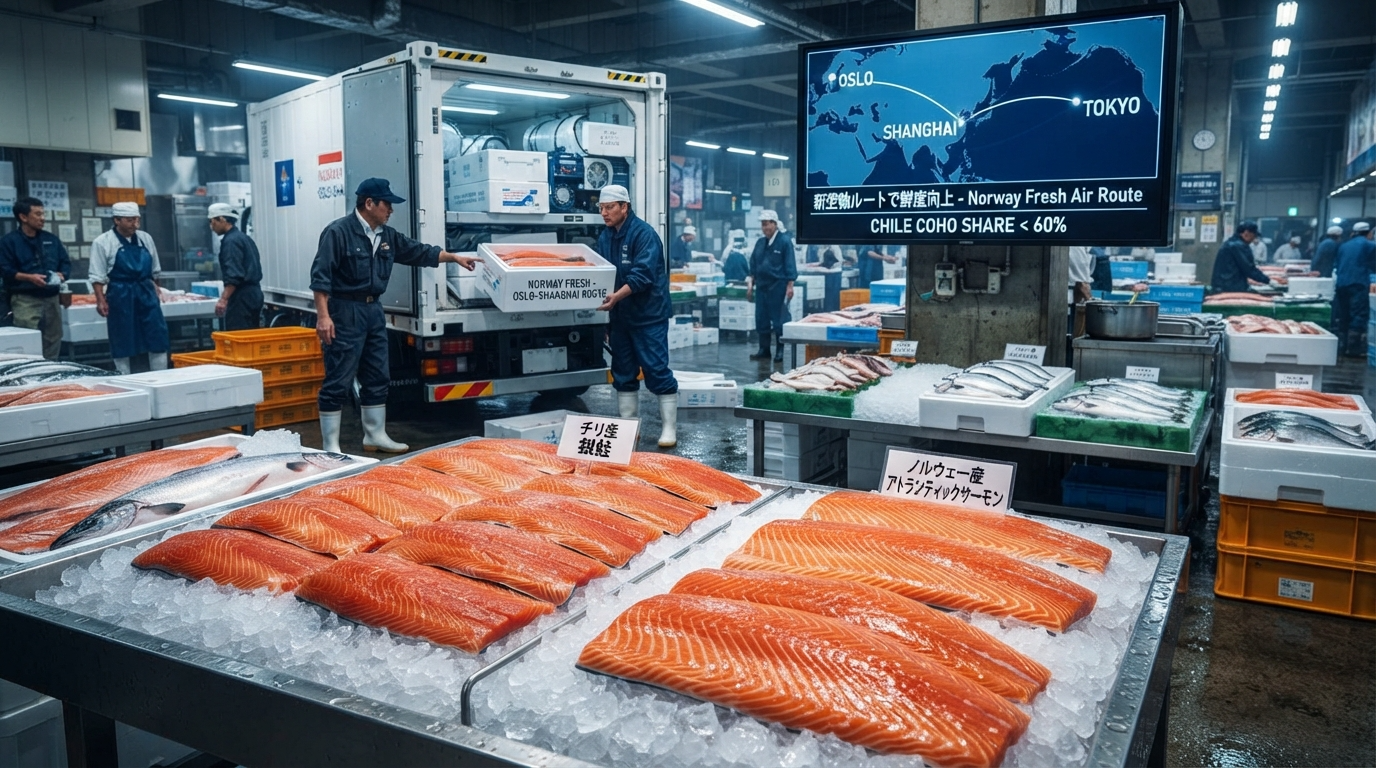

Japan’s salmon import market is undergoing structural realignment. Chile’s H&G coho market share in Japan declined below 60% for the first time (previously dominant at 60%+), while Norway gains competitive advantage through a new direct air cargo route carrying 200 tonnes of fresh salmon weekly to Shanghai.
Table of Contents
The Market Shift: Chile’s Coho Dominance Ending
Japan’s salmon import market is experiencing its most significant structural realignment in over a decade. For decades, Chile dominated Japan’s frozen coho (H&G) market with consistent supply at unbeatable prices. That era is ending.
Recent trade data confirms what market insiders have been observing: Chile’s market share of frozen H&G coho in Japan has fallen below 60% for the first time. This is a watershed moment. Chile’s coho dominance was built on three pillars: cost advantage (farmed coho costs 30-40% less than Atlantic salmon to produce), consistent supply, and deep buyer relationships in Japan.
Now, all three pillars are weakening:
- Cost advantage shrinking: As fishmeal prices spiked 80% in 2026 and Chilean cold-chain logistics costs increased 15-20%, the Chilean price advantage is eroding.
- Supply concentration risk: Chile’s farmed coho production is vulnerable to disease outbreaks, algal blooms, and environmental disruption. Large Japanese importers want supply redundancy.
- Buyer consolidation: Japan’s large seafood distributors are consolidating and seeking supply diversity to improve negotiating leverage. Concentrated dependency on Chile limits their power.
⚠️ CRITICAL: Chile exports approximately 271,584 MT of coho salmon annually (2025 data). Japan imported approximately 156,720 MT of coho in 2025—meaning Japan absorbed ~58% of Chile’s total coho production. Below-60% market share signals fundamental market restructuring, not a temporary blip.
This is not a small adjustment. It signals that Japanese buyers are actively building alternative supply relationships and reducing Chile dependency. The market share decline represents approximately 10,000+ MT of coho switching to alternative sources.
Why Japanese Buyers Are Diversifying Away from Chile
Risk #1: Supply Concentration Vulnerability
Chile’s salmon industry, while world-class, is concentrated geographically and vulnerable to regional disruptions. Past El Niño events, ISA (infectious salmon anemia) disease outbreaks, and algal blooms have forced Chilean government fishing closures and production cutbacks.
In 2023 alone, Chile cancelled its first anchovy fishing season—not for Chilean salmon directly, but the supply-chain ripple effects were severe. More recently, El Niño conditions impacted Chilean farmed salmon disease pressure and growth rates.
Large Japanese wholesalers recognize this risk. They’re actively building supply alternatives from Russia, Norway, and domestic Japanese producers to hedge concentration risk.
Risk #2: Price Vulnerability & Cost Escalation
The cost advantage that made Chilean coho attractive to price-conscious Japanese importers is eroding. Fishmeal (primary input cost for all farmed salmon) spiked 80% from October 2025 to August 2026. While Chilean producers have adapted better than others, margins are compressing.
Simultaneously, Norwegian fresh salmon is becoming more competitive through improved logistics. The new direct Oslo-Shanghai air route (launched August 19, 2026) reduces transit time and improves freshness—allowing Norwegian salmon to command premium pricing for premium channels (sushi, sashimi) in Japan.
Risk #3: Buyer Consolidation Dynamics
Japan’s seafood importing/distributing ecosystem is consolidating. Larger distributors seeking to improve supply chain negotiating power and operational efficiency are actively diversifying suppliers. A buyer dependent on Chilean coho has limited leverage—Chile sets the price. A buyer with multiple coho sources (Chile, Russia, Japan domestic) can negotiate better terms.
This is standard supply-chain logic: multiple suppliers = buyer power; single supplier = supplier power.
Norway’s Game-Changing Fresh Salmon Route
On August 19, 2026, China Southern Airlines launched a direct cargo service between Oslo Airport and Shanghai Pudong International Airport. This is far more significant than a routine cargo-route announcement. It’s a structural shift in the competitive landscape for Norwegian salmon in Asia.
The Oslo-Shanghai Route Details:
- Launch Date: August 19, 2026
- Frequency: Twice weekly (two flights per week)
- Aircraft: Boeing 777F freighters (each carries ~100 tonnes)
- Capacity: 200 tonnes of fresh salmon per week
- First Route Type: China Southern’s first-ever direct cargo service to Oslo
- Transhipment: Direct routing eliminates 1-2 day transshipment delays through European hubs (Frankfurt, Amsterdam)
- Cold Chain: Temperature-controlled handling throughout journey, critical for fresh product quality
Why does this matter so much? Time is everything for fresh salmon.
Norwegian salmon destined for Japan traditionally flew through hub airports (Frankfurt, Amsterdam, Doha), creating transshipment delays of 1-2 days. For fresh salmon where shelf-life is 10-12 days post-harvest, those delays were costly—reducing premium pricing for sushi/sashimi applications.
The direct Oslo-Shanghai route cuts transit time significantly. A 36-48 hour direct flight is substantially better than 48-72 hours with transshipment. This extends effective shelf-life in destination markets and enables Norwegian exporters to command premium prices for fresh product in high-value sushi/sashimi channels in Japan.
The route immediately becomes the fastest air cargo link for Norwegian fresh salmon to Asia. Competing against frozen Chilean coho (which doesn’t have freshness constraints), Norwegian fresh salmon now competes on quality grounds with better logistics supporting the premium positioning.
Strategic Implications:
- 200 tonnes/week = ~10,400 tonnes annually of additional fresh Norwegian salmon capacity to China
- Japan is served via Shanghai redistribution; this capacity is available for Japanese buyers
- Direct routing improves margins for Norwegian producers by reducing logistics costs and preserving product quality
- Competitive positioning shifts: Norwegian fresh salmon becomes viable for premium Japanese channels; Chilean frozen coho competes on price
Russia Gains Sockeye Share (11%+ Surge YoY)
While Norway’s fresh salmon gains visibility through the new direct route, Russia is quietly gaining market share through increased sockeye (red salmon) exports to Japan.
According to trade data, Japan’s 2025 frozen sockeye imports from Russia were up 37% year-over-year compared to 2024. This is a significant volumetric shift in a market historically dominated by American sockeye.
Russia’s sockeye is positioned differently than Chilean coho:
- Species Segmentation: Sockeye (red salmon) is distinct from coho; used in different applications (ikura roe, canned, grilled)
- Cost Position: Russian sockeye is competitively priced, offering value positioning
- Supply Consistency: Wild-caught Russian sockeye (not farmed) provides seasonal supply patterns different from year-round farmed coho
- Geopolitical Advantage: Despite sanctions on Russia, Japan continues significant seafood imports. Russian sockeye fills supply niches as other wild sources (Alaska) face constraints
Russian sockeye’s 37% growth signals two things: (1) Japanese buyers are diversifying salmon species mix, not just sources for the same species, and (2) Russia is becoming a meaningful competitor in Japan’s wild salmon markets.
Japan’s Domestic Salmon Production Scaling Rapidly
Perhaps the most structural diversification driver is Japan’s own domestic salmon production, which is scaling at unprecedented rates.
According to the Japan Fisheries Research and Education Agency, Japan’s domestic farmed salmon production is expected to reach 33,000-34,000 metric tonnes in 2026. This is a record high for Japan and represents meaningful production capacity.
Miyagi Prefecture—Japan’s Salmon Hub:
Miyagi Prefecture, in northeastern Honshu, is the center of Japan’s sea-farmed coho model. Expected 2026 production of approximately 15,000 MT of coho (marketed as “Miyagi Salmon”)—a 20% year-over-year increase.
This domestic production has unique characteristics:
- Seasonal Supply: Spring-to-early-summer production creates a natural seasonal supply window (March-July), though this limits year-round availability and produces smaller fish than Norwegian counterparts
- Market Positioning: Marketed as premium domestic-origin product; commands premium pricing vs imports; positioned for fresh/specialty retail channels
- Buyer Preference: Japanese retailers, sushi chains, and distributors increasingly feature domestic “Miyagi Salmon” as differentiated offering vs imported coho
- Supply Chain Advantage: Domestic production eliminates import logistics costs and regulatory complexity; fresher product; shipper can guarantee domestic origin labeling (consumer preference in Japan)
The scaling of domestic production creates a structural headwind for Chilean coho imports—not through direct price competition, but through customer preference for domestic origin and seasonal availability management.
Fresh vs Frozen: The Market Segmentation Explained
To understand Japan’s salmon market realignment, it’s critical to understand that the market is fundamentally segmented by product form and end-use:
Norwegian Atlantic Salmon (FRESH):
- Form: Flown fresh to Japan (typically within 48 hours)
- End Use: Premium sushi, sashimi, raw consumption
- Price: Premium ($12-14/kg wholesale)
- Demand: High-end restaurants, specialty retailers, supermarket fresh sections
- Supply Constraint: Air logistics critical; time-sensitive; direct routing is competitive advantage
- Geographic Origin: Predominantly Norway (premium positioning) + domestic Miyagi Salmon (domestic premium)
Chilean Coho (FROZEN, H&G or Fileted):
- Form: Frozen as H&G (head-and-gutted) or fileted; shipped by sea (15-21 days)
- End Use: Kirimi (sliced portions for grilling/cooking), processed foods, foodservice
- Price: Value/commodity positioning ($6-8/kg wholesale)
- Demand: Mass-market supermarkets, foodservice, food processors
- Supply Advantage: Consistent year-round supply; cost-effective; sea freight is economical
- Competition: Now facing Russian sockeye + Japanese domestic coho + potential Atlantic salmon at lower price points
These are not the same market. Norwegian fresh salmon and Chilean frozen coho compete in different channels for different end-uses and price points.
However, Chile’s market share decline signals that even in the frozen commodity segment, buyers are diversifying. Russian sockeye is filling some demand; Japanese domestic coho is filling other demand; and potentially Atlantic salmon in frozen form from Norway/Scotland is taking additional share.
The Chile-below-60% data point reflects market share loss across the entire coho/salmon import portfolio, not just within frozen commodity channels.
Implications for Global Supply Chains
Japan’s salmon market realignment has ripple effects across global salmon supply chains:
For Norwegian Exporters: The direct Oslo-Shanghai route is a major competitive advantage in fresh salmon positioning. Rather than competing head-to-head on price with Chilean frozen commodity coho, Norwegian exporters can now efficiently access Japan’s premium fresh salmon channels (sushi, sashimi) with superior logistics. Profitability improves through premium channel positioning + improved logistics.
For Chilean Producers: Coho market share decline in Japan signals reduced demand for low-cost frozen commodity salmon from their historically dominant market. Chilean producers will need to: (1) improve operational efficiency to compete on cost with domestic Japanese production, (2) pursue higher-value applications (fileted, specialty cuts), or (3) diversify geographically away from Japan-dependent sales.
For Russian Suppliers: Sockeye import growth signals that Japanese buyers view Russia as a viable alternative source for wild salmon products. This relationship will deepen if logistics improve or if Western supply (Alaska, Scotland) becomes less available.
For Japanese Domestic Producers: Scaling of domestic coho production (Miyagi Salmon +20% YoY) is reducing import dependency and creating local supply redundancy. Expect continued domestic production increases as domestic buyers prefer domestic origin and achieve supply security.
What Seafood Buyers Should Do NOW
IMMEDIATE ACTION ITEMS FOR SEAFOOD BUYERS:
- Diversify Chilean Coho Sourcing: Don’t increase Chilean coho dependency; market share below 60% signals shifting buyer preferences. Actively reduce Chilean coho as percentage of portfolio. Explore Russian sockeye, Japanese domestic coho, and Norwegian fresh salmon alternatives.
- Evaluate Norwegian Fresh Salmon via New Route: The direct Oslo-Shanghai route creates new availability for Norwegian fresh salmon to Japan. For premium channels (sushi, sashimi), evaluate Norwegian fresh salmon specifications and pricing. Improved logistics reduce delivery times; freshness advantages are real.
- Build Multi-Source Strategy: Avoid single-supplier dependency. Optimal portfolio should include: (a) Chilean frozen coho for value channels, (b) Norwegian fresh salmon for premium channels, (c) Russian sockeye for wild salmon applications, (d) Japanese domestic Miyagi Salmon for domestic-origin positioning.
- Secure Long-Term Contracts: Before integration of these new supply relationships (2H 2026 into 2027), lock in supply agreements and pricing with multiple sources. Post-integration, supplier negotiating power will increase if buyers are still consolidating.
- Develop Specification & Quality Standards: Each source (Chile, Norway, Russia, Japan domestic) has different specifications and quality characteristics. Develop buyer-side standards to ensure consistency across suppliers and maintain retail/foodservice customer satisfaction.
Sources & References
| Source | URL | Publication Date |
|---|---|---|
| Undercurrent News – Chile’s H&G coho exporters successfully diversify beyond Japan | https://www.undercurrentnews.com/2026/08/20/chiles-hg-coho-exporters-successfully-diversify-beyond-japan/ | August 20, 2026 |
| SeafoodSource – Chile’s salmon exports surpass USD 6.5 billion in 2025 | https://www.seafoodsource.com/news/supply-trade/chile-s-salmon-exports-surpass-usd-6-5-billion-in-2025 | January 20, 2026 |
| Aquafeed.com – Chile’s salmon industry looks to restart growth, with coho leading the way | https://www.aquafeed.com/newsroom/editors-picks/chiles-salmon-industry-looks-to-restart-growth-with-coho-leading-the-way/ | March 12, 2026 |
| j-fish.com – Japan’s farmed “salmon” sector grows amid higher airfreight costs for fresh imports | https://j-fish.com/news/japan-farmed-salmon-sector-airfreight-imports-2026.html | June 3, 2026 |
| Seafood News – Japan’s 2025 Frozen Sockeye Imports up 37% from Russia | https://www.seafoodnews.com/Story/1345646/Japans-2025-Frozen-Sockeye-Imports-up-37-percent-from-Russia-Plummets-69-percent-from-the-US | June 12, 2026 |
| SalmonBusiness – Freight: new Oslo-Shanghai cargo route adds capacity for 200 tonnes of salmon a week | https://www.salmonbusiness.com/china-new-oslo-shanghai-cargo-route-adds-capacity-for-200-tonnes-of-salmon-a-week/ | August 23, 2026 |
| Scandasia – New Oslo-Shanghai route expands Norwegian salmon export to China | https://scandasia.com/new-oslo-shanghai-route-expands-norwegian-salmon-export-to-china/ | August 21, 2026 |
| Aviation24.be – China Southern launches Oslo–Shanghai cargo route for Norwegian salmon exports | https://www.aviation24.be/airlines/china-southern-airlines/china-southern-launches-oslo-shanghai-cargo-route-for-norwegian-salmon-exports/ | August 22, 2026 |
| Aviation Direct – China Southern Airlines connects Oslo with Shanghai | https://aviation.direct/en/China-Southern-Airlines-connects-Oslo-with-Shanghai | August 21, 2026 |
| TravelWires – China Southern launches Oslo-Shanghai cargo route carrying up to 200 tonnes of Norwegian salmon weekly | https://www.travelwires.com/china-southern-launches-oslo-shanghai-cargo-route-carrying-up-to-200-tonnes-of-norwegian-salmon-weekly/ | August 22, 2026 |
| South China Morning Post – China Southern launches cargo route to Norway, bringing Norwegian seafood to China | https://www.newsgd.com/node_d36b0ef83f/20e322740b.shtml | August 21, 2026 |
| SeafoodSource – Chile’s salmon industry declares “clear signs of sustained recovery” with Q1 growth | https://www.seafoodsource.com/news/supply-trade/chile-s-salmon-industry-declares-clear-signs-of-sustained-recovery-with-q1-growth | April 27, 2026 |
| Emergent Cold LatAm – Coho salmon season in Chile: why the cold chain is decisive for export success | https://emergentcoldlatam.com/en/logistics/coho-salmon/ | August 14, 2025 |
| FAO GLOBEFISH – Fishmeal and Fish Oil Market Analysis | https://www.fao.org/in-action/globefish/species-analysis/fishmeal-and-fish-oil/en | Ongoing 2026 |
| Renub Research – Chile Salmon Market Forecast 2025–2033 | https://www.renub.com/chile-salmon-market-p.php | 2026 |
| Norwegian Seafood Council – Japan Country Profile | https://en.seafood.no/countrypages/japan/ | Ongoing 2026 |
Frequently Asked Questions (FAQ)
❓ What does “Chile’s coho market share below 60%” actually mean?
Chile dominated Japan’s frozen coho market for decades, typically with 60%+ market share. Trade data from Undercurrent News (August 20, 2026) confirms Chile’s share has fallen below 60% for the first time. This signals that approximately 10,000+ MT of coho that historically went to Chile are now sourced from alternative suppliers (Russia, Japan domestic, Norway). It’s a structural market shift, not a temporary fluctuation.
❓ Why is the Oslo-Shanghai direct cargo route so significant?
Fresh salmon is time-sensitive. Historically, Norwegian salmon flew through hub airports (Frankfurt, Amsterdam), creating 1-2 day transshipment delays. For fresh salmon with 10-12 day shelf-life, those delays reduce freshness and limit premium pricing. The direct route cuts transit time significantly, enabling Norwegian exporters to access high-value Japanese sushi/sashimi channels with superior freshness. It’s a structural competitive advantage for Norwegian fresh salmon vs Chilean frozen commodity coho.
❓ How much Norwegian salmon does the direct route carry?
China Southern Airlines’ direct Oslo-Shanghai route carries 200 tonnes of Norwegian fresh salmon per week (two Boeing 777F freighters, 100 tonnes each). That’s approximately 10,400 tonnes annually of incremental capacity. While not massive on a global scale, it’s significant for Japan market access and represents China’s third-largest seafood market receiving substantially improved logistics.
❓ What is the difference between Chilean coho and Norwegian Atlantic salmon?
Two different products: Chilean coho is farmed in the Southern Hemisphere, typically frozen in H&G or fillet form, costs 30-40% less to produce than Atlantic salmon, and is used for kirimi (sliced portions for grilling). Norwegian Atlantic salmon is farmed in Northern Hemisphere, typically flown fresh, commands premium pricing, and is used for raw consumption (sushi/sashimi). They compete in different market channels and serve different end-uses.
❓ What role does Russia play in Japan’s salmon market now?
Russia’s frozen sockeye (red salmon) imports to Japan surged 37% year-over-year in 2025. Sockeye is distinct from coho; it’s used for different applications (ikura roe, canned, grilled). Russian sockeye is wild-caught (not farmed) and provides seasonal supply patterns different from year-round farmed coho. Russia is becoming a meaningful competitor in Japan’s wild salmon markets, filling supply niches as diversification continues.
❓ How large is Japan’s domestic farmed salmon production?
Japan’s domestic farmed salmon production is expected to reach 33,000-34,000 MT in 2026—a record high. Miyagi Prefecture alone (the center of Japan’s sea-farmed coho model) is producing approximately 15,000 MT of coho in 2026, up 20% YoY. This domestic production reduces import dependency and creates local supply alternatives for Japanese buyers.
❓ How much coho does Japan import from Chile annually?
Japan imported approximately 156,720 metric tons of coho in 2025, predominantly from Chile. Chile exports 271,584 MT of coho annually (2025), meaning Japan absorbs ~58% of Chile’s total coho production. Market share below 60% signals approximately 10,000+ MT switching to alternative sources.
❓ What are the cost advantages of Chilean coho farming?
Coho salmon can be farmed 30-40% cheaper than Atlantic salmon due to shorter lifecycle (18-20 months vs 24-30 months), high disease resistance, and established Chilean farming expertise. However, 2026 fishmeal price escalation (+80% YoY) and cold-chain cost increases (+15-20%) are narrowing this advantage, making Chilean coho less competitively attractive to price-sensitive Japanese importers.
❓ What should seafood importers do to prepare for this market shift?
(1) Diversify Chilean coho sourcing—don’t increase dependency; (2) Evaluate Norwegian fresh salmon via the new route; (3) Build multi-source strategy (Chile, Norway, Russia, Japan domestic); (4) Secure long-term contracts before supply shifts create tighter conditions; (5) Develop quality standards to maintain consistency across suppliers.
❓ Is Chilean coho likely to become unavailable to Japanese buyers?
No. Chilean coho will remain available and competitive for price-sensitive, value-channel applications. However, market share will continue declining as buyers diversify. Chile needs to improve operational efficiency, pursue higher-value applications (specialty cuts), or diversify geographically to compensate for lost Japan market share. The days of 60%+ dominance are over.
❓ Will the Oslo-Shanghai route affect Chilean salmon prices?
Indirectly, yes. The route improves Norwegian fresh salmon competitiveness in premium Japanese channels, potentially drawing some high-value demand away from Chilean frozen commodity coho. However, the two products (fresh vs frozen, premium vs value) mostly compete in different channels. The primary impact is on competitive positioning rather than direct price pressure.