
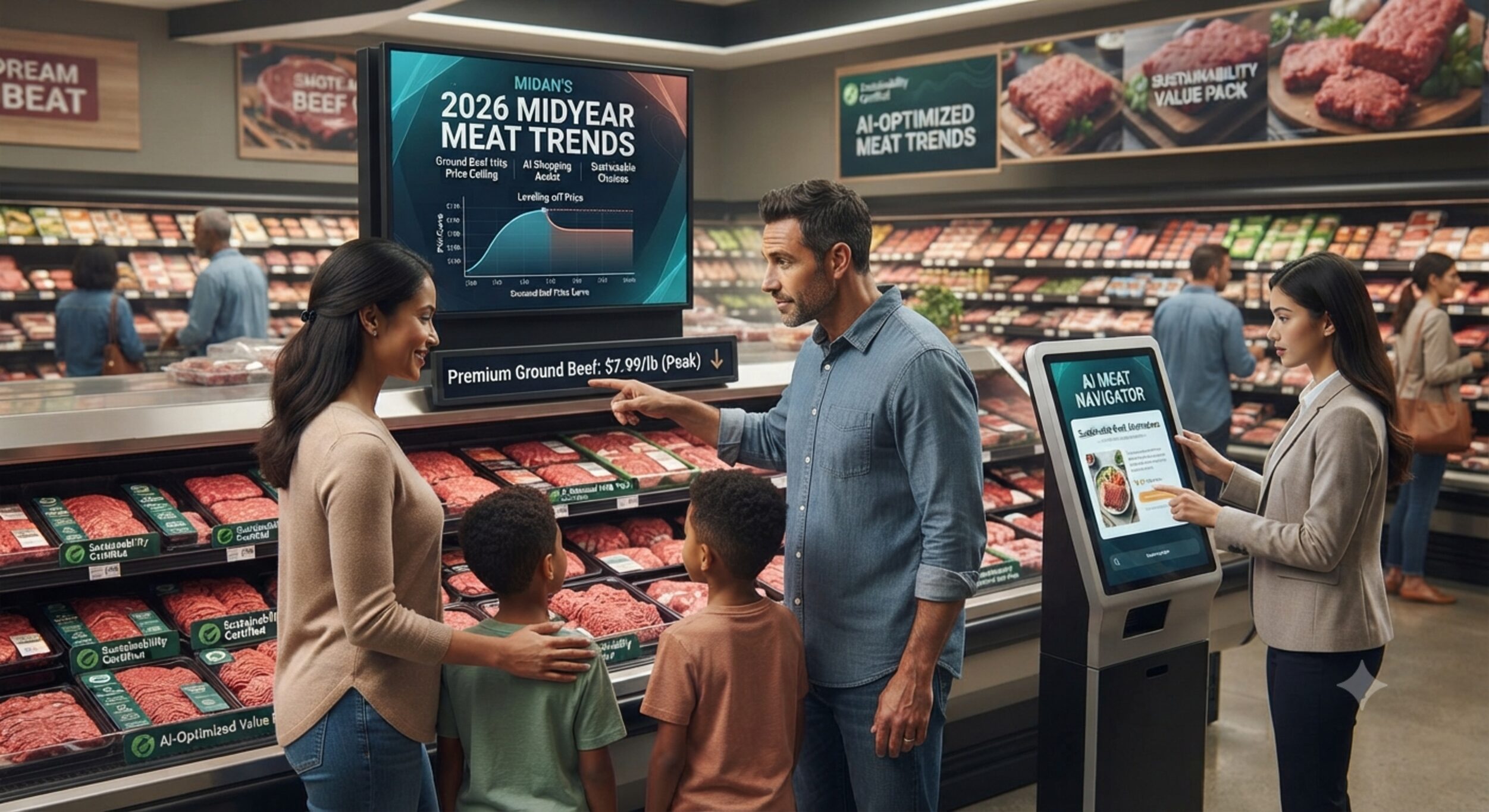
Midan Marketing’s 2026 Midyear Trends Report reveals that the year’s predicted meat industry dynamics are playing out in real time—with ground beef hitting an apparent consumer price ceiling as poultry and pork gain share, AI-driven commerce accelerating beyond expectations, and sustainability shifting from marketing differentiator to baseline consumer expectation. The data suggests meat brands face a critical pivot point requiring immediate strategic repositioning.
The AI Invasion: 68% of Google Searches Now Result in Zero Clicks
Artificial intelligence is reshaping consumer shopping behavior far faster than predicted, with profound implications for how meat and protein brands reach buyers. As of the first four months of 2026, 68.01% of all Google searches result in zero clicks, according to SparkToro data—meaning consumers never visit a website after viewing search results. Instead, they extract information directly from AI-generated summaries and move to purchase decisions without traditional web browsing.
This “zero-click buying era” is accelerating e-commerce transformation and fundamentally changing how meat brands compete for consumer attention. AI-driven traffic to retail sites is up 393% year-over-year in Q1 2026, according to the Quarterly AI Traffic Report from Adobe Digital Insights. Eighty percent of consumers using AI for online shopping report using AI assistants more than previously.
The IBM and National Retail Federation study found that 41% of consumers use AI assistants to research products, 33% to look for reviews, and 31% to search for deals. One-click checkout for AI-recommended products is simplifying transactions and reducing friction in the purchase journey.
For meat brands, this shift has critical implications. Traditional SEO optimization—ranking websites for specific search terms—is becoming less valuable when 68% of searches don’t drive website visits. Instead, Midan recommends implementing Generative Engine Optimization (GEO), a new approach that restructures content into clear, scannable formats with copy that answers questions consumers may ask AI assistants.
Practical strategy: Meat brands should publish original industry data, research, and thought leadership interviews to become the cited authority in AI’s generative responses. When a consumer asks an AI assistant “Which ground beef brand is most sustainable?” or “What’s the difference between grass-fed and grain-fed beef?”—the goal is for your brand’s data and messaging to appear in the AI’s response, not to drive the consumer to your website.
This requires fundamentally rethinking content strategy: instead of optimizing for Google’s search algorithm, optimize for being cited as an authoritative source within AI’s training data and generative responses.
Ground Beef Hits Consumer Price Ceiling: Poultry and Pork Surge
The data that will reshape 2026 meat retail strategy emerged in June: ground beef volume declined 3.3% year-over-year despite dollar sales climbing 9.1%. This divergence is the clearest sign yet that consumers have reached a price ceiling for ground beef.
USDA data estimates beef production will be around 25.438 billion lbs in 2026, slightly less than last year’s 26 billion lbs. Meanwhile, beef and veal prices jumped 11.8% year-over-year as of June, according to the Bureau of Labor Statistics Consumer Price Index. Fresh beef dollar sales grew 5.6% in June, but volume declined 1.7% year-over-year—signaling that retailers are capturing price increases while consumers reduce purchase quantity.
The ground beef category most clearly illustrates this elasticity collapse. Ground beef prices have nearly doubled that of ground pork or ground chicken, historically the budget-friendly protein alternatives. As of July, this pricing dynamic reversed consumer behavior:
- Ground beef dollar sales: +9.1% (June)
- Ground beef volume: -3.3% (June)
- Ground chicken: Growth in both volume AND dollar sales
- Ground pork: Growth in both volume AND dollar sales
“One month of data does not create a trend; however, it is possible this decline in ground beef volume suggests we have reached the consumer’s ground beef price ceiling,” Midan noted.
This is a critical inflection point for meat retail strategy. For the first time in 2026, consumers are actively substituting away from beef toward poultry and pork not because of health preferences or taste, but purely due to price elasticity. This suggests:
- Beef retail traffic will decline as price-conscious consumers redirect shopping dollars to poultry and pork
- Beef case margins may compress if retailers attempt to maintain volume through promotional intensity
- Ground beef premiumization becomes difficult if base price is already above consumer willingness-to-pay
- Poultry and pork capture share permanently as consumers build new habit patterns around lower-priced alternatives
Strategic Repositioning: Beef as “Weeknight Hero,” Not Everyday Protein
Recognizing this shift, Midan recommends beef brands pivot positioning from “everyday protein” to “occasion-driven, high-satisfaction centerpiece.” The strategy: promote beef as a “weeknight hero,” highlighting nutritional density, versatility, and satisfaction to justify premium pricing for specific occasions rather than attempting to compete on everyday affordability.
This requires messaging shift from “affordable protein for family dinners” to “nutrient-dense, highly satisfying protein for special occasions or premium meal experiences.” Think: “Beef is worth the splurge because of its nutritional profile and satisfaction” rather than “Beef is an economical family protein.”
For pork and chicken brands, the opportunity is equally clear. Now is the time to:
- Promote grinds as budget-friendly and versatile to capture beef-switching consumers
- Feature whole muscle cuts (chicken breasts, pork chops) to position as premium alternatives to beef
- Build habit loyalty among consumers making permanent shifts from beef to poultry/pork by promoting recipe versatility and nutritional value
Sustainability: From Differentiator to Baseline Expectation
Midan’s third critical trend is the shift of sustainability from unique marketing differentiator to baseline consumer expectation. General sustainability claims on meat packages are giving way to specific statements, commonly focused on regenerative agricultural practices.
Innova Market Insights found that new food and beverage product launches with regenerative agriculture claims grew globally at 44% compound annual growth rate (CAGR) between 2021 and 2025—demonstrating that consumers are increasingly expecting and rewarding specific, credible sustainability claims over vague “all-natural” or “eco-friendly” messaging.
This shift has profound procurement implications: meat brands can no longer compete on generic sustainability positioning. Instead, they must:
- Share value-driven stories of how farmers and ranchers care for land and animals
- Provide transparency and credibility through third-party certifications (Regenerative Organic Certified, Land to Market, etc.)
- Address consumer skepticism around unsubstantiated sustainability claims through data, audit trails, and supply chain transparency
For retail buyers, this means supplier selection will increasingly hinge on documented sustainability practices, not marketing claims. Suppliers unable to provide auditable sustainability credentials will face retail shelf pressure as retailers curate their meat cases around credible sustainability positioning.
Related
Frequently Asked Questions
If ground beef volume is declining, should retailers reduce ground beef SKUs?
Not necessarily. Retailers should maintain ground beef SKU depth but reposition pricing and promotion strategy. Instead of heavy promotional discounting (which signals commodity pricing), feature ground beef in premium applications (grass-fed, organic, regenerative) where pricing justifies shelf space. Simultaneously, aggressively feature ground chicken and pork alternatives to capture price-sensitive traffic that historically would have defaulted to ground beef. The category doesn’t shrink; it fragments into premium (beef) and value (poultry/pork) tiers.
How should meat brands respond to the zero-click search environment?
Publish original research, sustainability data, nutritional studies, and thought leadership that answers questions consumers ask AI assistants. Position your brand as the authoritative source on specific meat-related queries: beef nutritional value, regenerative ranching practices, food safety protocols, etc. When AI systems cite sources, ensure your brand appears as the credible expert, not as a website link consumers may or may not visit.
Is the ground beef price ceiling permanent, or will demand recover if prices moderate?
Likely permanent, at least for 2026-2027. Once consumers build habit loyalty to ground chicken or pork, price moderation alone may not reverse the shift. However, if beef prices decline significantly (10-15%+ drop from current levels) due to supply recovery, volume may gradually recover. The key insight: at current price levels, ground beef is perceived as premium/discretionary, not everyday. Pricing must shift that perception or volume will remain depressed.
Should retailers expand poultry and pork case space at beef’s expense?
Strategic case optimization is warranted. Retailers should expand ground chicken and ground pork SKU depth, feature more whole muscle cuts (pork chops, chicken breasts) as beef alternatives, and test cross-promotional “Build Your Own Dinner” concepts featuring multiple proteins. Ground beef shelf space can be reduced without losing traffic if alternative proteins are positioned as compelling substitutes.
How can meat suppliers compete on sustainability without certification costs becoming prohibitive?
Start with one credible certification (Regenerative Organic, Land to Market, or equivalent) covering key suppliers, then build scalable documentation (photos, water testing, soil health metrics) that demonstrate commitment without full certification. Develop supply-chain transparency using blockchain or simple spreadsheet tracking that allows retailers to audit claims. Communicate clearly about what you can verify vs. aspirational goals.
Sources
| Source | URL | Details |
|---|---|---|
| Midan Marketing | https://www.midanmarketing.com | 2026 Midyear Trends Report; meat industry analysis; consumer behavior tracking |
| Meat+Poultry | https://www.meatpoultry.com | Rachael Oatman reporting; July 23, 2026; midyear trends analysis |
| SparkToro | https://sparktoro.com | Zero-click search data; Google search behavior analysis; Q1 2026 |
| Adobe Digital Insights | https://www.adobe.com/insights | Quarterly AI Traffic Report; AI-driven retail traffic; e-commerce transformation |
| IBM and National Retail Federation | https://www.ibm.com | Consumer AI assistant usage study; product research behavior; deal-seeking trends |
| U.S. Department of Agriculture | https://www.usda.gov | Beef production forecasts; 2026 meat supply estimates |
| Bureau of Labor Statistics | https://www.bls.gov | Consumer Price Index; beef and veal price inflation; June 2026 data |
| Circana | https://www.circana.com | Fresh beef dollar sales; volume data; ground beef category analysis |
| Innova Market Insights | https://www.innovamarketinsights.com |

