
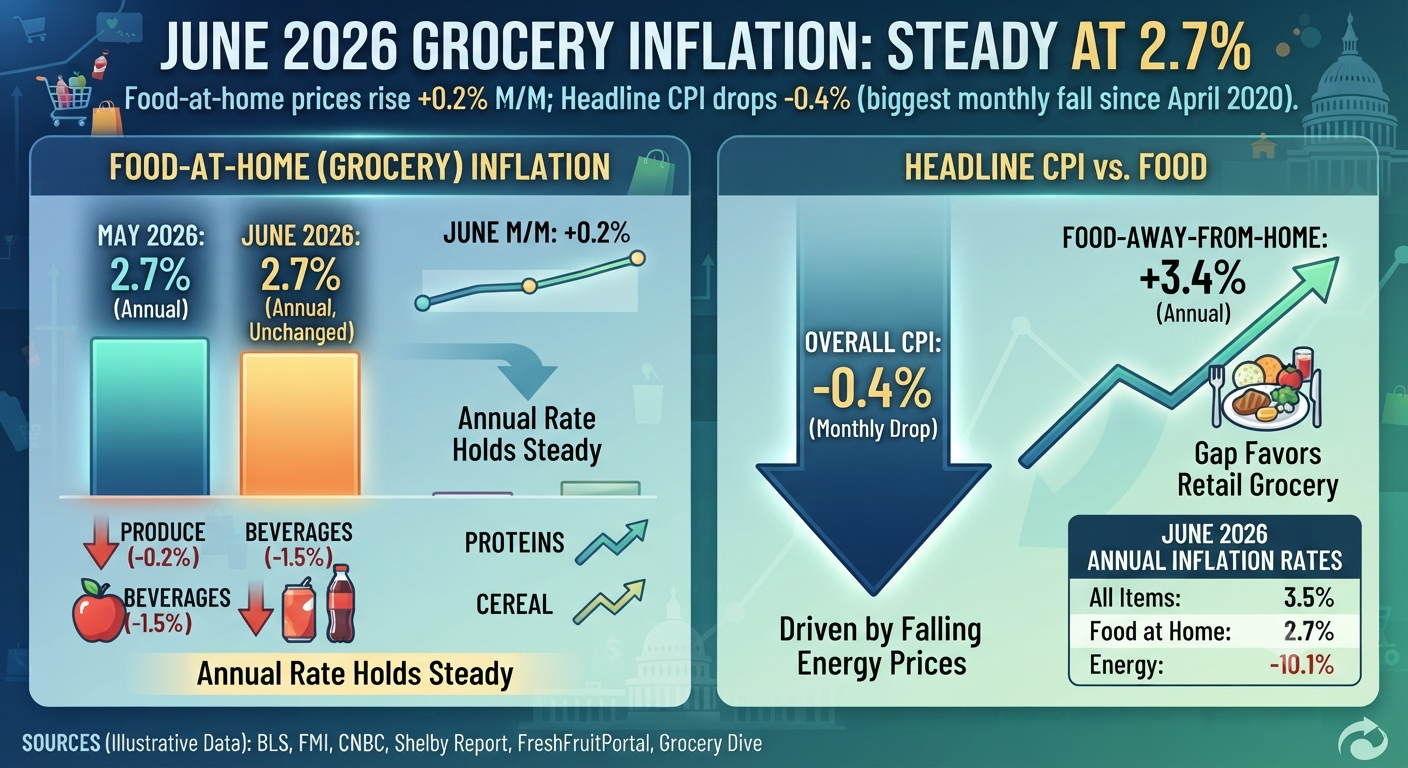
US grocery inflation held at 2.7% in June as food-at-home prices rose 0.2%, while headline CPI posted its biggest monthly drop since April 2020.
Grocery retailers got a rare piece of steady news this week. The Bureau of Labor Statistics released its June Consumer Price Index on Tuesday, showing food-at-home prices rose 0.2% for the month and 2.7% over the past 12 months — unchanged from May’s annual rate. The stability at the grocery shelf stood in sharp contrast to the headline number: overall CPI fell 0.4% on a seasonally adjusted basis, the largest one-month decline since April 2020, pulling annual inflation down to 3.5% from May’s 4.2% as energy prices swooned.
What the June Numbers Show
June marked the fifth monthly increase in the grocery index this year, though the 0.2% rise was modest against April’s 0.7% spike — the year’s sharpest. Within food-at-home, fresh produce and non-alcoholic beverages were the only categories to decline, falling 0.2% and 1.5% respectively. Overall food prices rose 3% year-on-year, easing from 3.1% in May, with food away from home still running hotter at 3.4% — a gap that continues to favour grocery over restaurants in the battle for the consumer food dollar.
Core inflation, which strips out food and energy, was flat on the month at 2.6% annually, well below the 2.9% consensus. The soft print shifted rate expectations, with traders trimming the odds of a September Fed hike to around 63% from more than 75% a day earlier.
Industry Reads Relief, With Caveats
FMI — The Food Industry Association welcomed the print, calling June’s historically consistent increase an encouraging sign for households following the larger increases earlier in the year. But the association flagged that significant uncertainties remain, pointing to global energy markets, geopolitical tensions and supply chain pressures as factors that could move food costs in the short and medium term.
That caution is warranted. Grocery inflation may be steady, but it is steady at an elevated level, compounding on top of the punishing increases of 2022–2024. Consumers continue to behave accordingly — trading down to discounters, shifting toward private label, and rewarding retailers who move visibly on price.
Retailers Are Already Competing on Price
The June data lands amid an intensifying price war. Giant Eagle this month temporarily cut prices on 300 items by an average of 10% through Labor Day — notable timing, given its pending $1.65 billion acquisition by Kroger and the scrutiny that deal is drawing. Discount formats including Grocery Outlet, Aldi and Sprouts continue to add stores at pace, and traditional grocers’ generic “low price” messaging is increasingly failing to land with sceptical shoppers, according to recent industry research. A steady CPI gives retailers cover to hold or sharpen price investments without margin panic — but it does nothing to relieve the underlying pressure from labour, shrink and distribution costs.
What It Means for Suppliers and Category Managers
For F&B suppliers, the June print carries several practical signals. First, retailer pushback on cost increases will stiffen: with shelf inflation flat month-on-month and retailers publicly cutting prices, buyers have little appetite to accept new list-price increases without hard input-cost justification. Second, the produce and beverage deflation is a category-specific warning — suppliers in those aisles face the toughest negotiations, while categories still inflating (proteins, cereals and bakery) retain some pricing headroom. Third, the widening gap between food-at-home (2.7%) and food-away-from-home (3.4%) inflation continues to shift volume toward retail, supporting demand for retail-format pack sizes, meal solutions and private-label manufacturing capacity. Finally, the energy-driven headline decline is a reminder that freight and processing cost relief may be coming through the chain — procurement teams should be pressing logistics and co-packing partners now to pass falling energy costs into 2027 contract rates.
How much did grocery prices rise in June 2026?
Food-at-home prices rose 0.2% from May and 2.7% over the 12 months to June — the same annual rate recorded in May, according to the Bureau of Labor Statistics.
Why did overall inflation fall while grocery prices rose?
The 0.4% monthly decline in headline CPI was driven largely by a sharp drop in energy prices, which outweighed modest increases in food and other categories. It was the biggest one-month fall since April 2020.
Which grocery categories saw prices fall in June?
Fresh produce and non-alcoholic beverages were the only food-at-home categories to decline, down 0.2% and 1.5% respectively, while most other categories posted modest increases.
Sources
- US Bureau of Labor Statistics (June 2026 CPI release)
- FMI – The Food Industry Association
- CNBC
- The Shelby Report
- FreshFruitPortal
- Grocery Dive

