
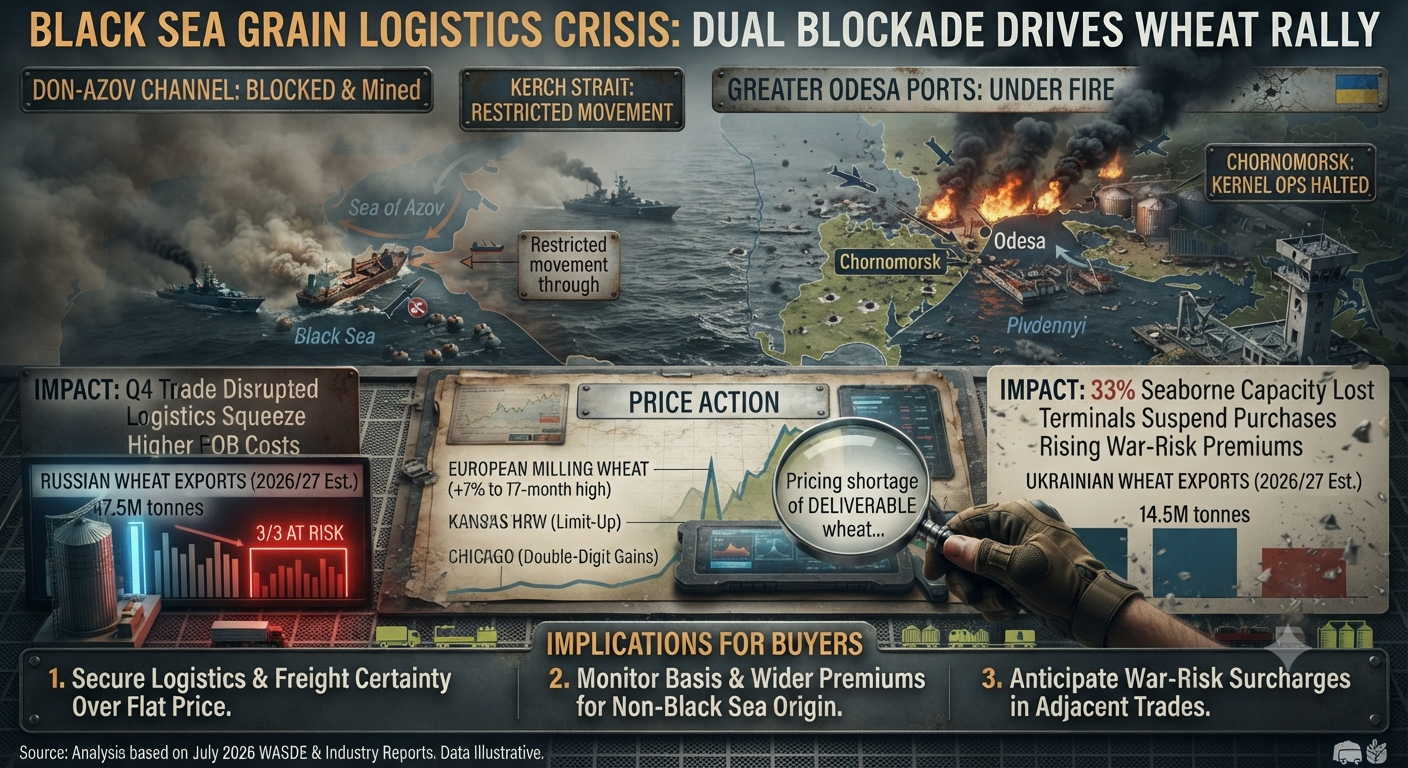
Wheat markets have snapped out of their harvest-season slumber. European milling wheat jumped roughly 7% on Wednesday to a 17-month high, Kansas hard red winter futures traded limit-up, and Chicago extended a rally that has added double-digit percentage gains in under a week — all driven not by crop failure, but by the sudden prospect that grain from the world’s most important export basin may struggle to reach the water at all.
Both corridors are under fire at once
What distinguishes this escalation from previous Black Sea flare-ups is that it is squeezing Russian and Ukrainian export logistics simultaneously. Following Ukrainian strikes on tankers in the Sea of Azov, Russia suspended commercial navigation through the Don-Azov channel and restricted movement through the Kerch Strait — a corridor that handles an estimated quarter to a third of Russian wheat shipments. Moscow has responded with intensified missile and drone attacks on Ukraine’s deepwater ports around Greater Odesa, where agribusiness group Kernel halted operations at Chornomorsk after strikes damaged grain and sunflower oil infrastructure.
The compounding damage is showing up in trade capacity. Ukraine’s main farmers’ union estimates the country has lost about a third of its seaborne grain export capability, four of its thirteen large grain terminals have reportedly suspended purchases, and some shipowners are declining Ukrainian port calls altogether. War-risk insurance premiums are climbing on both sides of the basin.
What the price action is saying
The market is not pricing a shortage of wheat — it is pricing a shortage of deliverable wheat. Russia is still harvesting a crop estimated near 90 million tonnes, and the July WASDE pegs 2026/27 Russian wheat exports at 47.5 million tonnes with Ukraine adding 14.5 million tonnes of a 213-million-tonne global trade. The grain exists; the question is routing.
The clearest tell is in cash markets nearest the disruption: Romanian wheat gained $11 per tonne in just two sessions, a premium nobody would have assigned a week ago against record Black Sea production forecasts. Fresh buying rather than short-covering is driving much of the futures move, with Chicago open interest rising alongside price and implied volatility pushing above 33%. Rerouting Russian grain by truck and rail toward alternative ports is possible, but it collides with constrained domestic fuel supply and rising costs — meaning any workaround shows up in FOB values.
Implications for buyers and procurement teams
For millers, feed compounders and food manufacturers, the immediate exposure is less the flat price than basis and freight behaviour. Import-dependent buyers in North Africa, the Middle East and Southeast Asia who have leaned on cheap Black Sea origin now face wider premiums for Romanian, Bulgarian, French and Baltic replacement — and French supply carries its own question mark, with crop condition ratings slipping to 65% amid a west European heatwave. Buyers with coverage gaps in Q4 should note that war premiums historically price in fast and unwind just as fast; the discipline is securing logistics certainty, not chasing the futures board. Freight desks should also watch war-risk insurance surcharges bleeding into adjacent Black Sea trades, including sunflower oil and meal.
Outlook: big crops meet broken logistics
The fundamental cushion remains real — early Black Sea harvest results are solid and northern-hemisphere supply is expanding weekly, with the US winter wheat harvest already two-thirds complete and running ahead of pace. That is why analysts caution that this rally is conditional: if strikes on port and vessel infrastructure ease, the premium can evaporate within sessions. But the pattern of the past week — infrastructure and energy assets increasingly targeted on both sides — suggests a longer tail of disruption risk than earlier episodes. For the trade, the operating assumption should be a wider trading range and elevated volatility through the peak Black Sea export window of August–October.
Frequently Asked Questions
Why are wheat prices rising if Russia’s harvest is so large?
Because the constraint is logistics, not production. Restrictions on the Kerch Strait and Don-Azov channel, plus strikes on Odesa-area ports, threaten the routes that move Black Sea wheat to buyers — so the market is pricing delay and rerouting cost, not a smaller crop.
How much wheat normally moves through the affected routes?
Roughly a quarter to a third of Russian wheat exports transit the Sea of Azov corridor, while Ukraine’s Greater Odesa ports handle the bulk of its projected 43 million tonnes of grain exports for 2026/27. Together the two countries account for around 30% of world wheat trade.
What should wheat buyers do now?
Review Q4 coverage, price alternative origins (EU, Baltic, US, Australian) before replacement premiums widen further, and stress-test contracts for force majeure and freight and insurance surcharge exposure. Avoid panic-buying the top of a war-premium spike, which can retrace quickly if shipping resumes.
Sources
- Grain Central (Daily Market Wire): Romanian and Russian cash values, volatility, rerouting cost analysis
- Reuters via Business Recorder: Don-Azov channel suspension, trader commentary
- Maritime Professional / Reuters: Euronext 17-month high, KC limit move, terminal suspensions, lost Ukrainian capacity
- Stock & Land / ACM: Kernel Chornomorsk halt, French crop ratings, cross-market price moves
- USDA WASDE / NASS: export forecasts, US harvest progress

