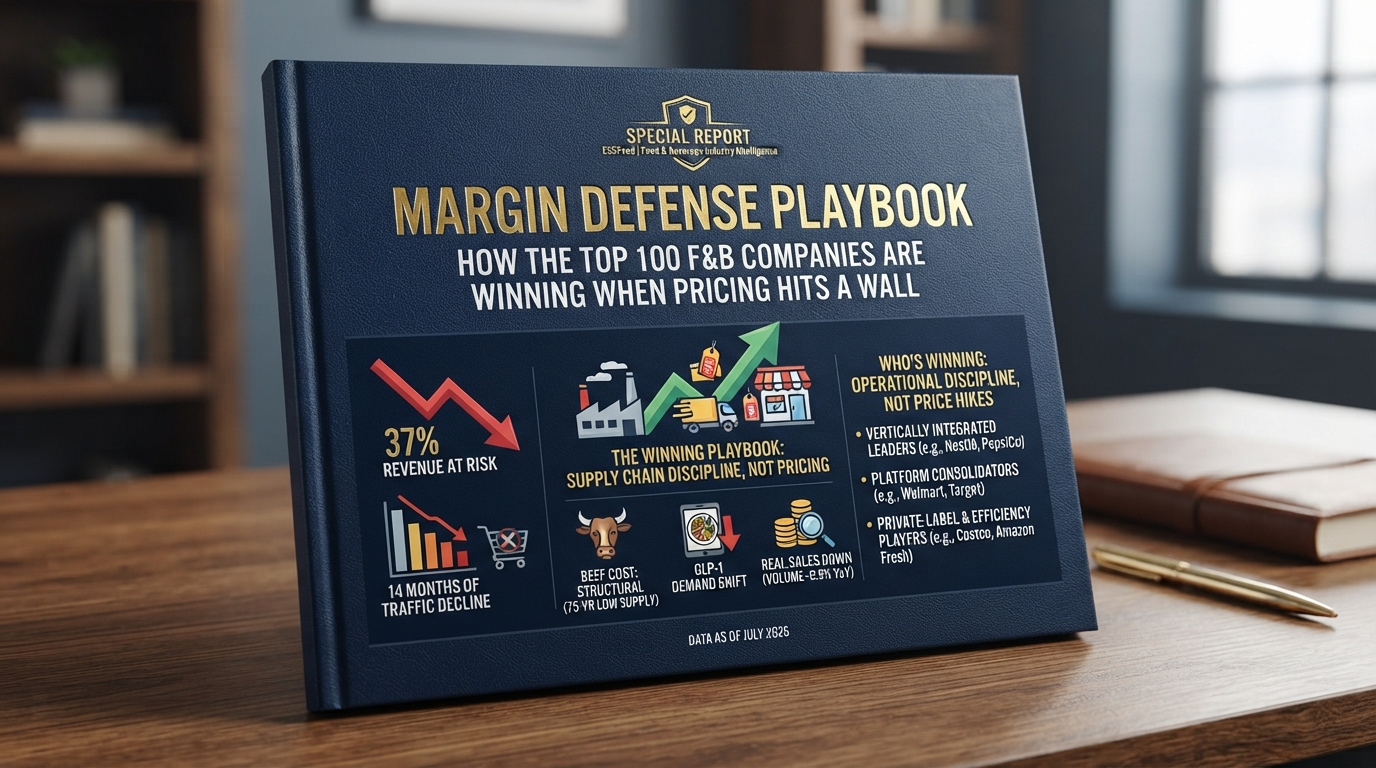
How the Top 100 F&B Companies Are Winning When Pricing Hits a Wall

rgultig

July 14, 2026

Margin Defense Playbook: How the Top 100 F&B Companies Are Winning in 2026
Special Report

Margin Defense Playbook

How the Top 100 F&B Companies Are Winning When Pricing Hits a Wall

Pricing stopped working 6 months ago. The Top 100 F&B companies know it. Margins are under structural pressure from input costs, labor, and logistics. But while some are defending profitability, others are watching margins collapse. This report reveals what separates the winners—and it has almost nothing to do with raising prices.

37%
Revenue at Risk
14
Months of Traffic Decline

The Bifurcation Story

The top 100 aren’t moving as one unit anymore. In the last quarter, one tracked company posted 21.4% sales growth while another dropped 9.5%—a 31-point spread. That’s not coincidence. It’s operational discipline.

The companies holding margin are doing three things differently: they’ve stopped relying on pricing, they’ve tightened supply chain execution, and they’re winning on the floor—not on the menu.

📊 Real Sales Are Down
Inflation-adjusted sales (actual volume, not pricing) declined 0.9% YoY as of May 2026. Most of the headline $1.55T in sales growth is pricing, not more visits or units sold. This is unsustainable.
🥩 Beef Cost Is Now Structural
The U.S. cattle supply is at a 75-year tightness. This isn’t a commodity spike that reverses in six months—it’s a menu problem for the next 2–3 years. Winners are already repositioning their protein strategy.
📱 GLP-1 Demand Shift Is Real
Smaller portions, protein-forward offerings, and shareables aren’t trend-chasing—they’re operational responses to real behavior change. Companies adapting their operations to this reality are capturing incremental occasions.

The Winning Playbook

Companies defending margin share are executing on these four moves:

1
Supply Chain Tightness, Not Menu Tightness
Winners are squeezing 2–4% out of operations (procurement, logistics, waste, labor scheduling) instead of cutting menu and losing customers. That’s where the margin actually sits.
2
Real-Time Execution Visibility
Top performers have invested in supply chain tech (POS integration, inventory routing, order optimization). They know where every dollar is leaking and can react within days, not weeks.
3
Segmented Pricing, Not Blanket Increases
Instead of raising menu prices uniformly, winners are using data to raise prices only where consumers accept it (premium lines, convenience, certain dayparts) and defending volume elsewhere.
4
Proactive M&A and Portfolio Moves
Private equity is moving again after three flat years. Leaders aren’t waiting for margins to recover—they’re consolidating, shedding low-margin SKUs, and repositioning portfolios now.

Who’s Winning

Three company archetypes are pulling ahead:

Vertically Integrated Leaders
Companies with control over their supply chain (sourcing, processing, logistics) have 300–500bp margin advantage over competitors buying in open markets. Nestlé, PepsiCo, Mondelēz are aggressively defending this moat.
Platform Consolidators
Walmart and Target’s expansion into premium grocery (37% of shoppers now see mass retailers as primary grocery destination) is forcing regional players to merge or exit. Winners are partnering or being acquired at strategic prices.
Private-Label & Efficiency Players
Costco, Amazon Fresh, and regional players betting on private-label and direct distribution are capturing margin through operational excellence, not pricing power. They’re winning volume and margin simultaneously.

What It Means for the Next 12 Months

For brands: Pricing power is gone. Restructure operations, not menus. The companies that don’t make this shift will lose share to more disciplined competitors.

For retailers: Margin pressure is coming to your suppliers, which means your selection and shelf space negotiations are about to get more favorable. But commoditized suppliers are also consolidating fast—choose your partners carefully.

For supply chain professionals: You’re about to become the most valuable person in the room. Companies will invest in visibility, data, and automation to recover 2–3 points of margin. That’s $20–50M of opportunity for a company doing $1B+ in revenue.

The Bottom Line

The top 100 F&B companies aren’t all heading in the same direction. The ones defending margin are operating like trading companies: ruthless on cost, disciplined on pricing, and strategic about where they compete. The ones losing share are still thinking like brand companies—managing around pricing and hoping traffic holds.

You can predict who wins and loses based on this one distinction alone.

Explore More Insights