
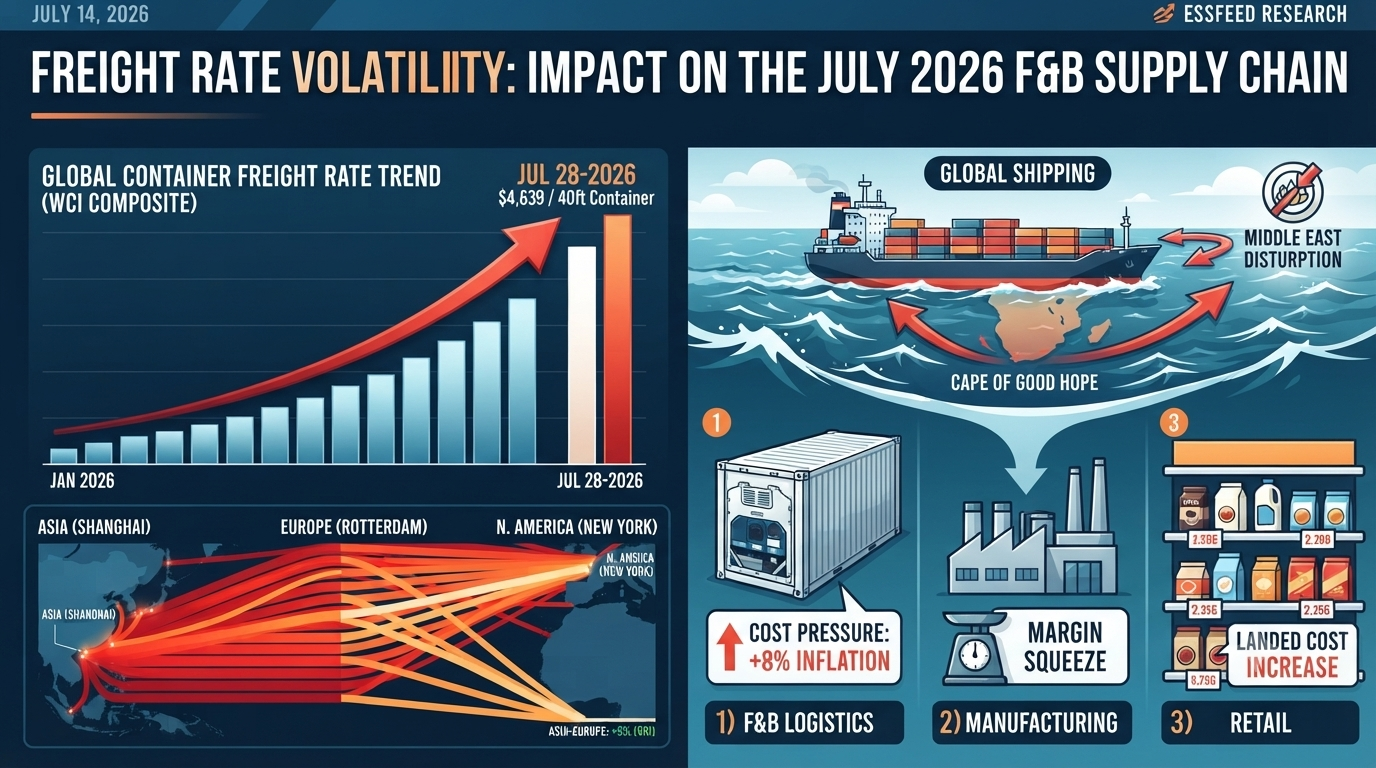
Global trade is facing a period of renewed pressure as container freight rates continue their upward climb. According to the latest assessment from Drewry Supply Chain Advisors for Week 28 of 2026, the composite World Container Index (WCI) rose by 2%, reaching $4,639 per 40-foot container.
This increase—the highest level seen since September 2024—is driven largely by tightening capacity on key Asia-to-Europe trade routes. For the global Food and Beverage (F&B) industry, these rising costs and lingering logistical bottlenecks are more than just a headline; they represent a fundamental shift in how supply chains must be managed in the second half of 2026.
Table of Contents
Why Freight Rates Are Rising
The current volatility is not the result of a single issue, but rather a “perfect storm” of structural constraints:
- Capacity Management: Shipping lines are maintaining tight capacity through measures like blank sailings, effectively supporting higher freight rates even as demand fluctuates.
- Geopolitical Disruption: Continued security concerns in the Red Sea and the Strait of Hormuz are forcing carriers to bypass the Suez Canal, resulting in longer transit times and higher operating costs as ships reroute around the Cape of Good Hope.
- Front-loading Demand: Many importers are accelerating shipments into the U.S. and other markets to “beat” potential tariff deadlines, creating a compressed and highly competitive peak season.
Implications for the Food & Beverage Sector
F&B supply chains are uniquely sensitive to these logistics costs. Commodities such as coffee, cocoa, dairy, meat, and processed foods rely heavily on containerized shipping—often in specialized refrigerated containers (reefers) that are currently experiencing severe capacity tightness.
- Inflationary Pressure on Landed Costs: Most international commodity transactions are priced as “FOB + freight.” When freight rates jump, the Cost, Insurance, and Freight (CIF) price rises immediately, even if the base commodity cost remains stable. This forces downstream manufacturers to absorb these costs or pass them on to consumers.
- Margin Compression: With carriers implementing General Rate Increases (GRIs) and peak season surcharges, F&B processors and exporters are finding their margins squeezed. Businesses that have not secured long-term contract structures may find themselves particularly exposed to spot market volatility.
- Inventory Strategy Re-evaluation: The uncertainty surrounding delivery times and container availability is forcing companies to transition from “just-in-time” models to higher safety stock levels to mitigate the risk of stockouts during these prolonged transit windows.
Outlook for the Rest of 2026
While peak seasonal demand is expected to ease late in the third quarter, analysts warn that freight rates will likely remain elevated due to the structural nature of the current disruptions. For F&B industry professionals, the current environment demands a total risk-management approach. Success now depends less on finding the “lowest rate” and more on securing reliable space, protecting margins through strategic procurement, and maintaining flexibility across global trade corridors.
Related
Frequently Asked Questions (FAQ)
How do rising container rates specifically impact food prices?
Food and beverage companies often operate on thin margins. When ocean freight costs rise, the total “landed cost” (CIF) of ingredients and finished products increases. Companies must then decide whether to absorb these higher costs, reducing profitability, or pass them on to the end consumer, contributing to food price inflation.
Why are refrigerated containers (reefers) particularly affected?
Reefer capacity is finite and requires specialized equipment and power supply on ships. Because F&B products like meat, dairy, and frozen goods are perishable, they cannot be delayed without risking product loss, making them more vulnerable to capacity shortages and the premium surcharges carriers apply during peak periods.
Will freight rates decrease later this year?
While some market corrections may occur after current front-loading cycles conclude, analysts believe rates will remain well above historical norms throughout Q3 2026. Ongoing geopolitical instability in the Middle East and the structural requirement for longer transit routes around Africa continue to serve as a floor for global shipping costs.
What can F&B exporters do to protect their supply chains?
Exporters should monitor equipment availability closely, diversify their routing options rather than relying on a single corridor, and engage in index-linked contracts that provide more predictability than the volatile spot market.
Sources
- Shipping Telegraph: Drewry: The World Container Index increased 2% this week 28-2026
- Drewry Maritime Research: World Container Index Assessed by Drewry
- TFG Global: July 2026 Freight Market Update
- YesStainless (via SGL data): Global Ocean Freight Market Update July 2026
- New Food Magazine: Global Food Supply Chains in 2026: building resilience under pressure
- IMF Blog: Global Disruptions Are Testing How the World Moves Goods and People

