
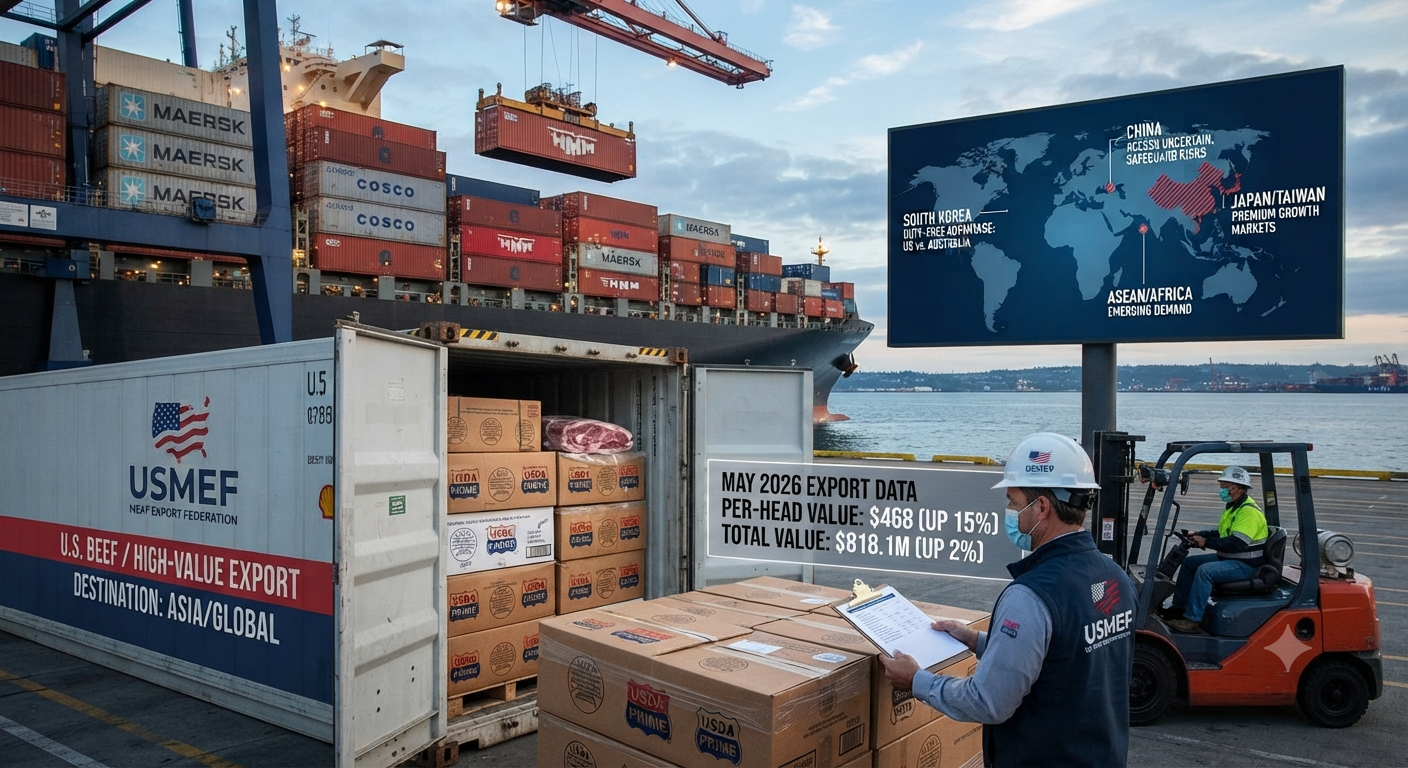
The US beef export story in 2026 has become a study in contradiction: fewer tons leaving the country, but more dollars coming back per animal. May trade data released by USDA and compiled by the US Meat Export Federation (USMEF) confirms the trend — and reveals a global beef trade map being redrawn in real time by tariff triggers, technical barriers and tight supply.
May beef exports totaled 91,925 metric tons, down 5% from a year earlier, yet value rose 2% to $818.1 million. The headline number for producers and packers: export value per head of fed slaughter soared to $468 in May, up 15% year-over-year and the highest since July 2022. The January–May average stands at $435.38 per head, up 5% on the same period in 2025.
For an industry working through the tightest cattle supplies in decades, that per-head figure is the metric that matters. With the US herd at 86.2 million head and still contracting, maximizing the value of every animal — every cut, every variety meat item — is the commercial imperative. On that measure, exporters are delivering.
Table of Contents
The China Distortion
Year-to-date volumes tell a bleaker story on the surface: January–May exports of 457,063 metric tons ran 10% below last year’s pace, with value down 5% to $3.95 billion. But strip out China and the picture transforms — volumes down less than 1% and value up 6%.
That single adjustment explains most of 2026’s export weakness. Most US beef plant registrations were declared expired in March 2025, and although Beijing renewed the bulk of them in mid-May, shipments have barely responded. May exports to China totaled just 471 metric tons worth $2.7 million, a new low since the registration lapse. Many facilities remain suspended, and exporters are reluctant to ship until technical obstacles are resolved and China honors its Phase One Agreement commitments.
There is a second-half catalyst worth watching, though. Brazil and Australia are both reportedly at or near China’s 2026 safeguard tariff quotas for beef — Australia triggered its China safeguard on June 18 and now faces a 55% tariff into that market. If US access normalizes while competitors face punitive rates, the swing in Chinese demand toward US product could be substantial.
Korea: The Tariff Clock Is About to Strike
The most consequential near-term shift is unfolding in South Korea. By mid-July, Korea’s imports of Australian beef are expected to breach the safeguard threshold in the Korea-Australia FTA, lifting the tariff on Australian beef from 5.3% to 24% through year-end. US beef enters Korea duty-free under the Korea-US FTA.
That is a roughly 24-point duty advantage for US product in one of its highest-value markets — but the first half told the opposite story. Anticipating the tariff jump, Korean importers stockpiled frozen Australian beef, which weighed on US results: May exports to Korea fell 21% in volume to 19,817 metric tons and 12% in value to $206 million, with January–May volumes down 10% at 96,265 metric tons.
USMEF has been positioning US beef — particularly chilled cuts and USDA Prime — to take Australian shelf space in the second half. For exporters, foodservice distributors and Korean retail buyers, the July safeguard trigger is the date that resets the competitive landscape.
Taiwan and Japan: The Value Engines
Taiwan has been the standout market of 2026. May exports climbed 9% year-over-year to 5,358 metric tons with value up 16% to $63.7 million, and January–May shipments are running 16% ahead of last year at 25,159 metric tons, worth $287.9 million. Taiwan’s appetite spans a diverse range of US beef products, including round cuts like outside round flats — a demand profile that complements carcass utilization rather than competing for middle meats alone.
Japan illustrates the value-over-volume theme perfectly. May volumes fell 8% to 20,102 metric tons, yet value rose 7% to $166.2 million. With more US production grading USDA Prime, USMEF has intensified promotion of Prime cuts that are underutilized domestically but command premiums in Japanese retail and foodservice — Prime round cuts, chuck eye rolls and coulottes among them.
Emerging Demand: ASEAN, Latin America and Africa
Beyond the established Asian markets, several growth stories stand out.
ASEAN exports jumped 38% in May to 3,193 metric tons with value up 61% to $31.4 million, driven largely by Indonesia’s re-emergence after the elimination of some onerous non-tariff barriers, plus strengthening demand in Vietnam. January–May shipments to the region are up 33% in volume and 43% in value. Indonesia still restricts imports through a de facto quota system via import licensing, but implementation of the US-Indonesia Agreement on Reciprocal Trade would open substantial opportunity.
South America delivered the sharpest value growth: May exports rose 13% in volume and 41% in value, led by the largest monthly shipments to Chile since 2022 at nearly 900 metric tons — up 54% year-over-year. Central America posted a 12% May value gain despite lower volumes.
Africa, primarily a variety meat destination, saw May exports climb 15% in volume and a striking 70% in value, led by growth in Morocco and a demand rebound in South Africa, alongside established markets Côte d’Ivoire and Gabon. Egypt, largely a liver and variety meat market, grew January–May value 12% despite the Iran conflict disrupting Middle East foodservice demand and transport routes.
Variety Meat: The Quiet Margin Story
May was another big month for beef variety meat, with shipments up 34% year-over-year to 27,200 metric tons and value up 55% to $128.4 million. In a tight-supply environment, variety meat exports are pure incremental value on animals already being processed — a direct contributor to that record-adjacent $468 per-head figure. One caveat: USMEF anticipates downward adjustments to 2026 variety meat data, with some volume and value possibly reclassified as muscle cuts.
Export share metrics round out the picture: May beef exports accounted for 13.8% of total production and 10.4% of muscle cuts, both up from May 2025 on the total production measure.
The Takeaway for F&B Professionals
The 2026 US beef export market is no longer a volume game — it can’t be, with production constrained and domestic prices at records. It is a value-extraction game, and the May data shows it working: higher per-head returns, premiumization in Japan and Taiwan, variety meat monetization, and tariff-driven openings in Korea about to materialize.
For importers, distributors and foodservice buyers outside the US, the signals are equally clear. Korean buyers face a compressed window to secure US supply before the Australian tariff advantage fully bites. Southeast Asian markets are opening structurally, not cyclically. And the China question — the single biggest swing factor in global beef trade — remains unresolved but increasingly loaded toward a second-half shift.
FAQ
How did US beef exports perform in May 2026?
May exports totaled 91,925 metric tons, down 5% year-over-year, but value rose 2% to $818.1 million. Export value per head of fed slaughter reached $468 — up 15% and the highest since July 2022.
Why are US beef export volumes down in 2026?
January–May volumes fell 10%, but the decline is almost entirely China-driven. Excluding China, volumes are down less than 1% and value is up 6%. Tight domestic cattle supplies and record US prices have also constrained exportable volumes.
What is happening with US beef exports to China?
Despite China renewing most expired US plant registrations in mid-May, exports remain minimal — just 471 metric tons in May — as technical obstacles persist and many facilities remain suspended. Exporters are holding back until barriers are resolved and Phase One commitments are met.
How will Korea’s tariff change affect US beef?
By mid-July 2026, Australian beef imports into Korea are expected to exceed the FTA safeguard threshold, raising Australia’s tariff from 5.3% to 24% through year-end. US beef enters Korea duty-free, creating a significant second-half competitive advantage — though Korean importers pre-stocked frozen Australian beef, which dampened first-half US sales.
Which markets are growing for US beef in 2026?
Taiwan (January–May volume up 16%, value up 12%), the ASEAN region (volume up 33%, value up 43% on Indonesia’s re-opening and Vietnamese demand), South America (value up 38%, led by Chile), and Africa (value up 20%, led by Morocco and South Africa).
Why does export value per head matter?
With the US cattle herd at 86.2 million head and still contracting, packers and producers must maximize revenue from every animal. Exports monetize cuts and variety meats that are undervalued domestically — the $468 per-head May figure shows international demand directly supporting cattle values.
Sources
| Source | Publication | Date |
|---|---|---|
| USMEF: Beef Export Value Above Year-Ago | EuroMeat News / USMEF | July 13, 2026 |
| Offal Restrictions Impact May Pork Exports; Beef Export Value Above Year-Ago | US Meat Export Federation | July 2026 |
| USMEF Details Headwinds in Beef, Pork World Market | MEAT+POULTRY | July 2026 |
| US Beef Exports Down 10% in 2026 as Supply Crunch Bites | Meatingplace | July 2026 |
| Mexico PRV Restrictions Slash Pork Offal as Beef Exports Rebound | National Hog Farmer | July 2026 |
| Smaller Cattle Herd Creates Market Volatility | American Farm Bureau Federation Market Intel | 2026 |

