
A Monsoon Season Starting Under Real Stress
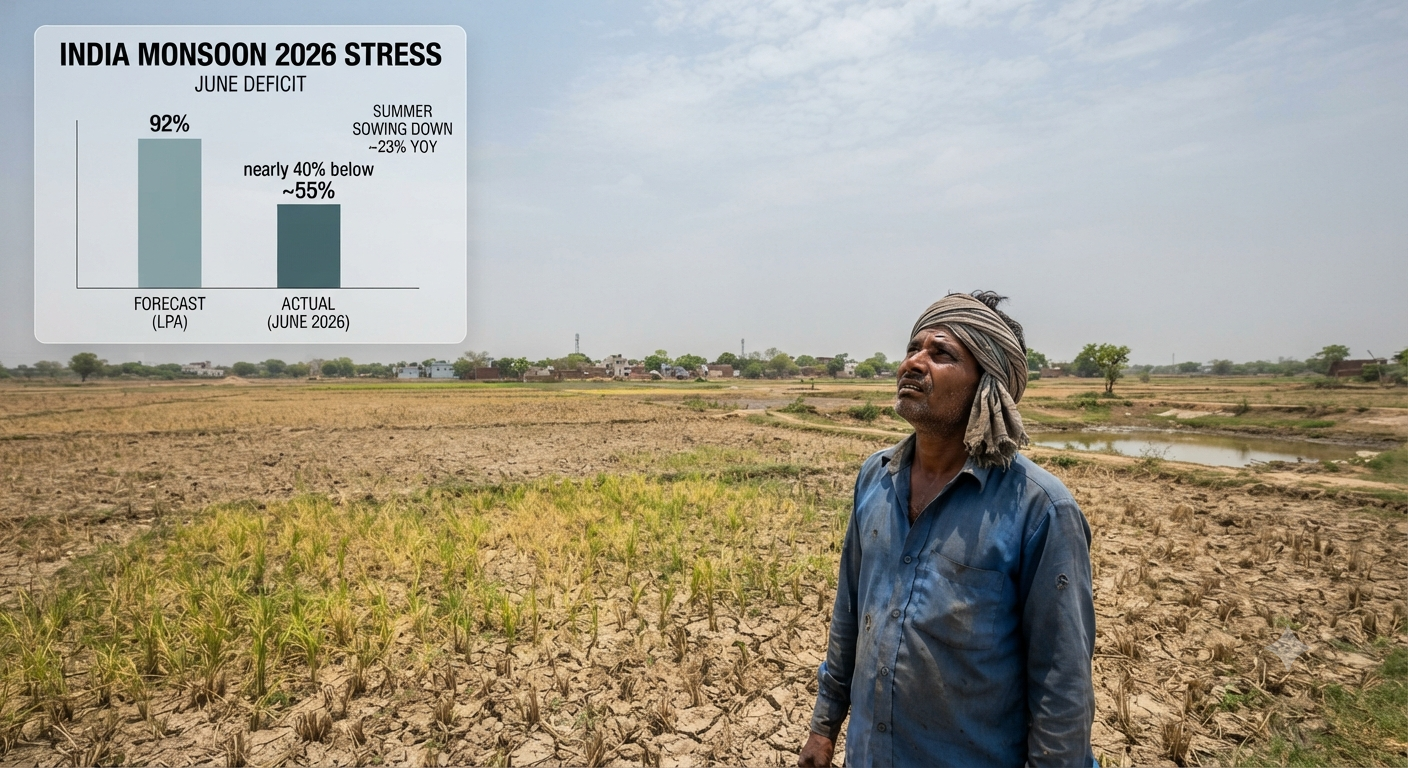
India has just recorded its driest June in twelve years, and the fifth-driest since nationwide rainfall records began in 1901. Only four Junes on record — 1905, 1926, 2009 and 2014 — have been drier. The India Meteorological Department had forecast June rainfall at 92% of the long-period average; actual rainfall came in nearly 40% below that projection.
For a country where roughly 70% of annual rainfall arrives during the four-month southwest monsoon, and where nearly half of net sown farmland has no assured irrigation, this isn’t a minor data point. It’s the number that determines how much rice, oilseed, cotton, sugarcane and jute India’s farmers can put in the ground this season — and by extension, what global buyers of those commodities should expect over the next twelve months.
Table of Contents
Sowing Numbers Already Show the Impact
The delay is already visible in planting data. Government figures show summer crop sowing across India stood at 18.27 million hectares by the end of June, down nearly 23% from 23.65 million hectares at the same point in 2025.
Rice has taken the sharpest hit. Farmers had planted rice across 2.58 million hectares by late June this season, compared with 3.44 million hectares a year earlier — a drop of roughly 25%. The monsoon’s onset over Kerala was delayed by three days, and its northward advance stalled for close to two weeks across western India, pushing back field preparation and planting windows across several key agricultural regions.
Oilseed production is the other pressure point. Weaker monsoon rainfall is expected to reduce India’s domestic oilseed output, which will likely increase the country’s reliance on imported edible oils — a dynamic worth watching closely for anyone in vegetable oil sourcing or trading, given India is already one of the world’s largest edible oil importers.
Why This Isn’t a Confirmed Crisis Yet
It’s worth being precise about what this data does and doesn’t tell us. The monsoon season runs through September, and July — typically the wettest month, contributing about a third of total monsoon rainfall and coinciding with peak sowing for most crops — still has the potential to close much of the current gap. A slow start doesn’t guarantee a poor season.
India also entered this monsoon with an unusually strong buffer. Government rice stocks stood at 39.7 million tonnes as of 1 July — nearly three times the official buffer requirement of 13.5 million tonnes — with a further 29.8 million tonnes expected once already-procured paddy is milled. That stockpile gives India, and by extension global rice markets that depend on Indian export availability, meaningful insulation against a short-term supply shock, even if the current planting shortfall persists.
The El Niño Overlay
This monsoon weakness is unfolding against the backdrop of a strengthening El Niño, which NOAA confirmed in June and which forecasters expect to intensify through the rest of 2026. India carries some of the most concentrated monsoon-dependent agricultural risk globally in El Niño years — the country hasn’t seen an El Niño-driven drought since 2015-16, and the last major event, in 2010, cut national rainfall by nearly 22%.
The IMD has now forecast below-normal rainfall for July specifically, which is the detail markets should be watching most closely. A below-normal July, layered on an already-dry June, would confirm rather than reverse the current trajectory — and July is the month that matters most for peak sowing completion.
India’s Government Response
Indian authorities are not waiting to see how the season unfolds before acting. The government has identified 315 districts at risk of below-normal rainfall and has prepared contingency measures, including promoting short-duration crop varieties, less water-intensive crop options, and expanded water conservation efforts. Officials have also sought to reassure domestic markets that current rice and wheat buffer stocks remain comfortable and that there is no immediate threat to the country’s food security, even with the monsoon’s slow start.
What This Means for F&B Buyers and Traders
For anyone sourcing rice, edible oils, cotton or sugar with exposure to Indian supply, a few things are worth tracking over the coming weeks:
- Watch July rainfall data closely. It’s the single biggest swing factor for whether this season becomes a genuine shortfall or a delayed-but-recovered season. July typically delivers a third of total monsoon rainfall and coincides with peak sowing.
- Rice export policy risk remains low for now, given stock levels. India’s current rice reserves are nearly triple the official buffer requirement, which reduces (though doesn’t eliminate) the likelihood of near-term export restrictions of the kind seen during prior shortage cycles.
- Edible oil import demand is the more immediate signal. A weaker oilseed harvest pushing India further into import dependence is a more probable near-term outcome than a rice supply disruption, and worth factoring into vegetable oil sourcing and pricing models now.
- This adds to, rather than replaces, the broader El Niño risk picture. India’s monsoon performance was already flagged as one of the highest-risk data points in the 2026 El Niño outlook — this data confirms that risk is materializing rather than remaining theoretical.
- Don’t overreact to a single dry month. With two-thirds of the monsoon season still ahead and unusually strong buffer stocks in place, this is a data point to monitor closely rather than a confirmed supply shock to price in immediately.
The Bottom Line
India’s driest June in over a decade, combined with a below-normal rainfall forecast for July, has turned what was a background El Niño risk into an active, measurable trend in the ground. Rice sowing down a quarter and summer crop sowing down nearly a quarter overall are numbers serious enough to justify closer monitoring across rice, oilseed and edible oil supply chains — even though India’s substantial buffer stocks mean this is not yet a confirmed crisis. July’s rainfall performance will be the number that determines which way this goes.
Related
Sources
| Source | Publication | Date | URL |
|---|---|---|---|
| BBC News | Farming worries after India records driest June in over a decade | July 2026 | Provided by user (BBC) |
FAQ
How dry was India’s June 2026 compared to historical records?
It was India’s driest June in twelve years and the fifth-driest since nationwide rainfall records began in 1901. Only 1905, 1926, 2009 and 2014 recorded drier Junes.
How much has rice sowing fallen this season?
Rice sowing area is down approximately 25% year-on-year, at 2.58 million hectares compared with 3.44 million hectares at the same point in 2025.
Is India at risk of a rice supply shortage?
Not immediately. India’s government rice stocks stood at 39.7 million tonnes as of 1 July — nearly three times the official buffer requirement — providing a substantial cushion against short-term disruption.
How does this connect to the 2026 El Niño?
India’s monsoon has consistently been flagged as one of the highest-risk data points in this year’s El Niño outlook, given the country’s heavy dependence on monsoon rainfall for summer crop production. The IMD’s below-normal rainfall forecast for July aligns with that risk.
What crops are most affected by the weak monsoon start?
Rice has seen the sharpest sowing decline, but oilseeds, cotton, sugarcane and jute — all monsoon-dependent summer crops — are also affected. Reduced oilseed output is expected to increase India’s reliance on imported edible oils.
Could July rainfall reverse the current shortfall?
It’s possible. July typically delivers about a third of total monsoon rainfall and coincides with peak sowing season, leaving meaningful room for recovery if rainfall normalizes.

