
Beef Producers in the USA sector remains one of the most consolidated and high-volume segments of the global protein supply chain. Driven by intense domestic demand and critical export markets across North America and Asia, a select group of heavily integrated processors controls the vast majority of the nation’s daily slaughter capacity.
For international procurement officers, food service distributors, and retail category buyers, understanding the operational footprint, facility concentration, and strategic direction of these market leaders is vital for supply chain resilience.
For a broader look at macroeconomic trends, production volumes, and trade shifts across international borders, see our comprehensive Global Beef Industry Report 2026.
Top 10 Beef Producers in the USA
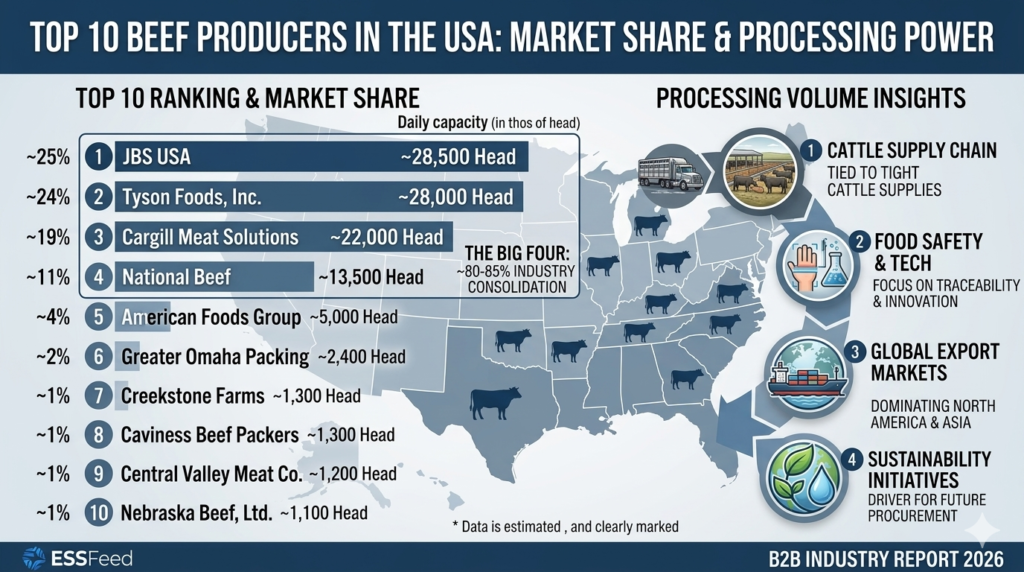
Below is the definitive breakdown of the top 10 beef producers in the USA, ranked by daily processing capacity, market share, and operational scale.
1. JBS USA
- Headquarters: Greeley, Colorado
- Estimated Daily Capacity: ~28,000–29,000 head
- Overview: A subsidiary of Brazil-based JBS S.A., JBS USA is the largest beef processor in the United States. Operating massive, highly efficient facilities across key cattle-feeding states (including Texas, Nebraska, and Colorado), JBS handles a dominant share of both domestic USDA Choice/Prime programs and high-volume export lines. Their core brand portfolio includes Swift, Aspen Ridge, and 1855 Black Angus.
2. Tyson Foods, Inc.
- Headquarters: Springdale, Arkansas
- Estimated Daily Capacity: ~28,000 head
- Overview: Tyson Fresh Meats operates neck-and-neck with JBS for the top spot in US processing volume. Utilizing an extensive network of strategically positioned plants across the Midwest and Great Plains, Tyson leverages unparalleled logistics infrastructure. They are a primary supplier to major domestic retail chains and quick-service restaurant (QSR) networks, anchored by brands like Tyson Open Prairie Natural Meats and Chairman’s Reserve.
3. Cargill Meat Solutions
- Headquarters: Wichita, Kansas
- Estimated Daily Capacity: ~22,000 head
- Overview: Cargill is a foundational giant in global agribusiness and agricultural commodities. Its beef division focuses heavily on technology-driven food safety, supply chain transparency, and sustainability initiatives. Cargill is highly integrated with major commercial feedlots and excels in private-label retail packaging as well as box-beef exports. Core brands include Sterling Silver, Excel, and Our Certified.
4. National Beef Packing Company, LLC
- Headquarters: Kansas City, Missouri
- Estimated Daily Capacity: ~13,000–14,000 head
- Overview: Controlled by Marfrig Global Foods, National Beef is known for its high-quality Angus programs. Operating primary, massive processing hubs in Kansas and Iowa, the company commands a substantial percentage of the high-quality USDA Certified Angus Beef (CAB) market and is a dominant player in premium chilled exports to Japan and South Korea.
Industry Note: Together, the “Big Four” (JBS, Tyson, Cargill, and National Beef) control roughly 80% to 85% of the total federal inspected steer and heifer slaughter capacity in the United States.
5. American Foods Group (AFG)
- Headquarters: Green Bay, Wisconsin
- Estimated Daily Capacity: ~4,500–5,500 head
- Overview: AFG is the largest of the independent processors sitting just outside the Big Four. With a massive footprint across the upper Midwest, AFG specializes heavily in ground beef components, lean manufacturing trimmings, and case-ready programs for retail and institutional food service.
6. Greater Omaha Packing
- Headquarters: Omaha, Nebraska
- Estimated Daily Capacity: ~2,400 head
- Overview: Operating out of a single, highly optimized, state-of-the-art facility in Nebraska since 1920, Greater Omaha is a premium powerhouse. They focus explicitly on high-quality corn-fed beef sourced within a tight radius of the plant, exporting premium steaks and chilled beef to over 70 countries worldwide.
7. Creekstone Farms Premium Beef LLC
- Headquarters: Arkansas City, Kansas
- Estimated Daily Capacity: ~1,200–1,400 head
- Overview: Owned by Japan’s Marubeni Corporation, Creekstone Farms represents the pinnacle of specialized, large-scale premium production. They are universally recognized for their strict Black Angus genetics verification, certified humane handling protocols, and high-end restaurant programs.
8. Caviness Beef Packers
- Headquarters: Amarillo, Texas
- Estimated Daily Capacity: ~1,200–1,500 head
- Overview: A family-owned operation deeply rooted in the Texas Panhandle, Caviness operates modern processing plants that serve a vital regional role. They provide extensive custom harvesting services, case-ready packaging, and are a critical supplier of grinding materials to regional and national food manufacturers.
9. Central Valley Meat Co.
- Headquarters: Hanford, California
- Estimated Daily Capacity: ~1,200 head
- Overview: As the premier beef processor on the US West Coast, Central Valley Meat handles a distinct operational mix. Following their acquisition of Harris Ranch Beef Holding Company, they command a powerful localized supply chain, supplying high-quality, West Coast corn-fed beef to major retail and institutional programs across California and Pacific export corridors.
10. Nebraska Beef, Ltd.
- Headquarters: Omaha, Nebraska
- Estimated Daily Capacity: ~1,100 head
- Overview: Located in the heart of the primary cattle feeding region, Nebraska Beef is a single-plant independent packer that focuses on high-volume boxed beef production. They excel at processing high-yield, high-quality Midwestern cattle for domestic wholesale and industrial food manufacturers.
The Top 10 Beef Producers in the USA: Strategic Market Takeaway for 2026
The US beef packing sector is navigating a period of tight cattle supplies, cyclical herd rebuilding, and shifting international trade dynamics. While independent, regional processors (such as those ranked 5 through 10) provide essential regional capacity and specialized premium programs, the core supply chain remains highly dependent on the operational efficiency and logistical scale of the Big Four. For enterprise buyers, diversifying procurement across both tier-one consolidators and agile independent premium processors is the standard blueprint for mitigating supply chain disruption.
For enterprise buyers navigating global supply constraints, diversifying procurement across both tier-one domestic consolidators and agile regional processors is essential. For an analytical look at cost-competitive processing alternatives on the international stage, see our report on the Top 10 Beef Exporters in India.
Which company is the largest beef producer in the United States?
JBS USA (a subsidiary of JBS S.A.) is currently the largest beef producer in the United States by daily slaughter capacity, closely followed by Tyson Foods, Inc. Together, these two entities control a significant share of the total processed volume in the country.
What percentage of the US beef market do the “Big Four” control?
The “Big Four” beef packers—JBS USA, Tyson Foods, Cargill Meat Solutions, and National Beef Packing Company—collectively process approximately 80% to 85% of all federally inspected steers and heifers in the United States.
Why is the US beef processing industry so highly consolidated?
The high degree of consolidation is driven by intense economies of scale. Massive, centralized facilities minimize per-head cold storage, logistics, and processing overhead, allowing large packers to operate efficiently even during tight margins or cyclical cattle supply contractions.
Where are the majority of large-scale US beef packing plants located?
The heaviest concentration of high-volume facilities is located throughout the Midwest and Great Plains regions—specifically in states like Texas, Kansas, Nebraska, Iowa, and Colorado. This places processing hubs in immediate geographic proximity to the primary commercial cattle feedlots and grain supplies.
How do independent beef processors compete with the dominant market leaders?
Independent regional processors focus on premium differentiation, certified genetic tracing (such as verified Black Angus programs), strict animal welfare compliance, and highly agile case-ready custom packaging contracts that cater directly to boutique retail brands and high-end foodservice distributors.
| Source Organization / Platform | Resource Type | Reference Link / Destination URL |
| USDA Economic Research Service (ERS) | Live Market Data & Slaughter Reports | Inquire USDA ERS Market Data |
| CattleFax | US Cattle Supply & Capacity Analytics | Inquire CattleFax Market Insights |
| National Cattlemen’s Beef Association | Industry Statistics & Producer Profiles | Inquire NCBA Industry Statistics |
