
June 9, 2026
The global snacking market was valued at USD 1.2 trillion in 2025 and is projected to grow from USD 1.3 trillion in 2026 to USD 1.8 trillion by 2034 at a CAGR of 4.5%. The global confectionery and snacks market is tracking toward USD 0.94 trillion in 2026, growing at a CAGR of 5.54% from a 2018 base of USD 0.63 trillion. Confectionery demand is estimated at USD 344.8 billion in 2026, with global snack food products valued at USD 718.72 billion, and the broader snacking category encompassing every food consumed between traditional meal occasions — from salted snacks to protein bars, chocolate to functional gummies — collectively approaching the USD 1.3 trillion threshold.
This is a category that defies economic cycles. Snacks and confectionery represent among the most recession-resilient consumer spending categories in the global food economy — affordable indulgences that consumers protect even when larger discretionary expenditures are cut. And in 2026, the industry is navigating the most transformative period in its modern history, driven by a convergence of extraordinary forces that are simultaneously reshaping what snacks are, who makes them, and who buys them.
The two most consequential events in the global snacks and confectionery industry in 2026 are the completion of Mars’ USD 36 billion acquisition of Kellanova — the largest deal in confectionery history — and the ongoing cocoa price crisis that has imposed unprecedented cost pressure on the entire chocolate confectionery industry, driving Mondelēz International to record pricing actions while simultaneously accelerating investment in alternative cocoa sourcing and precision fermentation. These two events, taken together, capture the dual character of the industry in 2026: the extraordinary scale and ambition of its consolidation, and the profound supply chain vulnerability that underpins even its most iconic products.
This report provides the most comprehensive publicly available analysis of the global snacks and confectionery industry in 2026 — covering market scale, the Mars-Kellanova transformation, the cocoa crisis, product categories, the GLP-1 revolution, health and better-for-you innovation, flavour trends, regional dynamics, sustainability, key challenges, strategic outlook, and leading companies.
Executive Summary: The 2026 Snacks and Confectionery Landscape
The global snacks and confectionery industry in 2026 is defined by a “great portfolio reset” — the largest players in the industry are simultaneously defending their core indulgent brands while aggressively building better-for-you, protein-forward, and functional snacking capabilities through acquisitions, reformulations, and portfolio rationalisation.
Key Takeaways for Stakeholders:
The global snacking market is valued at USD 1.3 trillion in 2026, growing at a CAGR of 4.5% toward USD 1.8 trillion by 2034. Confectionery contributes USD 344.8 billion and snack food products USD 718.72 billion.
Mars completes the USD 36 billion Kellanova acquisition: As 2025 closed, Mars completed its landmark acquisition of Kellanova, bringing together Mars confectionery (Snickers, M&M’s, Twix, Milky Way) with Kellanova’s savory snacking portfolio (Pringles, Cheez-It, Pop-Tarts, RXBAR). The most significant deal in confectionery history creates a diversified snacking powerhouse with unmatched global reach.
Ferrero acquires WK Kellogg for USD 3.1 billion and Bold Snacks in Brazil: Ferrero’s twin acquisitions signal the confectionery industry’s structural pivot toward healthier snacking — adding WK Kellogg’s cereal brands (Froot Loops, Special K) and a Brazilian protein snack platform to its core Nutella, Kinder, and Ferrero Rocher portfolio.
Cocoa price volatility was the defining challenge of 2025: Mondelēz International reported that unprecedented cocoa cost headwinds impacted profitability significantly in 2025, with the company executing disciplined pricing, structural supply chain actions, and investing in alternative technologies including cell-cultured and fermented cocoa. Cocoa markets are stabilising in 2026 as sourcing diversification matures.
GLP-1 is the category’s most significant demand disruptor: A study released in January 2026 found GLP-1 drug use cuts grocery spending by 6%, with purchases of calorie-dense, processed items including chips, baked goods, and cookies among the most affected. The industry is responding with smaller, more nutrient-dense formulations, protein fortification, and “value per bite” positioning.
Protein is the #1 snacking trend: Innova’s top trend for 2026 is “Powerhouse Protein” — consumers equating protein with health and seeking it across all snacking occasions. PepsiCo debuted Doritos Protein and reformulated Baked Lay’s with zero seed oils at Sweets & Snacks Expo 2026.
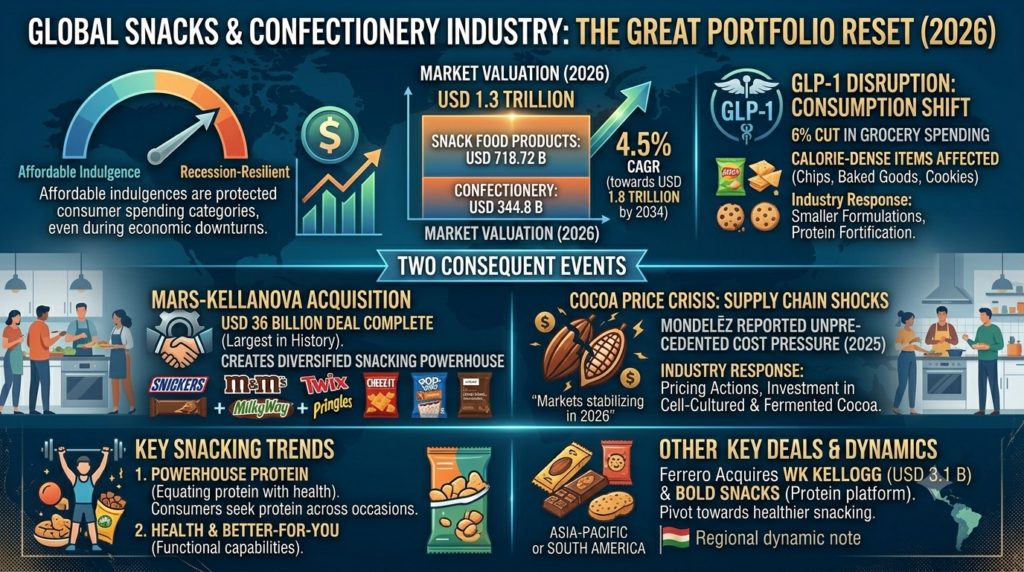
Table of Contents
1. Market Overview: Scale, Structure and Scope
Global Valuation
The snacks and confectionery industry is one of the broadest and most diverse categories in the global food economy. Depending on the scope of measurement — whether defined narrowly as packaged snack foods and confectionery, or broadly as all between-meal eating occasions including bakery snacks, frozen snacks, dried fruit, meat snacks, and functional snacking formats — the total addressable market ranges from USD 718 billion (snack food products alone) to USD 1.3 trillion (all snacking occasions).
The global snack products market was valued at USD 471.61 billion in 2026, growing from USD 456.06 billion in 2025, projected to reach USD 616.71 billion by 2034 at a CAGR of 3.41%. Europe dominated the snack food products market with a market share of 29.63% in 2025.
The confectionery market is estimated at USD 344.8 billion in 2026, growing at a CAGR of 6.4% toward USD 643.4 billion by 2036. Within confectionery, chocolate is the dominant category capturing approximately 42% of global market share in 2026 due to premium gifting trends.
The Combined Snacking Universe
Within the broader snacking universe in 2026: frozen and refrigerated snacks account for USD 328.7 billion; savory snacks for USD 258.3 billion; confectionery snacks for USD 176.1 billion; fruit snacks for USD 189.3 billion; and bakery snacks for USD 137.7 billion. The combined confectionery and snacks market is growing at a CAGR of 5.54%, with snack food growing at 6.7% and confectionery at 5.4% in 2026.
Around 47% of consumers prefer flavoured condiments and snacks daily, while 41% of packaged food consumption is accompanied by dipping sauces and snacking products. Approximately 72% of households keep at least one snack format regularly available for on-demand consumption.
Industry Structure
The global snacks and confectionery industry is moderately consolidated at the top — dominated by a small number of very large multinationals — but extraordinarily fragmented at the challenger and artisan end, where barriers to DTC e-commerce entry are low and social media enables niche brands to achieve rapid awareness growth. The top players — Mars (post-Kellanova), Mondelēz International, PepsiCo (Frito-Lay), Ferrero, Nestlé, and Hershey — collectively account for a significant share of total category revenue, but their combined dominance is being steadily eroded by a wave of better-for-you, protein-forward, and artisan challenger brands that are capturing the most valuable consumer segments.
2. The Mars-Kellanova Deal: Reshaping the Global Snacking Map
The Transaction
As 2025 came to a close, Mars, Inc. quietly completed its landmark acquisition of snacking giant Kellanova — a deal valued at approximately USD 36 billion — cementing its dominance across the global snacking landscape. The transaction brings together two of the industry’s most influential brand portfolios: Mars’ confectionery powerhouse (M&M’s, Snickers, Twix, Milky Way, Bounty, Skittles, Starburst) with Kellanova’s global savory snacking platforms (Pringles, Cheez-It, Pop-Tarts, Special K, RXBAR, Nutri-Grain).
The strategic rationale for the deal is articulated clearly: the Kellanova acquisition expands Mars beyond confectionery into resilient global snacking, with the combined portfolio benefiting from Kellanova’s repositioned savory brands — including Pringles’ Harvest Blends and Cheez-Its made with whole grains and real cheese — that provide the better-for-you credentials Mars’ core confectionery portfolio lacks.
Why Confectioners Are Pivoting to Snacking
The Mars-Kellanova deal and Ferrero’s simultaneous acquisition of WK Kellogg reflect a structural recognition by the world’s largest confectionery companies that their core category faces mounting headwinds: health consciousness, GLP-1 medication adoption, HFSS regulatory pressure across European and increasingly global markets, and the growing sophistication of consumers who are applying nutritional scrutiny to every purchase decision. Confectionery companies score poorest on healthiness of portfolios among major food categories — a ranking that creates both reputational and regulatory risk in an era of expanding front-of-pack warning labels and advertising restrictions.
The savory snacking and breakfast categories that Kellanova and WK Kellogg represent offer multiple advantages over pure confectionery exposure: they are perceived as less indulgent, they are being actively repositioned toward better-for-you credentials (Pringles Harvest Blends, Special K protein), and they carry lower sugar content that makes them less vulnerable to HFSS restrictions.
As Euromonitor International’s head of snacks and nutrition commented, Mars will be able to “better buffer the challenges faced in any one part of its business — like offsetting chocolate pressures with a push in its future savory offerings.”
3. The Cocoa Crisis: Confectionery’s Defining Supply Chain Challenge
The Scale of the Crisis
Cocoa price volatility was the defining challenge of the global confectionery industry in 2025, creating an unprecedented cost environment that materially impacted the profitability of every major chocolate manufacturer. Mondelēz International, with 2025 net revenues of approximately USD 38.5 billion and a global position as the world’s second-largest chocolate company, reported that its earnings declined in 2025 due to “unprecedented input cost increases in our largest commodity, cocoa.”
The cocoa crisis has two primary structural causes: weather-related harvest failures in West Africa — particularly in Côte d’Ivoire and Ghana, which together account for approximately 60% of global cocoa production — driven by the El Niño weather pattern and the long-term impact of climate change on cocoa-growing regions; and the structural underinvestment in cocoa farming infrastructure, farmer welfare, and agronomic improvement over decades that has left West African cocoa supply highly vulnerable to weather disruption.
The Industry Response
Mondelēz’s response to the cocoa crisis has been comprehensive and multi-year in its ambition: disciplined pricing (significant price increases executed across major markets), structural supply chain actions including diversifying sourcing beyond West Africa and supporting improved agronomy practices through large-scale farming investment, and technological investment in alternative technologies including cell-cultured and fermented cocoa. The company expects cocoa markets to stabilise in 2026 with improved margin dynamics and stronger earnings growth beginning in 2027.
Barry Callebaut, the world’s largest cocoa and chocolate manufacturer supplying ingredients to virtually every major confectionery brand, is reportedly planning to spin off its cocoa business in a deal that could reshape the confectionery industry’s upstream supply chain. The potential spinoff reflects the strategic logic of separating the volatile cocoa commodity trading and processing business from the higher-margin, more predictable chocolate ingredient manufacturing business.
4. Product Categories: Deep Dives
Chocolate Confectionery
Chocolate is the dominant confectionery category, capturing approximately 42–58% of global confectionery market share in 2026 (depending on measurement scope). The category is characterised by simultaneous premiumisation in developed markets and volume expansion in emerging markets as rising incomes bring chocolate into the affordable indulgence range for hundreds of millions of first-time consumers in Asia, Africa, and Latin America.
The chocolate confectionery segment navigated the cocoa crisis of 2025 through a combination of price increases and format changes — smaller portion sizes, thinner bars, and reduced fill weights (shrinkflation) — while accelerating investment in premium positioning where higher prices can be more credibly justified by provenance, ingredient quality, and sensory experience.
The most commercially significant chocolate innovation trend in 2026 is the pistachio moment — a continuation of the Dubai chocolate phenomenon where pistachio tahini cream and kataifi filling combined to create one of the most viral food trends in social media history. Pistachio chocolate variants from Mars, Ferrero, Lindt, and hundreds of smaller producers are among the fastest-selling confectionery launches of 2026, demonstrating the industry’s ability to rapidly commercialise viral flavour trends when the manufacturing and distribution infrastructure is in place.
Sugar Confectionery and Gummies
Sugar confectionery — encompassing hard candies, chewy sweets, gummies, lollipops, mints, and liquorice — is experiencing the same health-driven reformulation pressure as chocolate, but with the added innovation dynamic of the functional gummy revolution. Gummies have become the most commercially successful supplement delivery format in the global dietary supplements industry, and this format innovation is crossing back into confectionery through gut health gummies, vitamin-infused candy, collagen chews, and probiotic confectionery that sit at the intersection of indulgence and function.
At the ISM 2026 confectionery trade show in Cologne, a dedicated “ISM Functional Sweets” section was introduced for 2026, spotlighting products that emphasise health, functionality, and innovative wellness concepts within confectionery and snacks — a formal acknowledgement by the industry’s most important trade event that functional confectionery has achieved mainstream commercial status.
Savory Snacks
Savory snacks — encompassing potato chips, corn snacks, pretzels, popcorn, rice cakes, and the expanding world of plant-based and protein-forward savory formats — are the fastest-growing major snacking category in 2026, driven by three structural tailwinds: the ongoing “snackification of meals” as traditional three-meal eating structures give way to frequent small eating occasions; the growth of global flavour exploration creating demand for authentic ethnic and fusion savoury formats; and the protein trend’s intersection with savory snacking as consumers seek protein-rich alternatives to traditional confectionery for between-meal nourishment.
PepsiCo’s major 2026 strategy reset — cutting nearly 20% of its US SKUs and doubling down on functional innovation — illustrates the strategic challenges and opportunities in savory snacking. At Sweets & Snacks Expo 2026, PepsiCo debuted Doritos Protein (10 grams of protein per serving with zero artificial ingredients), NKD Doritos (no dyes or artificial flavours), and Baked Lay’s made with zero seed oils. PepsiCo also acquired Siete Foods — a Mexican-American heritage snack brand — for USD 1.2 billion, demonstrating the premium it places on authentic cultural provenance in premium savory snacking.
Protein Bars and Better-For-You Snacking
The protein bar and better-for-you snacking category is growing faster than virtually any other segment within snacks and confectionery, driven by the convergence of protein as the most desired functional attribute in snacking, the GLP-1 medication adoption driving demand for nutrient-dense, high-protein, lower-calorie snack formats, and the mainstreaming of fitness culture that has normalised protein supplementation as a daily eating habit.
Innova’s top trend for 2026, “Powerhouse Protein,” demonstrates how consumers equate protein with health and look for it across all snacking occasions. RXBAR (now owned by Mars through Kellanova) and the broader Kellanova better-for-you snacking portfolio sit at the centre of Mars’ ambition to build a comprehensive better-for-you snacking platform. Ferrero’s acquisition of Bold Snacks in Brazil — a protein snack brand — adds to its growing portfolio of better-for-you brands including Eat Natural, Fulfil in Europe, and Power Crunch in North America.
Popcorn and Specialty Snacks
Popcorn has completed its transformation from a cinema-only treat to a mainstream daily snacking format, growing consistently above the overall snack market average and now occupying significant premium retail shelf space in gourmet, artisan, and protein-fortified formats. The category’s growth is driven by its positioning as a relatively low-calorie, whole-grain snacking option that delivers satisfying crunch and is compatible with a wide range of flavour innovations.
5. GLP-1: The Most Significant Demand Shift in Snacking History
The Commercial Impact
A study released in January 2026 found that GLP-1 drug use cuts grocery spending by 6%, with purchases of calorie-dense, processed items such as chips, baked goods, and cookies among the most affected. One-in-eight adults currently takes a GLP-1 drug, and as oral formulations reduce the access barrier, usage rates are expected to continue increasing through the late 2020s.
GLP-1 medications are reshaping snacking formats as demand grows for smaller, nutrient-dense, high-protein snacks with strong “value per bite.” GLP-1 is reshaping not just what consumers want from snacks, but how much they want to eat and how they make trade-off decisions between nutritional density and caloric intake.
Valio is already seeing a shift underway in the snacking space: smaller portions paired with higher expectations per serving. The Hershey Company is focusing on designing products for GLP-1 users that pack the same nostalgic flavours into every nutrient-dense bite — preserving the emotional and sensory experience of iconic confectionery products while reducing the caloric footprint.
The Fibermaxxing Phenomenon
Alongside the protein trend, “fibermaxxing” — the deliberate maximisation of dietary fibre intake through food choices — is emerging as a significant driver of snacking innovation in 2026. Mondelēz’s head of snack futures identified the trajectory: “We saw it come through protein. We see it now come through fibre, and lots of other emerging trends around things like gut health, mental health.” Products delivering 5+ grams of fibre per serving are appearing across snack categories — muffins, cookies, breads, protein bars, and even confectionery — as the category’s most innovative brands respond to consumers’ increasing awareness of fibre’s role in digestive health, satiety, and metabolic function.
Nebula Snacks debuted a caramel sauce at Sweets & Snacks Expo 2026 with five grams of fibre and zero sugar; Dirty Gut Chocolate Bites launched with pre- and probiotics and only three grams of coconut sugar per serving. The “dirty gut” positioning — acknowledging that gut health and indulgence are not mutually exclusive — is one of the most commercially interesting positioning experiments in the better-for-you confectionery space in 2026.
6. Flavour Innovation: The Global Snack Flavour Revolution
The Pistachio Moment and Dubai Chocolate’s Legacy
Pistachio has become the defining flavour of 2026 confectionery and snacking, fuelled by the global viral phenomenon of Dubai chocolate. The original pistachio-tahini cream and kataifi-filled chocolate bar that went viral in 2024–2025 spawned hundreds of derivative products — pistachio chocolate bars, pistachio cream pastries, pistachio protein bars, and pistachio-flavoured chips — that collectively constitute one of the most commercially significant single-flavour moments in modern confectionery history. Premium snack brand launches including Matcha Chocolate Almonds and Pistachio Crisp Dates reflect how these flavours are crossing from confectionery into broader premium snacking occasions.
Swicy Evolves into Swangy
The “swicy” (sweet and spicy) flavour trend — commercially dominant across both snacking and condiment categories — continues to drive innovation in 2026 while evolving further into three-dimensional “swangy” formulations that add tangy, acidic notes. Hot honey popcorn, chilli crisp flavoured crisps, Korean BBQ chips, and Tajín-dusted fruit snacks are among the fastest-selling flavour innovations across the savory snacking category. Frank’s RedHot’s expansion into ten new SKUs including Korean BBQ and Pineapple Hawaiian illustrates how hot sauce culture is converging with snacking in commercially significant ways.
“Naked” Reformulation: Clean Label at Scale
PepsiCo closed 2025 with a Simply NKD launch across its Doritos and Cheetos brands — no colours, no artificial flavours, with the same flavour intensity. “Doritos and Cheetos are pioneering a snacking revolution — reinventing our iconic brands to deliver options with the bold flavours fans know and love, now reimagined without any colours or artificial flavours,” said PepsiCo Foods US’s chief marketing officer. This clean-label reformulation of iconic mass-market snack brands represents the most significant mainstream acknowledgement that the better-for-you imperative extends beyond niche health brands to the entire snack food portfolio.
7. Sustainability: The Snacking Industry’s Responsibility Reckoning
Cocoa Sustainability and Deforestation
The chocolate confectionery industry’s most urgent sustainability challenge is the relationship between cocoa farming and deforestation in West Africa. Approximately 37% of the world’s cocoa is grown in Côte d’Ivoire and Ghana, where deforestation for new farmland — driven by low farmer incomes, limited access to improved seedlings, and inadequate land rights — has been a persistent environmental and human rights concern. Mondelēz is expanding sourcing beyond West Africa, supporting improved agronomy practices and large-scale farming. Major chocolate companies including Mars, Nestlé, Lindt, and Ferrero have committed to deforestation-free supply chains, but implementation at the scale required remains a long-term challenge.
Packaging Innovation
The snacks and confectionery industry generates significant packaging waste — the individual-serve format’s convenience that drives consumption also produces billions of small, often non-recyclable packaging units annually. The transition from non-recyclable multilayer flexible films to mono-material recyclable structures, paper-based alternatives, and compostable formats is advancing, but the food safety and shelf-life requirements of confectionery and savoury snacks create genuine technical barriers to rapid packaging material transition.
Sugar Reduction and HFSS Compliance
HFSS (High in Fat, Sugar, and Salt) regulatory restrictions — already in force in the UK limiting promotions and advertising of HFSS products, and advancing across European markets — represent a structural compliance challenge for the snacks and confectionery industry that is simultaneously driving reformulation investment and creating competitive advantage for brands that have already completed their clean-label and sugar-reduction programmes.
8. Regional Dynamics
North America: The Innovation Hub Under Pressure
North America is simultaneously the world’s most dynamic snacking innovation market and the most commercially pressured. Consumer health consciousness, GLP-1 medication adoption, inflation-weary household budgets, and the expansion of value-tier private label competition are creating an operating environment where even the most established brands are under volume pressure.
PepsiCo’s strategic reset — cutting nearly 20% of its US SKUs and pivoting hard into functional snacking — is the most significant strategic repositioning of a major US snacking company in a generation. The “strategic deflation” of the snacking portfolio — removing lower-performing SKUs to fund investment in higher-growth, better-for-you formats — is a template that other major snacking companies are studying carefully.
The US salted snack food market generates the most revenue of any single country market globally, anchored by Frito-Lay’s extraordinary distribution depth and the extraordinary per-capita consumption of chips and savoury snacks that is embedded in American food culture.
Europe: Premium, Sustainable, and Regulatory-Driven
Europe is the world’s largest snack food products market by value at 29.63% of global share, combining the confectionery heritage of UK, Germany, France, Belgium, and Switzerland with among the most health-conscious and sustainability-oriented consumer bases globally. HFSS regulations in the UK and increasingly across EU member states are reshaping category dynamics — accelerating the transition to reduced-sugar, cleaner-label formulations and creating regulatory barriers to the promotion and placement of high-sugar and high-fat snack products.
The European confectionery market navigated the cocoa crisis through disciplined pricing, and as Mondelēz noted, “category fundamentals remain attractive, supported by strong brand loyalty and historically moderate elasticity.” European consumers’ deep cultural relationship with chocolate — and their willingness to pay premium prices for quality-credentialed products — has insulated the category’s value performance even as volumes faced pressure from the pricing actions required to offset cocoa cost inflation.
Asia-Pacific: The Volume Growth Engine
Asia-Pacific is simultaneously the world’s largest and fastest-growing snacking region, driven by the extraordinary population scale of China and India, rapid urbanisation, rising disposable incomes, and the progressive adoption of Western snacking formats alongside the rich regional snacking traditions of Asia. Confectionery demand in China is set to grow at 7.5% CAGR, fuelled by the rapid integration of confectionery into digital ecosystems like WeChat and Tmall, where e-gifting vouchers for premium chocolate boxes are popular during festivals.
Japan’s confectionery market is valued at USD 11.63 billion in 2026, China at USD 18.11 billion, and India at USD 7.13 billion — with India’s rapid growth trajectory making it one of the most significant medium-term expansion markets for both confectionery and savoury snacking globally.
Latin America and Emerging Markets
Latin America is increasingly a focal point for international expansion in better-for-you and premium snacking. Ferrero’s acquisition of Bold Snacks in Brazil and PepsiCo’s acquisition of Siete Foods (a Mexican-American heritage snack brand for USD 1.2 billion) both reflect the strategic value that global CPG players are placing on authentic local brands that can serve as platforms for premium snacking expansion in markets that were traditionally underserved by “better-for-you” packaged snacks.
9. Critical Risks and Challenges
Cocoa Price Volatility and Supply Security
The cocoa crisis of 2025 demonstrated with painful commercial clarity how dependent the entire chocolate confectionery industry is on a geographically concentrated, climate-vulnerable agricultural supply chain. With approximately 60% of global cocoa production concentrated in Côte d’Ivoire and Ghana, any significant weather disruption in these two countries creates an industry-wide cost crisis. The long-term structural solutions — diversifying cocoa sourcing to Southeast Asia and Latin America, investing in farmer welfare and agronomic improvement in West Africa, and developing alternative technologies including cell-cultured cocoa — are all multi-decade initiatives that will not protect the industry from the next weather-driven supply disruption in the medium term.
GLP-1 and Structural Demand Shift
While the snacks and confectionery industry has largely absorbed the initial wave of GLP-1 adoption without catastrophic volume impact — PepsiCo’s CEO noted they hadn’t seen a “direct impact” — the structural trajectory of GLP-1 adoption is toward higher usage rates at lower cost as oral formulations expand access. The 6% reduction in grocery spending among GLP-1 users, with calorie-dense snacks disproportionately affected, represents a demand headwind that will intensify as the GLP-1 user base grows from one-in-eight to potentially one-in-four or one-in-three adults in developed markets over the next decade.
HFSS Regulation and Advertising Restrictions
The expansion of HFSS regulatory frameworks from the UK across European markets and increasingly globally is creating structural constraints on the marketing, promotion, and placement of high-sugar and high-fat snack and confectionery products. For companies whose core portfolio is dominated by HFSS-qualifying products, the regulatory trajectory is a long-term headwind that requires proactive portfolio transformation to address.
Mars-Kellanova Integration Complexity
The USD 36 billion Mars-Kellanova combination, while strategically compelling, represents a formidable integration challenge. Combining an iconic private confectionery company’s culture with the operational systems, retailer relationships, and distribution infrastructure of a publicly traded global savory snacking business is one of the most complex integration tasks in CPG history. Brussels’ antitrust scrutiny adds regulatory complexity to the integration timeline. The risk of brand neglect, operational disruption, and cultural friction during a multi-year integration process is a genuine commercial risk that could benefit both established competitors and agile challenger brands.
10. Strategic Outlook for Stakeholders
Actionable Recommendations
Build a Better-For-You Platform as a Strategic Priority, Not a Defensive Play: The most commercially successful snacking companies in 2026 are those who treat better-for-you not as a response to regulatory or health pressure, but as a proactive growth strategy. The protein, fibre, and functional snacking segments are growing at rates materially above the overall category. Brands with credible, clinically validated functional positioning will capture disproportionate growth as the GLP-1-influenced consumer base expands.
Invest in Cocoa Supply Chain Resilience and Diversification: Any confectionery company with meaningful chocolate category exposure should be treating cocoa supply chain diversification — through geographic sourcing diversification, farmer partnership programmes, and technology alternatives including fermentation and cell-cultured cocoa — as a strategic infrastructure investment rather than a sustainability communications exercise. The cocoa crisis of 2025 will not be the last.
Use the Mars-Kellanova Integration Window Strategically: The period of management attention diversion, potential distribution disruption, and retailer relationship recalibration associated with the Mars-Kellanova integration creates a genuine competitive window for both established challengers and premium artisan brands to capture shelf space, retailer attention, and consumer trial.
Build for GLP-1 Compatibility Now: GLP-1 medication adoption will continue growing. The snacking and confectionery companies that proactively redesign their portfolios for smaller portions, higher protein density, lower sugar, and more nutrient-dense formulations will be positioned to serve this growing consumer segment — rather than watching their volumes erode as GLP-1 users reduce their consumption of products that offer low nutritional value per calorie.
Strategic Summary: The 2026 Snacks and Confectionery Business Model
| Strategic Priority | Traditional Model | 2026 Competitive Standard |
|---|---|---|
| Portfolio Design | Indulgence-anchored with health add-ons | Dual-track: premiumised indulgence + functional better-for-you |
| Innovation Engine | Incremental line extensions | AI-accelerated, trend-responsive with 6-month development cycles |
| GLP-1 Response | Reactive reformulation | Proactive smaller-format, protein-dense portfolio design |
| Cocoa Strategy | West Africa-concentrated sourcing | Diversified global sourcing + alternative technology investment |
| M&A Strategy | Category-focused acquisitions | Cross-category snacking platform consolidation |
| Sustainability | Packaging recycling targets | Full supply chain — cocoa, palm oil, packaging, carbon |
11. Leading Industry Companies
| Company | Region | Strategic Focus |
|---|---|---|
| Mars, Inc. (post-Kellanova) | USA/Global | World’s largest confectionery company following USD 36 billion Kellanova acquisition. Brands include M&M’s, Snickers, Twix, Milky Way, Bounty, Pringles, Cheez-It, RXBAR, Pop-Tarts, KIND, and Nature’s Bakery. Premiumisation via Hotel Chocolat acquisition. Reducing sodium by 5% across portfolio. |
| Mondelēz International | USA/Global | USD 38.5 billion in 2025 net revenues. Leading brands: Oreo, Cadbury Dairy Milk, Milka, Toblerone, Ritz, LU, Clif Bar. Navigated unprecedented cocoa cycle through pricing discipline. Investing in cell-cultured and fermented cocoa alternatives. Expanding premium offerings and accelerating innovation as cocoa costs stabilise. |
| PepsiCo (Frito-Lay) | USA/Global | Global savory snacking leader through Frito-Lay. Cutting nearly 20% of US SKUs in major strategy reset. Debuting Doritos Protein, NKD Doritos, and Baked Lay’s with zero seed oils. Acquired Siete Foods for USD 1.2 billion. Pivoting hard into functional snacking. |
| Ferrero Group | Italy/Global | Acquired WK Kellogg (USD 3.1 billion) and Bold Snacks Brazil. Building dual-track portfolio across iconic indulgence (Nutella, Kinder, Ferrero Rocher, Tic Tac) and growing better-for-you platform (Fulfil, Eat Natural, Power Crunch). |
| Nestlé (Confectionery) | Switzerland/Global | KitKat, Smarties, Aero, Quality Street. Advancing sustainability across cocoa sourcing through the Nestlé Cocoa Plan. Strong Asia-Pacific presence. |
| The Hershey Company | USA/Global | Reese’s, Kisses, Hershey’s Bar. Designing products for GLP-1 users packing nostalgic flavours into nutrient-dense bites. Strong North American market leadership. |
| Lindt & Sprüngli | Switzerland/Global | Premium chocolate market leader. Master Chocolatier narrative and progressive premiumisation driving continued volume and value growth. Ghirardelli and Russell Stover brands in the US. |
| Haribo | Germany/Global | Global leader in gummy confectionery. GOLDBEARS iconic brand. Investing in better-for-you gummy formats and clean-label reformulation. |
| General Mills (Snacking) | USA/Global | Nature Valley, Annie’s, Lärabar in healthy snacking. Blue Buffalo in pet snacking. Strong better-for-you snacking credentials across retail channels. |
| Barry Callebaut | Switzerland/Global | World’s largest cocoa and chocolate manufacturer. Reportedly planning cocoa business spinoff that could reshape the confectionery supply chain. Supplying every major confectionery brand globally. |
Related: As the processed food industry grapples with stricter clean-label regulations and a massive pivot toward nutrient-dense convenience, the landscape for manufacturers is rapidly evolving. We dive into the critical production, regulatory, and market trends defining the year in our Global Processed Food Industry Report 2026.
Frequently Asked Questions (FAQ)
What is the global snacks and confectionery market size in 2026?
The global snacks and confectionery industry is one of the broadest and most commercially significant categories in the food economy. The global snacking market is valued at approximately USD 1.3 trillion in 2026. Within this, the snack food products segment is valued at USD 718.72 billion growing at a CAGR of 5.30%, the confectionery market at USD 344.8 billion growing at 6.4%, and the snack products sub-segment at USD 471.61 billion growing at 3.41%. The combined confectionery and snacks market is tracking toward USD 0.94 trillion in 2026, consistent with a CAGR of 5.54%. Market size estimates vary across research sources because of differences in category scope — some include frozen snacks, meat snacks, and functional bars while others focus on packaged confectionery and savoury snacks. Europe holds the largest snack food products market share at 29.63%, and North America leads in per-capita consumption and market value.
What is the Mars-Kellanova deal and why does it matter?
The Mars-Kellanova deal — valued at approximately USD 36 billion — is the largest acquisition in confectionery industry history. Mars, the maker of M&M’s, Snickers, Twix, and Milky Way, completed its acquisition of Kellanova (formerly Kellogg’s global snacks business) as 2025 closed, adding Pringles, Cheez-It, Pop-Tarts, RXBAR, and Special K to its portfolio. The deal matters because it represents the most explicit acknowledgement by a major confectionery company that the pure confectionery category faces structural headwinds from health consciousness, GLP-1 adoption, and HFSS regulation — and that diversification into savory snacking and better-for-you nutrition is necessary for long-term growth resilience. The combined Mars-Kellanova entity is now the world’s most diversified snacking company, with exposure spanning chocolate, savoury snacks, gum, petcare, food, and better-for-you nutrition platforms.
What is the cocoa crisis and how is it affecting the chocolate industry?
The cocoa crisis refers to the extraordinary price surge and supply shortage that defined the global cocoa market in 2024–2025, driven by weather-related harvest failures in West Africa — particularly Côte d’Ivoire and Ghana, which together produce approximately 60% of global cocoa. Cocoa prices reached record highs not seen in decades, creating unprecedented input cost inflation for every major chocolate manufacturer. Mondelēz International reported that cocoa volatility was “the defining challenge of 2025,” materially impacting profitability and forcing significant pricing actions that raised consumer prices across the chocolate category. The industry is responding through: pricing discipline and revenue growth management; geographic diversification of cocoa sourcing beyond West Africa; investment in farmer welfare and agronomic improvement to increase yields sustainably; and longer-term investment in alternative technologies including cell-cultured cocoa and precision fermentation-derived cocoa ingredients. Cocoa markets are stabilising in 2026, with major manufacturers expecting improved margin dynamics in 2027 as sourcing diversification matures.
What is the cocoa crisis and how is it affecting the chocolate industry?
The cocoa crisis refers to the extraordinary price surge and supply shortage that defined the global cocoa market in 2024–2025, driven by weather-related harvest failures in West Africa — particularly Côte d’Ivoire and Ghana, which together produce approximately 60% of global cocoa. Cocoa prices reached record highs not seen in decades, creating unprecedented input cost inflation for every major chocolate manufacturer. Mondelēz International reported that cocoa volatility was “the defining challenge of 2025,” materially impacting profitability and forcing significant pricing actions that raised consumer prices across the chocolate category. The industry is responding through: pricing discipline and revenue growth management; geographic diversification of cocoa sourcing beyond West Africa; investment in farmer welfare and agronomic improvement to increase yields sustainably; and longer-term investment in alternative technologies including cell-cultured cocoa and precision fermentation-derived cocoa ingredients. Cocoa markets are stabilising in 2026, with major manufacturers expecting improved margin dynamics in 2027 as sourcing diversification matures.
How is GLP-1 affecting the snacks and confectionery industry?
GLP-1 receptor agonist medications — including Ozempic, Wegovy, and Mounjaro — reduce appetite and shift food preferences toward smaller portions, higher protein, and lower caloric density. A study released in January 2026 found that GLP-1 drug use cuts grocery spending by 6%, with calorie-dense, processed snacks among the most affected categories. One-in-eight adults currently takes a GLP-1 drug, and as oral formulations expand access, usage rates are expected to grow through the late 2020s. The industry is responding by: designing smaller, nutrient-dense formats with higher “value per bite”; accelerating protein fortification across savoury and confectionery categories; launching portion-controlled premium variants that maintain the indulgence experience at lower caloric cost; and reformulating core brands to reduce sugar and add functional ingredients. The key industry insight from Mondelēz is that the GLP-1 knock-on effect extends beyond medication users — the heightened awareness of nutrition and functional ingredients that GLP-1 culture creates is influencing the broader consumer population’s snacking choices.
What are the biggest trends in snacks and confectionery in 2026?
Seven trends are defining the global snacks and confectionery industry in 2026. First, the protein revolution — “Powerhouse Protein” is Innova’s top 2026 trend; PepsiCo, Hershey, Mars, and hundreds of challenger brands are racing to add protein to iconic formats. Second, fibermaxxing — fibre is following protein as the next most sought-after functional snacking attribute, driven by gut health awareness. Third, the pistachio moment — Dubai chocolate’s viral legacy is sustaining extraordinary commercial momentum for pistachio-flavoured confectionery and snacks. Fourth, the clean-label reset — PepsiCo’s NKD reformulations and McCormick’s clean-label cooking sauces reflect the industry-wide shift to recognisable ingredients. Fifth, GLP-1 format innovation — smaller, more nutrient-dense, portion-controlled formats designed for the growing GLP-1 user base. Sixth, functional confectionery — the ISM Functional Sweets section, gut health gummies, and probiotic chocolate represent the convergence of confectionery and supplements. Seventh, consolidation-driven innovation — the Mars-Kellanova and Ferrero-WK Kellogg combinations are generating entirely new cross-brand innovation possibilities.
Who are the largest snacks and confectionery companies globally in 2026?
The global snacks and confectionery industry is dominated by a small number of very large multinationals. Mars (post-Kellanova) is the world’s largest confectionery and snacking company, combining iconic chocolate brands with Kellanova’s savory snacking portfolio. Mondelēz International is the world’s second-largest snacking company with USD 38.5 billion in 2025 net revenues, leading in biscuits globally through Oreo and Ritz and second in chocolate through Cadbury, Milka, and Toblerone. PepsiCo’s Frito-Lay division is the global savory snacking leader through Lay’s, Doritos, Cheetos, and Pringles (now with Mars). Ferrero, through its combination of Nutella, Kinder, Ferrero Rocher, WK Kellogg cereal brands, and the growing better-for-you portfolio, is the world’s third-largest confectionery company. Nestlé, Hershey, Lindt, and Haribo round out the global tier. In the premium artisan and better-for-you segments, KIND, RXBAR, Fulfil, and hundreds of emerging DTC brands are the most commercially significant challengers.
What is the outlook for the global snacks and confectionery industry through 2030?
The global snacking market is projected to reach approximately USD 1.5–1.6 trillion by 2030, growing at a CAGR of approximately 4.5%. The key dynamics shaping the industry through 2030 include: the completion and commercial delivery of the Mars-Kellanova integration, which will define whether mega-scale snacking platforms can outgrow their combined parts; the structural transition of the better-for-you snacking segment from premium niche to mainstream expectation, as protein, fibre, and functional claims become baseline consumer requirements across the category; the GLP-1 medication adoption trajectory, which may reshape snacking demand patterns in developed markets more profoundly than any trend since the low-fat revolution; the cocoa supply chain stabilisation and the commercial arrival of fermentation and precision biology cocoa alternatives; and the continued growth of Asia-Pacific as the dominant volume expansion engine, with China, India, and Southeast Asia collectively adding more snacking revenue than North America and Europe combined through the remainder of the decade.
Sources and Additional References
- Market.us: Confectionery Statistics and Facts 2026 — https://www.news.market.us/confectionery-statistics/
- Media Market.us: Snacks Statistics and Facts 2026 — https://media.market.us/snacks-statistics/
- Future Market Insights: Confectionery Market Size & Forecast 2026–2036 — https://www.futuremarketinsights.com/reports/asean-confectionery-market
- Market Data Forecast: Snack Products Market Size, Share & Growth Report 2026–2034 — https://www.marketdataforecast.com/market-reports/snack-products-market
- Fortune Business Insights: Snack Food Products Market Size, Share & Growth Analysis 2026–2034 — https://www.fortunebusinessinsights.com/industry-reports/snack-food-products-market-100259
- Fortune Business Insights: Confectionery Market Size, Share & Trends Report 2026–2034 — https://www.fortunebusinessinsights.com/industry-reports/confectionery-market-100542
- Intel Market Research: Snacking Market Outlook 2026–2034 — https://www.intelmarketresearch.com/snacking-market-33630
- Food Navigator: Mars-Kellanova — The USD 36bn Merger Transforming the Snacking Sector — https://www.foodnavigator.com/Article/2026/01/21/marskellanova-the-36bn-deal-transforming-global-snacking/
- Food Navigator: First Mars, Now Ferrero — Why Confectioners Are Betting Big on Snacks — https://www.foodnavigator.com/Article/2025/07/16/why-mars-and-ferrero-are-expanding-into-snacks/
- Food Navigator: M&A Drivers Shaping Big Food in 2026 — https://www.foodnavigator.com/Article/2026/02/02/ma-drivers-shaping-big-food-in-2026/
- Food Dive: From Candy Giant to Snacking Powerhouse — What’s Behind Mars’ USD 36B Kellanova Acquisition — https://www.fooddive.com/news/Mars-Kellanova-Mondelez-Pepsico-merger-snacking/724597/
- Food Ingredients First: Ferrero’s Bold Snacks Acquisition in Brazil — https://www.foodingredientsfirst.com/news/ferrero-bold-snacks-brazil-health-market.html
- Food Ingredients First: ISM 2026 Preview — Protein-Packed, Gut-Friendly Snacks Set to Dominate — https://www.foodingredientsfirst.com/news/healthy-functional-snacking-trends-ism-2026.html
- Food Ingredients First: GLP-1 Friendly Menus and Food Dining 2026 — https://www.foodingredientsfirst.com/news/glp-1-friendly-menus-food-dining-2026.html
- Confectionery News: Mars’ Growth Strategy — Confectionery and Snacking Giant’s Next Move — https://www.confectionerynews.com/Article/2026/05/06/mars-growth-strategy-confectionery-and-snacking-giants-next-move/
- Food Dive: How Mondelēz Identifies the Next Disruptive Snacking Trends — https://www.fooddive.com/news/mondelez-snack-futures-ventures-richie-gray-future-of-snacking/814999/
- Food Dive: PepsiCo to Focus on Value and Healthier Offerings Amid Slump in Snacks — https://www.fooddive.com/news/pepsico-to-focus-on-value-healthier-offerings-amid-slump-in-snacks/739203/
- Bakery and Snacks: PepsiCo Cuts SKUs and Bets on Protein Snacks in Major 2026 Strategy Reset — https://www.bakeryandsnacks.com/Article/2026/03/24/pepsico-cuts-skus-and-bets-on-protein-snacks-in-major-2026-strategy-reset/
- Prepared Foods: How Snacking Trends Reshape US Innovation 2026 — https://www.preparedfoods.com/articles/131336-how-snacking-trends-reshape-us-innovation
- New Hope Network: Functional Treats Dominate Sweets & Snacks Expo 2026 — https://www.newhope.com/natural-product-trends/top-trends-from-sweets-snacks-
- Speciality Food Magazine: The Trends Shaping Snack Foods in 2026 — https://www.specialityfoodmagazine.com/food-and-drink/trends-shaping-snack-foods
- Mondelēz International SEC Form 8-K FY2026 — Q4 2025 Earnings Release — https://www.sec.gov/Archives/edgar/data/0001103982/000162828026005016/mdlzearningsreleasecontent.htm
- Mondelēz International SEC Form DEF 14A FY2026 — 2026 Proxy Statement — https://www.sec.gov/Archives/edgar/data/1103982/000162828026023640/mdlz-20260403.htm
