

The global protein landscape is currently navigating a “Great Transition.” As of late 2025, cultivated meat—once a high-tech novelty—is moving from the laboratory to industrial-scale bioreactors. While the sector has faced significant political headwinds in certain regions, the combination of technical breakthroughs in cell-line stability, serum-free growth media, and a surge in regulatory approvals is cementing its role as a critical pillar of the future food value chain.
Current market projections estimate the global cultured meat market size will exceed $590 million by 2030, growing at a CAGR of roughly 13–21% depending on regional adoption rates. This report explores the technical, economic, and regulatory milestones defining the industry today.
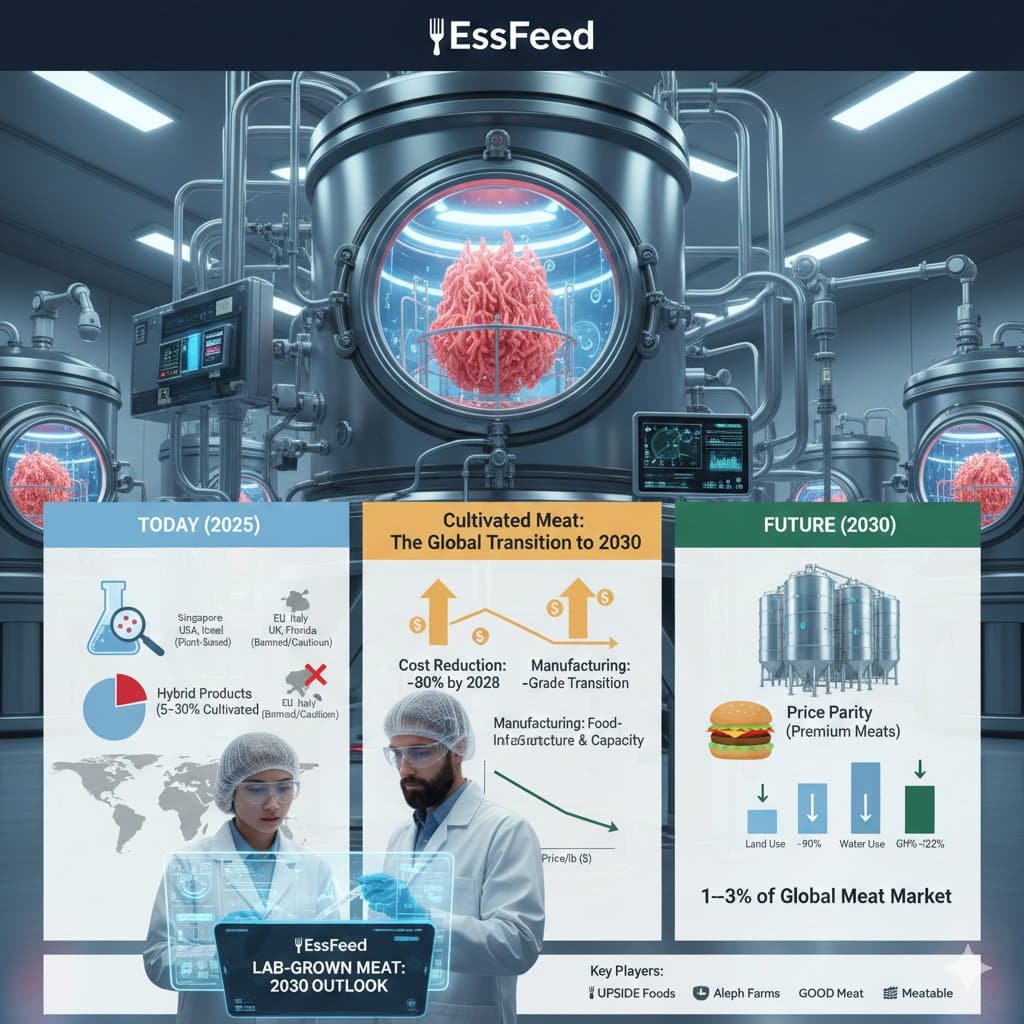
1. The 2025 Market Landscape: From “Pharma” to “Food”
In 2025, the industry’s primary challenge remains “The Scale-Up.” For years, cultivated meat was produced using pharmaceutical-grade processes, which kept prices astronomical. The 2024–2025 period has seen a decisive shift toward “Food-Grade” manufacturing.
The Rise of Hybrid Products
To solve the immediate issues of cost and texture, 2025 has become the year of The Hybrid. Most consumer-facing products currently are a blend of:
- 5%–30% Cultivated Cells: Providing the essential “meaty” flavor and fat profile.
- 70%–95% Plant-Based Scaffolding: Using pea, soy, or mycelium to provide structure and fiber at a lower cost.
Technical Breakthroughs: Media & Bioreactors
- Serum-Free Growth Media: The industry has almost entirely moved away from Fetal Bovine Serum (FBS). Companies like Mosa Meat and Meatable have developed proprietary plant-based or fermentation-derived growth factors, reducing media costs by up to 80%.
- Continuous Perfusion Bioreactors: Traditional “batch” processing is being replaced by continuous systems that recycle media and remove waste in real-time. This has increased cell density and output by nearly 10x compared to 2022 levels.
2. Global Regulatory Status: A Divided World
The regulatory environment in 2025 is a patchwork of “Innovation Hubs” and “Protectionist Zones.”
| Region | Status (As of Dec 2025) | Key Milestones |
| Singapore | Leading Hub | The first to approve cultivated meat in 2020. Now hosts over 10 approved companies. |
| United States | Expanding | FDA and USDA have cleared UPSIDE Foods, GOOD Meat, and Mission Barns. Florida and Alabama have implemented state-level bans. |
| Australia | Approved | Vow’s cultivated quail became the first Australian product to hit the market in 2025. |
| United Kingdom | Pioneering | Approved cultivated meat for pet food in mid-2025, a global first for the sector. |
| Israel | Beef Specialists | Aleph Farms received the world’s first approval for cultivated beef steaks in 2024. |
| European Union | Cautious | EFSA is reviewing several applications, but Italy has passed a formal ban to protect “traditional” agriculture. |
3. Key Players & Value Chain Leaders
The competitive landscape has matured. We are no longer looking at just “startups,” but industrial entities with significant backing from traditional meat giants (e.g., Tyson, JBS, Cargill).
- Aleph Farms (Israel): Known for whole-cut steaks. They focus on 3D bioprinting and tissue engineering.
- UPSIDE Foods (USA): A pioneer in cultivated poultry. Their “RUBY” facility is one of the world’s largest commercial plants.
- GOOD Meat (USA/Singapore): Currently holds the highest volume of retail sales globally.
- Meatable (Netherlands): Developed “Opti-Ox” technology, allowing them to grow a whole pork sausage in just 8 days.
- Wildtype (USA): The leader in cultivated seafood, specifically high-grade salmon for the sushi market.
- Vow (Australia): Strategically targets “exotic” and premium meats (quail, alpaca) rather than commodity beef.
- Mission Barns (USA): Specializes in cultivated pork fat, which is sold to plant-based companies to make their products taste more like real meat.
4. Environmental & Ethical Impact: 2025 Research
New life-cycle assessments (LCA) from 2025 provide a nuanced view of the “Green” claim:
- Land Use: Cultivated meat uses 90–99% less land than conventional beef.
- Water: Reductions of 80–90% in water usage are common in scaled facilities.
- Energy Debate: A 2025 UC Davis study noted that if facilities use non-renewable energy, the carbon footprint could be higher than conventional beef due to the energy required to heat bioreactors. However, when paired with renewable energy grids, the footprint drops by 92%.
5. Future Expectations & 2030 Outlook
- 2026–2027: The Premium Era. Cultivated meat will be a luxury item in Michelin-star restaurants and high-end pet foods.
- 2028: Price Parity. We expect cultivated chicken to match the price of “Organic/Free-Range” conventional chicken.
- 2030: Mainstream Grocery. Cultivated meat is projected to make up 1% to 3% of the global meat market, specifically in the ground meat and burger segments.
Frequently Asked Questions (FAQ)
Q: Is cultivated meat the same as plant-based meat (like Beyond/Impossible)? A: No. Plant-based meat is made from soy, peas, and oils. Cultivated meat is biologically identical to animal meat; it is grown from real animal cells in a controlled environment.
Q: Does it involve animal slaughter? A: No. A one-time, painless biopsy is taken from a living animal. Those cells are then immortalized and grown indefinitely in a bioreactor.
Q: Why is it called “Lab-Grown”? A: While the science starts in a lab, commercial production happens in large-scale cultivation facilities that look very similar to a modern beer brewery or yogurt factory.
Q: Will it replace traditional farming? A: Most industry analysts view it as a complementary source. With the global population reaching 8.5 billion by 2030, traditional farming cannot meet the protein demand alone.
Sources & Additional References
- GFI (Good Food Institute): State of the Industry: Cultivated Meat 2025
- ResearchGate: The Development of Lab-Grown Meat & Farming Revolution
- MDPI: Survey on Global Technological Status & Forecast 2025
- AZoCleantech: Is Lab-Grown Meat Better for the Environment? (2025 Analysis)
- Food & Nutrition Journal: Global Outlook on Meat Market & Alternatives (Dec 2025)
- McKinsey & Co: Cultivated Meat: A $25 Billion Global Industry by 2030?
Related: Top 20 Global Food & Beverage Companies: 2026 Edition
Related Analysis: View Previous Industry Report
