

When you think of Smithfield Foods, your mind may jump to the sprawling Tar Heel plant in North Carolina. But halfway across the world, China hosts an even more audacious vision of pork production — a vertical, high-rise facility capable of housing tens of thousands of hogs under one roof. Owned by WH Group, the global parent of Smithfield Foods, this facility represents a new era in industrial meat production. It’s not just a farm; it’s a city for pigs, a vertical empire reshaping how pork is raised, processed, and distributed in the world’s largest pork-consuming nation.
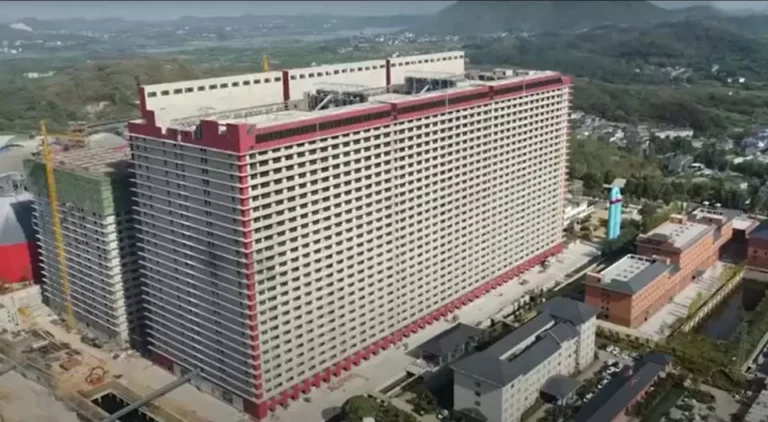
The sheer scale is almost hard to comprehend. Picture a multi-story building designed specifically for pigs, with automated systems managing feed, water, and waste, and specialized ventilation and temperature controls maintaining optimal conditions. Every aspect of the operation is tightly monitored, and every stage — from raising the hogs to processing, packaging, and distributing pork products — is vertically integrated. This is the industrial answer to feeding a country of over 1.4 billion people.
The benefits of such a facility are striking. By controlling the entire supply chain under one roof, WH Group can ensure consistent quality, improve efficiency, and maintain strict biosecurity measures that reduce disease risk. Pork produced here can reach consumers faster, costs can be managed more effectively, and the facility serves as a stabilizing force for China’s pork market. Partnerships with technology and e-commerce platforms, like JD.com, further streamline the distribution of fresh pork across cities, making industrial pork accessible to millions.
Yet, the facility also raises significant questions. For local farmers and smaller producers, these mega-operations create enormous competitive pressure, threatening livelihoods and accelerating consolidation in the industry. Environmental concerns loom large, too — from water consumption and waste management to greenhouse gas emissions. And with a foreign-linked multinational controlling major pork production in China, there are ongoing debates about food sovereignty and long-term domestic control of the country’s staple protein.
Inside the facility, the daily operation is a ballet of precision and scale. Automated feeders distribute nutrition to thousands of hogs simultaneously, robotic systems guide animals through processing lines, and human employees oversee quality control at every critical step. Each layer of the vertical farm is optimized for maximum efficiency, with technology and labor combining to manage one of the most complex pork operations on Earth.
The story of this vertical pork facility is a study in contrasts. On one hand, it demonstrates innovation, scale, and the ability to feed millions reliably. On the other hand, it highlights the challenges of industrialized food production — including environmental impact, consolidation, and foreign control.
Ultimately, WH Group’s vertical facility in China isn’t just a building; it’s a symbol of modern industrial agriculture — a place where vertical integration, advanced technology, and global ambition intersect. It shows how modern pork production is evolving, illustrating both the promise of efficiency and the questions that come with concentrating so much power in a single operation.
Next time you consider where your pork comes from, remember: some of it may have passed through this towering facility in China, where thousands of hogs live, grow, and begin their journey from farm to table under the watchful eyes of humans and machines alike. It’s a glimpse into the future of industrial meat — global, massive, and vertically ambitious.
Related:
Inside Smithfield Foods’ Tar Heel Plant — The World’s Largest Hog Factory
Smithfield Foods: Major Milestones and Acquisitions — A Complete History
📌 Sources Table
| Source | URL | What It Covers |
|---|---|---|
| NYT article on vertical pig farms in China | https://www.nytimes.com/2023/02/08/business/china-pork-farms.html | Details multi-story pig farms in China, trends in industrial pork production. |
| WH Group overview | https://en.wikipedia.org/wiki/WH_Group | Background on WH Group, global ownership, and operations including China. |
| WH Group & Smithfield strategic operations | https://www.globenewswire.com/news-release/2017/10/24/1152610/12889/en/WH-Group-s-Smithfield-Establishes-Strategic-Partnership-with-JD-com-for-Singles-Day-Fresh-Food-Sale.html | Collaboration for distribution and traceability in China. |
| Industry context on vertical integration | https://worldbenchmarkingalliance.org/publication/food-agriculture/2020/companies/wh-group/ | WH Group’s vertically integrated supply chain and production scale. |
| Pork market & supply chain in China | https://www.farmpolicynews.illinois.edu/2023/02/a-closer-look-at-chinas-pork-production-a-strategic-imperative/ | Analysis of China’s large-scale pork production, food security, and industrial farms. |
📚 Additional Resources
- WH Group Annual Reports & HKEX filings – financial and operational overview.
- Smithfield Foods Wikipedia – parent company background.
- China Daily coverage of industrial pork farms – market demand and production strategy.
- Provisioner Online on JD.com partnership – e-commerce integration and traceability.
- National Hog Farmer – tech and operational innovations in China’s pork industry.
❓ FAQ Section
Q1: What is a vertical pork farm?
A vertical pork farm is a multi-story facility that houses thousands of hogs under one roof, integrating feed, water, ventilation, and waste management in a stacked layout to maximize efficiency and biosecurity. (NYT)
Q2: Who owns the facility?
These large facilities are often owned or operated by WH Group, the parent company of Smithfield Foods, which controls significant pork production and processing in China. (Wikipedia)
Q3: What are the benefits of vertical integration in pork production?
- Consistent quality control from farm to finished product.
- Lower operational costs through economies of scale.
- Efficient distribution and traceability, reducing waste and disease risks.
- Stable supply for local and export markets. (GlobeNewswire)
Q4: What are the main concerns?
- Environmental impact: water use, waste, and emissions.
- Pressure on smaller local farms due to mega-facility dominance.
- Questions over foreign ownership in a staple food sector.
- Social and ethical concerns regarding industrial livestock farming. (Farmpolicynews)
Q5: How does technology factor in?
Automation, robotics, and monitoring systems ensure efficient feeding, health monitoring, processing, and traceability, blending human oversight with advanced industrial operations. (Provisioner Online)
Related Analysis: View Previous Industry Report
