

The global poultry industry in 2025 has evolved far beyond national production statistics. It is now a highly consolidated, vertically integrated sector, dominated by a handful of multinational corporations — often called “integrators” — that control the supply chain from genetics and feed to processing, cold-chain logistics, and retail-ready branded products.
This post presents a data-driven, visual analysis of the global poultry market, highlighting the largest integrators, market concentration, export flows, corporate strategies, and ESG performance. By combining tables, charts, and infographics, we aim to provide a comprehensive view of how the poultry industry operates on a global scale in 2025.
The Rise of Global Poultry Integrators
Global poultry production has shifted from a collection of national markets to a corporate-controlled ecosystem. The top integrators dominate the industry because they control multiple stages of the value chain, giving them economies of scale, supply stability, and market influence.
Key Drivers of Integration:
- Genetics Control: Companies like JBS and Tyson invest in proprietary or high-performance breeds such as Cobb and Aviagen to ensure consistent quality and growth rates.
- Feed Efficiency: Owning in-house feed mills protects these integrators from volatile grain prices, a major cost driver in poultry production.
- Processing Automation: AI-driven climate control, automated deboning, and robotic packing improve efficiency while reducing labor costs.
- Global Logistics: Proprietary cold-chain networks allow poultry processed in Brazil to reach markets in Japan or the Middle East in weeks.
- Brand Power: Moving from commodity meat to value-added products (marinated, ready-to-cook, and Halal-certified poultry) increases margins and market reach.
Infographic 1: Top 10 Global Poultry Integrators (2025)
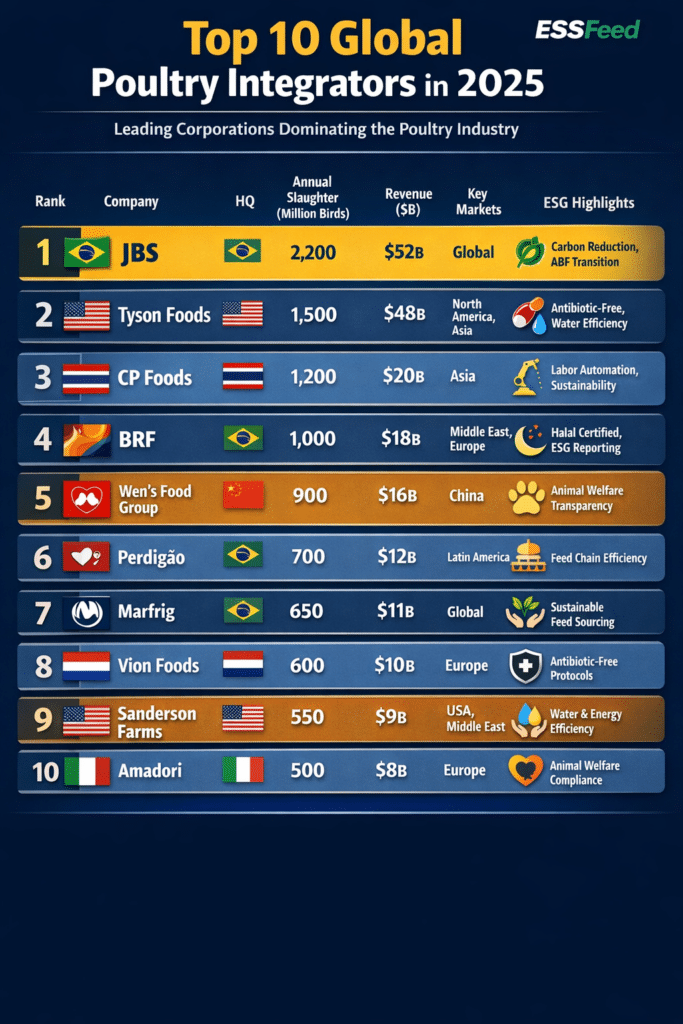
| Rank | Company | Headquarters | Annual Slaughter (million birds) | Revenue ($B) | Key Markets | ESG Highlights |
|---|---|---|---|---|---|---|
| 1 | JBS | Brazil | 2,200 | 52 | Global | Carbon reduction, ABF transition |
| 2 | Tyson Foods | USA | 1,500 | 48 | North America, Asia | Antibiotic-free, water efficiency |
| 3 | CP Foods | Thailand | 1,200 | 20 | Asia | Labor automation, sustainability |
| 4 | BRF | Brazil | 1,000 | 18 | Middle East, Europe | Halal certification, ESG reporting |
| 5 | Wen’s Food | China | 900 | 16 | Domestic China | Animal welfare transparency |
| 6 | Perdigão | Brazil | 700 | 12 | Latin America | Feed chain efficiency |
| 7 | Marfrig | Brazil | 650 | 11 | Global | Sustainable feed sourcing |
| 8 | Vion Foods | Netherlands | 600 | 10 | EU | Antibiotic-free protocols |
| 9 | Sanderson Farms | USA | 550 | 9 | USA, Middle East | Water and energy efficiency |
| 10 | Amadori | Italy | 500 | 8 | EU | Animal welfare compliance |
Insight: The top five integrators alone control over 50% of global poultry slaughter, demonstrating extreme market concentration and the growing influence of corporate integration over national production levels.
Global Poultry Market Concentration
While smaller producers still exist, the industry is dominated by mega-integrators who consolidate regional players through mergers and acquisitions (M&A).
- Top 5 companies: 51% market share
- Top 20 companies: 78% market share
- Others: 22%

Analysis: Consolidation allows integrators to stabilize prices, expand internationally, and control both commodity and branded product lines. It also raises barriers for new entrants in high-demand export markets.
Corporate Global Footprint
Leading poultry integrators operate like their own trade bureaus, exporting products globally rather than relying solely on national export data.

- JBS: Brazil, USA, Europe
- Tyson Foods: USA, Mexico, China
- CP Foods: Thailand, Malaysia, China
- BRF: Brazil, Middle East, Europe
- Wen’s Food Group: China
Observation: International trade now follows corporate infrastructure, not just geographic production, giving integrators an advantage in supply reliability and market diversification.
Trends Shaping the 2025 Poultry Industry
1. M&A and Expansion
Large players like JBS and Tyson continue acquiring regional companies to expand capacity and distribution. This consolidation strengthens their bargaining power with retailers and feed suppliers.
2. Automation & Technology
AI-controlled barns, automated deboning, and predictive logistics reduce costs, improve yield, and maintain product quality across markets.
3. ESG and Social License
Investors and retailers increasingly value ESG performance:
- Carbon emissions reduction: Measuring footprint across feed and transport
- Antibiotic-free production: Meeting consumer demand and regulatory requirements
- Animal welfare transparency: Increasing accountability in global supply chains
- Labor automation: Addressing workforce shortages while maintaining efficiency

Value-Added Products and Export Strategies
Leading integrators focus on ready-to-cook, branded, and Halal-certified products, especially in the Middle East and Asia. Dual-sourcing strategies allow them to maintain contracts even during trade disruptions, a competitive advantage over smaller producers.
Conclusion: The Future of Global Poultry in 2025
By 2025, the global poultry industry is defined less by countries and more by corporate scale. Mega-integrators dominate the supply chain, control global trade networks, and set the standard for ESG compliance and technological adoption.
Key takeaways:
- Vertical integration is the primary competitive advantage
- Market concentration favors a handful of global leaders
- ESG, automation, and value-added products increasingly drive growth
- The global poultry trade is corporate-led, not country-led
For analysts, investors, and industry professionals, understanding the corporate structure of poultry production is now essential to navigate global markets and emerging trends.
Related: Global Poultry Market Overview 2025: Production, Trade & Consumption (Visual Data)
🌐 Authoritative Sources
Market Size, Growth & Industry Trends
- Global poultry meat market size and production data — covers annual production, growth, and regional trends. Poultry Meat Market Size & Opportunities Report 2035 (includes market growth and major producers)
- Global poultry production and top producer data — shows global production volumes and leading companies. Global Poultry Production Report 2020‑2024 (shows production by country and top company producers)
- 2025 industry outlook with regional breakdown and corporate trends (vertical integration, automation adoption, value‑added growth). Global Poultry Industry Report 2025: Trends & Future Outlook
- Poultry market size and share projections, including concentration (industry structure & leading players). Poultry Market Size & Share Report 2025 Base Year 2025‑2032
Sustainability & ESG Data
- Sustainability practices and statistics in poultry production (environmental footprint, certifications, animal welfare improvements). Sustainability in the Poultry Industry Statistics (ZipDo Education Report 2025)
- Animal welfare and broader poultry sustainability data (carbon footprint, water use, antibiotics trends). Poultry Industry Sustainability & Welfare Statistics 2025
Recent Industry News (2025–2026)
- JBS expanding poultry capacity and exports — new production plant in Saudi Arabia.
- JBS acquiring processing capacity in Paraguay — corporate expansion and regional diversification.
- BRF navigating bird flu disruptions and export resilience — export challenges and adaptation.
- Tyson Foods 2025 sales forecast on poultry demand growth — industry performance signal.
❓ FAQ
Q1: What defines a poultry integrator?
A poultry integrator is a company that controls multiple stages of the poultry value chain — from genetics and hatcheries to feed production, processing, logistics, and distribution. Integration improves efficiency and reduces dependency on external suppliers.
Q2: Who are the largest poultry companies in the world?
Leading poultry integrators globally include JBS, Tyson Foods, BRF, CP Foods, and Wen’s Food Group. These companies operate complex, multinational processing and distribution networks.
Q3: How big is the global poultry market?
The global poultry meat market size is projected at over $352 billion in 2025, with growth expected through the 2030s driven by urbanization, demand for affordable protein, and value‑added products.
Q4: What are major trends in poultry sustainability?
Key sustainability trends in poultry production include reduced antibiotic use, increased cage‑free systems, carbon footprint reduction, water efficiency improvements, and broader adoption of sustainable certifications.
Q5: How has automation impacted poultry production?
Automation — including AI‑controlled barns, robotic deboning, and predictive logistics — is improving yield, reducing labor costs, and increasing data transparency across poultry operations.
