

The global food and beverage supply chain faces an unprecedented intersection of kinetic military action and economic coercion as the standoff between the United States and the administration of Nicolás Maduro in Venezuela intensifies in early 2026. For food and beverage professionals, the implications of this conflict transcend regional politics, fundamentally altering raw material sourcing, global logistics, and the pricing of essential commodities. The current landscape is defined by “Operation Southern Spear,” a U.S.-led campaign that has transitioned from traditional diplomatic pressure to a “total and complete blockade” of sanctioned maritime assets, creating a ripple effect that touches every node of the Caribbean and Western Hemisphere trade networks.
The New Paradigm of Supply Chain Warfare in the Southern Caribbean
As of January 2026, the strategic framework of the U.S. approach toward Venezuela has been redefined under a national security lens, specifically targeting what the Trump administration characterizes as a “narco-terrorist regime”. The legal foundation for this escalation was established earlier in 2025 with the designation of the Venezuelan-based criminal organization Tren de Aragua as a Foreign Terrorist Organization (FTO), which provided the necessary executive authority to expand military operations from simple interdictions to targeted strikes on coastal infrastructure.
The physical reality on the water involves a massive naval presence, including the USS Gerald R. Ford carrier strike group and over 15,000 U.S. personnel deployed to the region. This military buildup facilitates a “quarantine” of Venezuelan oil, but the secondary effects on commercial shipping are profound. Food and beverage professionals must recognize that while humanitarian exemptions for food and medicine remain technically in place, the operational environment has become so hostile that many commercial carriers are treating the entire southern Caribbean as a high-risk exclusion zone.
The escalation of maritime-to-land strikes, exemplified by the late December 2025 drone attack on a coastal dock tied to the Tren de Aragua, signals a willingness to disrupt physical loading infrastructure. For F&B supply chains, this introduces the risk of “collateral infrastructure damage,” where legitimate agricultural loading docks located in proximity to sanctioned facilities may be rendered inoperable or uninsurable.
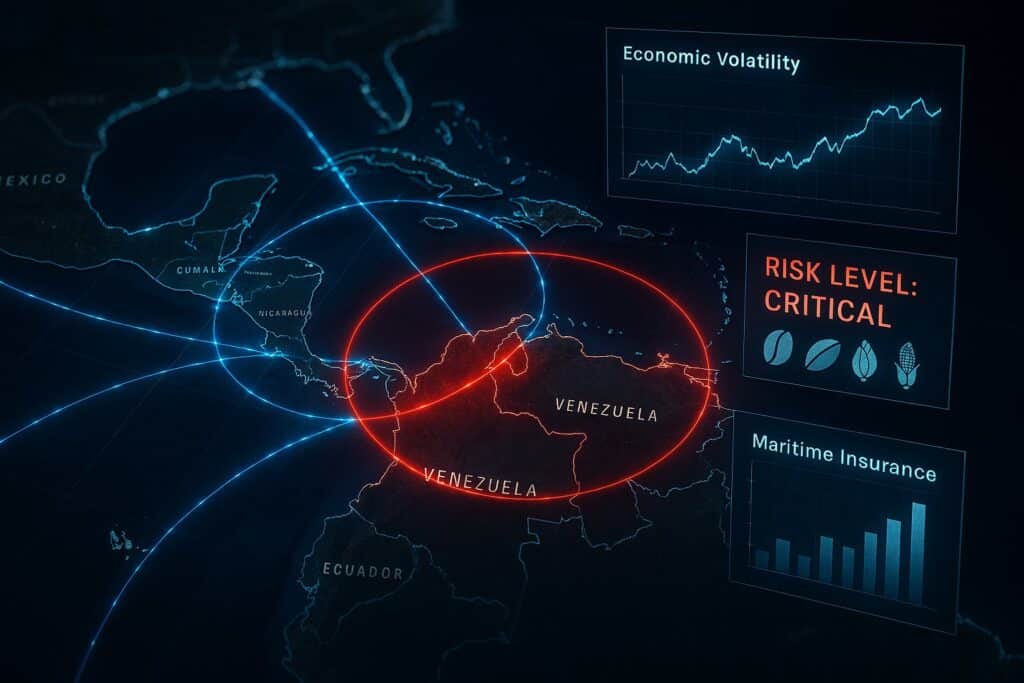
Strategic Interdiction: The 2026 U.S. Naval Blockade and Its Logistical Ripple Effects
The U.S. naval blockade represents the most significant disruption to Caribbean logistics in decades. By targeting the “shadow fleet”—older, opaquely owned tankers used by Maduro to export oil to Asian markets—the U.S. Treasury and Southern Command have effectively created a bottleneck in one of the world’s most critical maritime corridors.
The Surge in Maritime Insurance and Freight Costs
The most immediate consequence for food and beverage professionals is the dramatic increase in transport and logistics costs. The implementation of the blockade has pushed maritime insurance premiums to “skyrocket,” as the risk of vessel seizure or kinetic engagement becomes a tangible floor for market pricing. Even for companies not directly sourcing from Venezuela, the generalized “geopolitical risk premium” affects all cargo transiting the Caribbean Basin, a region that serves as a strategic route for trade between South America, the United States, and Canada.
Shipping lines are increasingly reassessing their exposure to sanctioned routes. Vessels that have called at Venezuelan ports face intense scrutiny and potential secondary sanctions, leading some operators to withdraw their tonnage from the southern Caribbean altogether. This reduction in available capacity has pushed freight rates higher and forced a redirection of cargo through regional transshipment hubs like Panama and Colombia, which are now facing increased congestion and hinterland transport pressure.
The Collapse of Aviation Links and Crew Logistics
A secondary but critical logistical failure is the virtual standstill of international flight connections to and from Venezuela. Following safety warnings from the FAA, major airlines have suspended routes through early 2026. This has a direct impact on the F&B supply chain by making regular crew changes and the repatriation of maritime personnel “extremely difficult”. For specialized F&B logistics—such as the transport of temperature-sensitive seafood or high-value spirits—the lack of reliable air freight options removes a vital contingency layer for high-priority shipments.
The Agro-Industrial Paradox: Navigating Venezuela’s Resilient Specialty Exports
Despite the tightening noose of sanctions and military pressure, a counter-intuitive trend has emerged within Venezuela’s domestic economy: a resilient and explosive growth in certain agricultural and agro-industrial sectors. F&B professionals are faced with a paradox where some of the world’s most sought-after raw materials are being produced in record quantities in a nation that is increasingly isolated from the global financial system.
The Renaissance of Venezuelan Specialty Coffee
The Venezuelan coffee industry has demonstrated remarkable growth, with the 2025-2026 harvest declared the largest in the nation’s history. National coffee production grew by an estimated 55% in 2025, with 250,000 hectares currently under cultivation. More importantly for global F&B buyers, the quality of these specialty lots has reached international “presidential rate” standards, with multiple lots surpassing 90 points in recent evaluations.
However, the “export orphan” risk is high. While the Maduro administration touts this growth as a victory over “imperialist illegality,” the actual mechanics of getting this coffee to markets in Europe and the United States are fraught with peril. F&B professionals sourcing these beans must navigate complex “debt-for-product” swaps or rely on third-country transshipments, both of which invite scrutiny from the U.S. Treasury’s Office of Foreign Assets Control (OFAC).
Cocoa and the Re-entry into Value-Added Chains
Similarly, the Venezuelan cocoa sector has posted triple and quadruple-digit growth figures in 2025. Cocoa beans saw a year-on-year export growth of 14,286%, albeit from a low base, while cocoa preparations and butter exports doubled. This signals Venezuela’s re-entry into the value-added segment of the global cocoa supply chain. For artisanal chocolate makers and large-scale confectioners, the purity of Venezuelan cocoa varieties (such as Chuao and Porcelana) remains a critical competitive advantage, but the blockade on Venezuelan ports means these materials may be diverted to non-sanctioning markets like Türkiye or China, potentially cutting off Western F&B firms from high-quality inputs.
Seafood: The New Engine of Non-Oil Exports
Seafood has emerged as Venezuela’s largest non-oil export sector, with the country now ranked as the world’s tenth-largest shrimp exporter. The purity of Venezuelan coastal waters has allowed for the consolidation of trade agreements with China, positioning Venezuela as one of only 15 countries permitted to export specific species to the Chinese market.
- Prepared Crab: Venezuela maintains a 9.5% share of the U.S. import market for prepared crab, with an export value reaching $44 million in 2025.
- Fresh Bigeye Tuna: This category showed a rapid short-term market share growth of 725% year-on-year.
- Shrimp and Jellyfish: Exports primarily serve European markets like Spain and France, with new expansions into Asian markets under recently signed trade agreements.
For F&B professionals, the risk in the seafood sector is twofold: the physical perishability of the product during maritime delays caused by U.S. Navy boardings, and the potential for these “clean” agricultural exports to be co-mingled with “dirty” sanctioned cargoes in shared logistical networks.
The High Stakes of Essential Commodity Inflows: U.S. Grains and Regional Protein Security
While the world watches Venezuela’s exports, the country’s domestic food security remains precariously balanced on a massive inflow of agricultural commodities, much of which originates in the United States. This “asymmetric dependency” creates a unique vulnerability for the Venezuelan protein sector, specifically poultry and eggs, which rely almost entirely on imported feed.
The Role of U.S. Soy and Corn
The United States remains the second-largest exporter of agricultural products to Venezuela, with a 26% market share as of 2025. In 2024, U.S. agricultural exports reached $800 million, the highest level in a decade. This trade is dominated by soybean meal, corn, and wheat, which are the fundamental inputs for the Venezuelan animal feed industry.
| U.S. Agricultural Exports to Venezuela (2024) | Total Value (USD) | 10-Year Growth Rate |
| Soybean Meal | $271.13 Million | 21% |
| Corn | $123.86 Million | 33% |
| Rice | $90.86 Million | 67% |
| Wheat | $70.42 Million | N/A |
The Venezuelan poultry industry, which accounts for 70% of animal feed consumption, is particularly exposed to the current maritime blockade. Post forecasts indicate that Venezuela will require 1.26 million metric tons (MMT) of yellow corn for the 2025/2026 market year to support a projected 5% growth in poultry and egg production. However, domestic corn production is expected to decline by 14% due to limited seed availability and rising fuel costs, making the “sea bridge” for U.S. corn a single point of failure for the nation’s food supply.
The Fertilizer Crisis and Regional Yield Contraction
A critical but often overlooked aspect of the conflict is the disruption of the regional fertilizer supply chain. Monomeros Colombo Venezolanos, once a dominant force in South American fertilizer production, is currently a pawn in the political standoff between the Maduro government and the opposition. For F&B professionals, the regional scarcity of fertilizers, combined with a global 15% price increase in late 2025, represents a significant threat to 2026 crop yields.
The “fertilizer affordability index” has matched its lowest point in 15 years, signaling a tough year ahead for global demand and a potential decline in use that will eventually manifest as lower crop yields and higher raw material prices for F&B manufacturers. In Venezuela specifically, severe flooding in the primary corn-producing state of Portuguesa has already eroded soil and destroyed crops, making the need for fertilizers even more acute.
Macroeconomic Collapse and the Return of Hyperinflation: Financial Risk Mitigation for F&B Professionals
The U.S.-Venezuela conflict is not just a military or logistical challenge; it is a financial catastrophe for companies operating within the Bolívar-denominated economy. After a period of relative stability in 2024, the “downward trend” of inflation has reversed, with catastrophic projections for 2026.
The Hyperinflationary Spiral
The International Monetary Fund (IMF) and other economic analysts project that Venezuelan inflation will surge to 682% in 2026. This is a direct consequence of the “total blockade” on oil revenues, which has depleted the government’s foreign currency reserves and led to a rapid depreciation of the Venezuelan Digital Bolívar (VED). For F&B professionals, this creates a “dollarization mismatch” that can destroy margins overnight.
Agricultural producers receive payment for their harvests in bolívars, but their input costs (seeds, fertilizers, parts) remain strictly dollarized. This creates a disincentive for domestic production and encourages the “hoarding” of inventory, further straining the availability of raw materials for F&B processors.
The “Savior Mentality” and Regional Displacement
The worsening humanitarian conditions in Venezuela are creating a regional spillover effect that F&B professionals must account for in their labor and market strategies. As the lack of fuel brings internal economies to a halt and drives up the cost of basic goods, millions are being pushed into food insecurity.
This humanitarian spillover creates a “resource curse” in neighboring Caribbean islands, where the influx of refugees and high-net-worth oil contractors widens the wealth gap and increases social tensions. For F&B retailers in the Caribbean, this means a shift in demand patterns, with a growing “stressed” consumer base that is increasingly focused on basic staples rather than discretionary food products.
Building a Resilient F&B Supply Chain: Technological and Strategic Solutions for 2026
In an environment where “disruption is no longer an excuse, it’s the norm,” food and beverage professionals are turning to advanced technologies to insulate their supply chains from geopolitical volatility. The successful F&B company of 2026 is one that replaces “reaction” with “anticipation”.
AI-Driven Demand Forecasting and Digital Twins
Approximately 35% of food and beverage leaders now cite inventory optimization as a top use case for Generative AI. When uncertainty in the Caribbean is the standard, brands are differentiating themselves by unifying their planning under AI-driven demand forecasts that can sense disruptions before they cascade downstream.
- S&OP Automation: Sales and Operations Planning is no longer a monthly manual exercise but an automated, real-time function that adjusts to maritime delays and raw material shortages.
- Digital Twins: Virtual models of the entire supply chain allow manufacturers to run “war game” simulations. For example, a digital twin can model the impact of a total closure of the Port of La Guaira on a company’s cocoa liquor supply, allowing them to pivot to a West African supplier weeks before a physical shortage occurs.
- InventoryAI+: Specialized tools are being deployed to manage multi-echelon inventory optimization (MEIO), ensuring that safety stocks are strategically placed to bypass the Caribbean “choke points”.
Diversification of Sourcing and Reshoring
The “single-supplier, single-region” model has become a fatal vulnerability in 2026. F&B leaders are actively seeking alternative suppliers across different regions to maintain volume and control costs. This is particularly evident in the “natural food dye” transition, a major 2026 trend where the shorter shelf-life of natural inputs requires a more agile and localized sourcing strategy.
Furthermore, the “multiplier effect” of reshoring manufacturing in critical industries is gaining traction. For every $1 spent on domestic manufacturing, $2.69 is converted into the broader economy, providing a strategic incentive for F&B firms to shorten their supply lines and reduce their exposure to maritime interdictions in the Caribbean.
The Role of ESG and Traceability
As the World Customs Organization (WCO) predicts increased digital customs practices and document interoperability by 2026, the need for technological systems that ensure consistency between shipments and compliance becomes non-negotiable. F&B professionals must prepare for a “greater data rigor,” where errors in traceability or a lack of clarity in sourcing (e.g., suspected co-mingling with sanctioned Venezuelan goods) will be penalized with “demurrage, fines, or customs detentions”.
Strategic Imperatives for F&B Professionals in the 2026 Conflict Zone
The conflict between the United States and Venezuela is not a transient political event but a structural shift in the global F&B landscape. The 2026 “wild ride” is marked by a “total and complete blockade” that is redrawing the geography of maritime trade and creating a new set of winners and losers in the energy and agricultural sectors.
Key Takeaways for the Industry
- Anticipate the “Venezuela Premium” in Logistics: Food and beverage professionals must build a “geopolitical risk floor” into their 2026 budgets. This includes accounting for “skyrocketing” maritime insurance premiums and the extended voyage times required for compliant Caribbean transit.
- Hedge Against Specialty Raw Material Scarcity: While Venezuela’s cocoa and coffee sectors are producing at record levels, the blockade makes extraction a high-risk endeavor. Professionals should explore alternative sourcing in Brazil, Colombia, or Central America to mitigate the risk of being “orphaned” by a total maritime closure.
- Monitor the “Sea Bridge” for U.S. Grains: The stability of the Venezuelan protein sector is entirely dependent on the continued flow of U.S. corn, soy, and wheat. Any disruption to this flow will not only collapse the Venezuelan poultry market but will trigger a massive humanitarian displacement that will destabilize the regional labor and consumer markets in the Caribbean.
- Embrace Technological Adaptability: In an environment of constant shocks, the most resilient supply chains will be those that can “reconfigure in real time”. This involves moving away from “redundancy” (overstocking) and toward “adaptability” (re-routing and re-prioritizing) enabled by AI and digital twin simulations.
- Prepare for a High-Compliance Customs Environment: As the U.S. Treasury steps up its pressure on the “shadow fleet” and its facilitators, F&B firms must standardize enhanced due diligence and cargo screening. The risk of “sanctions contagion”—where a legitimate F&B shipment is caught up in a maritime seizure—is now a standard operational risk that requires legal and technological oversight.
Conclusion: Strategic Vision in a Volatile Global Market
As of January 2026, the relationship between logistics efficiency, geopolitical risk, and profitability has become more direct than at any point in the post-globalization era. The U.S.-Venezuela standoff serves as a crucible for the modern food and beverage supply chain, testing the ability of leaders to integrate data intelligence with strategic vision. Organizations that can proactively sense these disruptions, diversify their sourcing, and leverage the “1 billion dollar advantage” of AI in manufacturing will be better positioned to protect their margins and grow sustainably in a world where “Goldilocks” conditions are a distant memory.
The southern Caribbean is no longer just a “zone of peace” but a theatre of “profound structural transformation” where the cost of bread, coffee, and poultry is dictated as much by carrier strike groups as by crop yields. For the food and beverage professional, the mandate for 2026 is clear: adapt to the “new baseline” of disruption or risk becoming a casualty of a conflict that shows no signs of de-escalation.
Research Sources & URLs
Additional Professional References
- Regional Stability & Human Rights: The Global Humanitarian Overview 2026 provides critical data on the 7.9 million people in need of assistance within Venezuela, which serves as a baseline for understanding potential labor migration and consumer market shifts in the neighboring Caribbean islands.
- Agricultural Health Standards: The Caribbean Agricultural Health and Food Safety Agency (CAHFSA) and the Caribbean Public Health Agency (CARPHA) continue to monitor regional food safety initiatives. These are essential for professionals ensuring that “clean” agricultural goods are not delayed by new maritime health and safety inspections triggered by the conflict.
- Technological Resilience: For deep dives into AI implementation, the report “AI in Food Manufacturing: What Top Performers Are Doing Differently” outlines the implementation of digital twins and autonomous operations to bypass logistical bottlenecks.
- Maritime Risk Assessment: The World Customs Organization (WCO) projections for 2026 highlight increased digital customs practices and document interoperability, which are critical for mitigating the risk of fines and detentions during Caribbean transit.
Frequently Asked Questions (FAQ)
Q: How will the conflict directly affect global food prices in 2026? A: The primary driver of food inflation will be the “geopolitical risk premium” added to maritime logistics. Increased insurance premiums for Caribbean transit and the rising cost of diesel (fueled by the blockade of Venezuelan heavy-sour crude) are expected to push global food prices higher.
Q: Is there a specific risk to the availability of fertilizers? A: Yes. The conflict threatens regional ammonia infrastructure, particularly the Point Lisas complex in Trinidad and Tobago. A disruption there could trigger a localized fertilizer shortage, impacting crop yields and raw material costs across the Americas.
Q: Can F&B professionals still source specialty cocoa and coffee from Venezuela? A: While Venezuelan production of coffee and cocoa grew significantly in 2025, the 2026 blockade makes these “export orphans.” Professionals should expect irregular cargo flows and may need to seek alternative specialty suppliers in Colombia or Brazil to ensure continuity.
Q: Are humanitarian food shipments exempt from the U.S. naval blockade? A: Technically, humanitarian exemptions remain in place. However, the operational reality of the “total and complete blockade” and kinetic strikes on coastal infrastructure mean many carriers now avoid the region entirely due to safety and insurance concerns.
Q: What is the projected inflation rate for the Venezuelan economy in 2026? A: The International Monetary Fund (IMF) and other economic analysts project that Venezuelan inflation will surge to 682% in 2026 as the oil revenue blockade depletes foreign currency reserves.
Related Analysis: View Previous Industry Report
