

The global shipping industry has just flashed a major warning light, and for businesses relying on international logistics, the message is stark: the costs of importing goods are skyrocketing, and the window for action is rapidly closing.
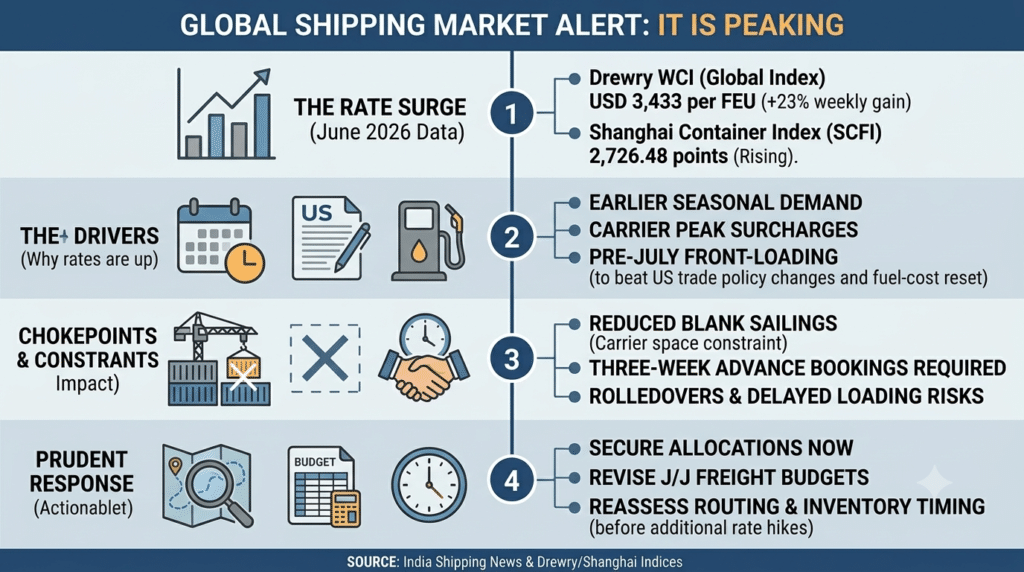
New data from the Drewry World Container Index (WCI) shows a staggering 23% weekly surge in global freight rates as of June 4, 2026, pushing costs to an 18-month high of USD 3,433 per FEU. Simultaneously, the Shanghai Containerized Freight Index (SCFI) is mirroring this sharp upward trajectory. For shippers and supply chain managers, this isn’t just a temporary fluctuation—it is a clear sign of extreme volatility.
Why is this happening?
We are witnessing a “perfect storm” of three converging pressures:
- Front-loading in panic: Shippers are aggressively pulling cargo forward. They are rushing to beat potential U.S. trade-policy changes in July and attempting to avoid the impact of a looming July 1st fuel-cost reset.
- Aggressive Carrier Tactics: Carriers have successfully executed a cycle of General Rate Increases (GRI) and peak season surcharges. They are capitalizing on demand to push rates up by as much as USD 1,000–1,800 per FEU on key routes.
- Capacity Squeezes: Carriers are not anticipating a short-term spike; they are planning for sustained volume. Reduced blank-sailing announcements and tightened space are already forcing forwarders to advise clients to book as much as three weeks in advance.
The “New Reality” for Shippers
The golden era of booking at the last minute is over. The practical implications of this current environment are brutal: businesses now face significantly higher freight expenditures, a complete loss of booking flexibility, and a mounting risk of cargo rollovers or delayed loading.
If you are currently waiting for mid-summer to normalize your inventory, you are likely already behind.
How to Respond
The most prudent course of action for logistics professionals right now is a total re-evaluation of the near-term strategy:
- Secure Allocations Now: Do not wait until the last minute. If you haven’t secured space, you may be left out entirely.
- Budget for Reality: Immediately revise June and July freight budgets to account for the current surcharge cycles and further potential increases.
- Audit Routing and Timing: If your inventory isn’t already in motion, reassess your routing options and lead times before the next wave of pricing increases hits the market.
Market sentiment suggests these elevated rates are here to stay until late summer demand tapers off or geopolitical uncertainty subsides. Until then, the shipping industry is in a state of high alert, and “business as usual” is no longer an option.
Are you currently seeing these freight rate increases impacting your own supply chain costs, or are you managing to navigate the volatility with existing contracts?

