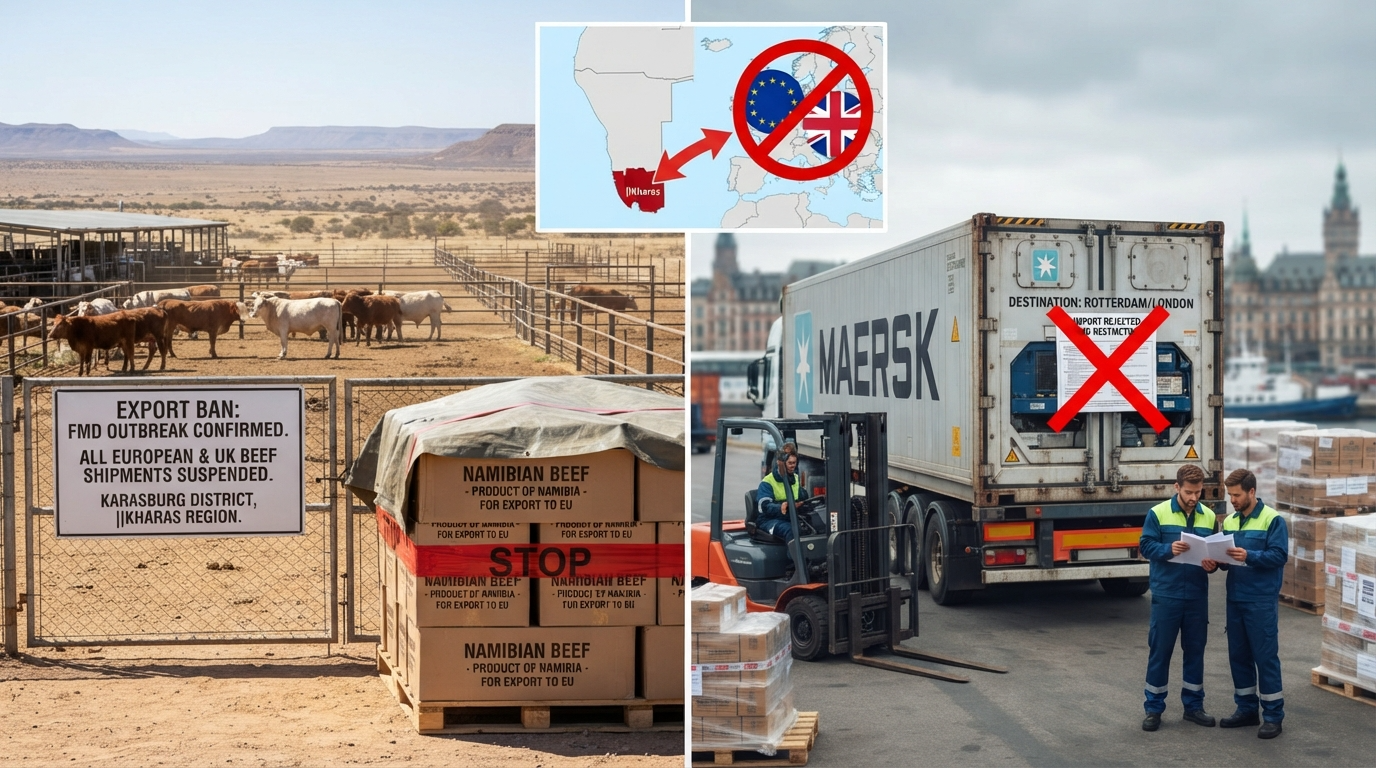

Namibia beef exports to Europe are on hold after foot-and-mouth disease reached its southern free zone, shutting its most valuable markets.
For decades, Namibia’s southern cattle region has been one of Africa’s few sources of FMD-free beef. That status gave it access to Europe’s strict premium markets. In late September, it was lost. Foot-and-mouth disease was confirmed on a commercial farm in the Karasburg district of the ||Kharas region, inside the country’s officially recognised FMD-free zone. It is the first outbreak in that southern region since 1964, and European markets are now closing.
How the Outbreak Unfolded
Routine surveillance on 22 September found 63 cattle showing clinical signs of FMD. Samples from 11 animals were sent for testing, and 10 came back positive the next day. Namibia’s veterinary services activated the national contingency plan. They halted nationwide movement, marketing and slaughter of cloven-hoofed animals and suspended imports, exports and transit of those animals and their raw products.
State processor Meatco paused beef exports in line with the measures. It is still working to establish what will happen to consignments that were exported or already at sea before the outbreak was confirmed. The government is also investigating reports that a shipment was sent back from Europe and is consulting EU partners about where the meat originated.
Europe Closes Its Doors
The United Kingdom has published safeguard declarations that suspend imports of fresh meat from FMD-susceptible species from Namibia, regardless of production or certification date. Shipments of casings and untreated wool and hair from Namibia are also restricted. EU restrictions on Namibian meat imports have been reported this week, which follows standard European practice when FMD appears in a supplying zone.
For Namibia, this hits its most important customers. The country exported more than 13,000 tonnes of beef in 2025, and over 90% of it went to Europe. Local analysts estimate that European, British and Norwegian markets make up roughly 60% of Namibia’s beef export earnings. These are also the markets with the strictest sanitary rules, so they were always going to close first.
A Regional Pattern, Not an Isolated Case
Namibia is not alone. Foot-and-mouth disease has spread across Southern Africa this year, with outbreaks reported in South Africa, Botswana, Zimbabwe, Zambia, Mozambique and Lesotho. Namibia had already blocked imports from affected neighbours to protect its own status. The southern outbreak shows how hard the disease is to contain once it is moving across a region with shared borders and wildlife corridors.
Recovering FMD-free status is a long process. Under international animal health rules, a country or zone has to show a disease-free period before trading partners restore full access. That usually takes months, not weeks, and depends on surveillance results and whether vaccination is used.
What It Means for European Beef Buyers
Namibian grass-fed beef has filled a niche in European retail and foodservice: traceable, pasture-raised and available on a counter-seasonal basis. With that supply suspended, several points follow:
- Southern African grass-fed supply has tightened. With several neighbouring countries also affected by FMD, there are few like-for-like regional replacements.
- Buyers may look to other origins. South American and Oceania suppliers are the established alternatives for grass-fed and chilled beef in Europe, at different price points and specifications.
- Consignments in transit remain uncertain. Importers with Namibian product at sea should expect delays while authorities assess origin and certification.
- Reopening timelines are unknown. Any return to European markets depends on Namibia’s containment results and formal recognition by trading partners.
Frequently Asked Questions
Why has Europe stopped importing Namibian beef?
Foot-and-mouth disease was confirmed in Namibia’s southern FMD-free zone in late September 2026. European and UK rules restrict fresh meat imports from areas affected by FMD to protect their own livestock.
How important is Europe to Namibia’s beef industry?
Very important. More than 90% of Namibia’s roughly 13,000 tonnes of 2025 beef exports went to Europe, and analysts estimate Europe, the UK and Norway account for about 60% of beef export earnings.
When could Namibian beef exports to Europe resume?
No date has been set. Resumption depends on Namibia containing the outbreak, completing surveillance, and regaining recognition from trading partners, which typically takes months.
Sources
| Source | Used for |
|---|---|
| Xinhua (via The Star) | Outbreak timeline, case and test numbers, contingency measures |
| The Namibian | Meatco export pause, in-transit consignments, analyst estimate of European market share |
| AFP (via Ver Angola) | 2025 export volume, share going to Europe, first southern outbreak since 1964, regional spread |
| UK Government (APHA OVS note) | UK safeguard declarations suspending imports |
| Africanews / RFI / Anadolu | Reported EU restrictions on Namibian meat imports |
Additional Resources
| Resource | What you’ll find |
|---|---|
| World Organisation for Animal Health (WOAH) – WAHIS | Official FMD outbreak notifications and disease status |
| Meat Board of Namibia | Namibian livestock and meat export statistics |
| European Commission – Animal Health and Import Conditions | EU rules for meat imports from third countries |
| UK APHA – Import information notes | UK import restrictions and safeguard measures |
| FAO – EuFMD (European Commission for the Control of FMD) | Regional FMD situation reports and control guidance |
Data note: the share of export earnings tied to Europe is an analyst estimate, not an official figure. EU restrictions are cited as reported by news outlets; the UK suspension is confirmed by official publication.