
DOJ expands beef pricing investigation to eight major retailers including Walmart, Costco, and Amazon. Ground beef represents 30–35% of retail beef sales; procurement teams should diversify sourcing now.
Executive Summary
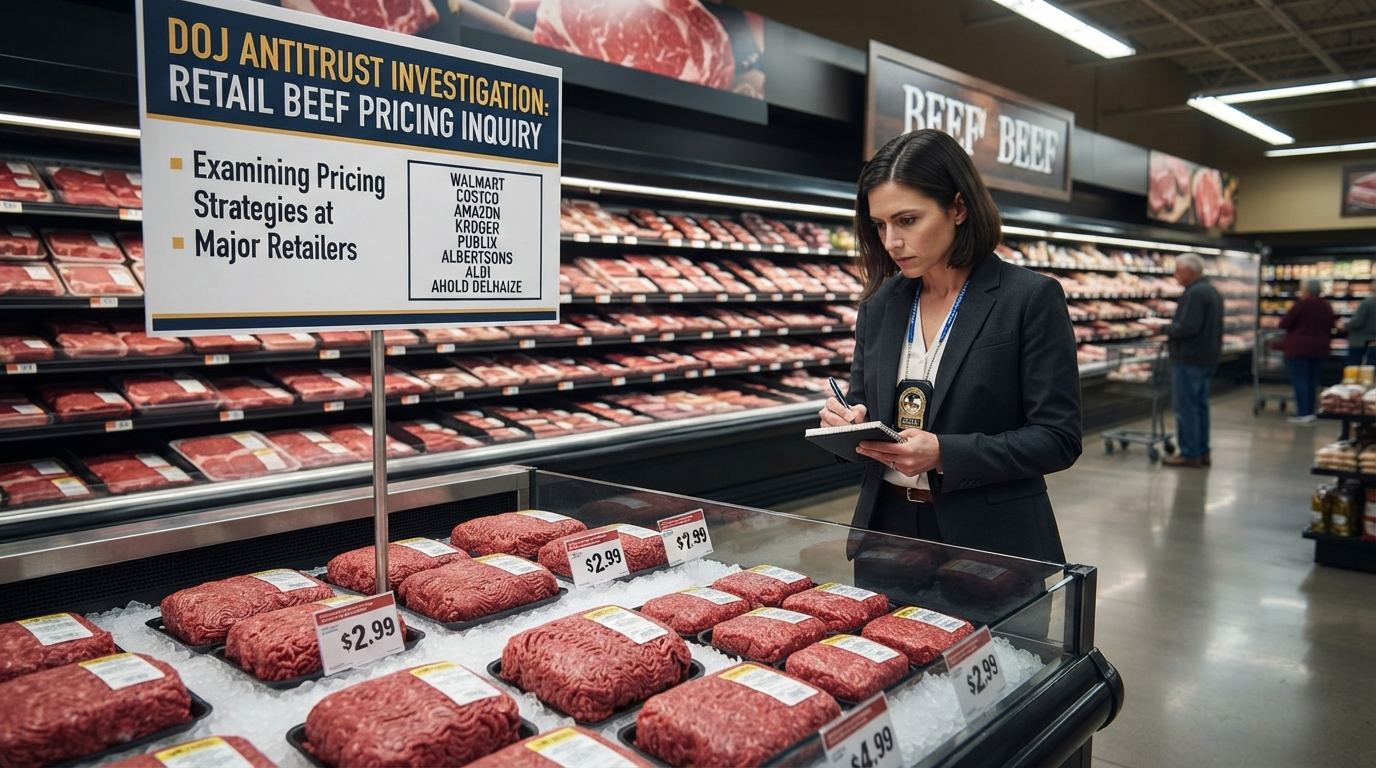
The Department of Justice has escalated its antitrust probe to include eight major grocery chains: Walmart, Costco, Amazon, Kroger, Publix, Albertsons, Aldi, and Ahold Delhaize, alongside existing meatpacker investigations. This expansion signals a critical shift in enforcement focus from processor-level activities to retail-level beef pricing strategies—affecting how procurement teams negotiate, source, and manage ground beef contracts.
What This Expansion Means for Beef Pricing
The DOJ’s investigation now covers the entire beef supply chain value stack. Previously, enforcement scrutiny concentrated on meatpacker conduct—how companies like Tyson Foods, Cargill, JBS, and National Beef Packing coordinate pricing. Now, regulators are examining whether major retailers use market power to suppress wholesale beef prices or manipulate consumer-facing ground beef pricing in ways that harm competition.
Ground beef accounts for 30–35% of total retail beef sales volume, making it the focal point for potential enforcement action. This category dominates consumer purchases, drives traffic to grocery stores, and represents a measurable cost control lever for retail chains. The DOJ’s targeting of this segment signals high-confidence antitrust concern—and possible remedial action.
Potential Outcomes: Consent Decrees and Procurement Disruption
If the DOJ pursues consent decrees against one or more of the eight retailers, several procurement scenarios emerge:
1. Pricing Transparency Requirements
Retailers may be forced to adopt third-party price-reporting mechanisms or publish wholesale-to-retail margin thresholds. This reduces retailer discretion in ground beef negotiations and increases predictability for suppliers—but also constrains margin flexibility for procurement teams.
2. Forced Sourcing Diversification
Consent orders may mandate minimum sourcing from independent meatpackers or regional processors, reducing reliance on the “Big Four” packers (Tyson, Cargill, JBS, National). Procurement teams must identify and vet alternative suppliers now.
3. Most Favored Nation (MFN) Pricing Caps
Regulators might prohibit retailers from negotiating better prices with certain packers while charging others premium rates for identical product. This flattens negotiation leverage but increases cost predictability.
4. Inventory and Promotion Restrictions
Consent orders could limit how aggressively retailers use ground beef as a loss-leader or promotional item, which would stabilize retail pricing but reduce procurement volume volatility.
Procurement Volatility Hedging Strategy
Given regulatory uncertainty, procurement leaders should act now:
Immediate Actions (0–30 days)
- Map ground beef sourcing concentration: Identify percentage of volume sourced from each packer and retailer relationship. Flag >40% dependence on any single packer.
- Audit wholesale price benchmarks: Document current pricing relative to USDA reporting and private indices (Steiner Consulting, Cattlemen’s Beef Board data).
- Identify secondary suppliers: Establish relationships with regional and independent meatpackers; request preliminary quotes at 5%, 10%, and 20% volume scenarios.
Medium-Term Mitigation (30–90 days)
- Diversify ground beef sourcing: Target 30/30/30/10 allocation across the Big Four (or their replacements), with 10% reserved for regional/grass-fed/specialty sourcing.
- Lock contract windows: Negotiate multi-quarter pricing agreements with at least two independent suppliers before Q1 consent order announcements.
- Explore alternative categories: Consider whole-muscle beef and processed beef alternatives (plant-based, formed beef) to reduce ground beef dependency.
Long-Term Portfolio Management (90+ days)
- Monitor consent decree negotiations: Track DOJ-retailer settlements via antitrust.justice.gov; adjust sourcing within 30 days of announcement.
- Build packer relationships directly: Bypass retail channels where possible; explore B2B co-packing partnerships that mitigate retail pricing power.
- Establish price-indexed contracts: Transition away from fixed-price ground beef agreements toward USDA-indexed or third-party benchmarked pricing to align with potential new retail cost structures.
Eight Retailers: Risk Profile for Procurement
| Retailer | Ground Beef Share* | Procurement Risk | Key Concern |
|---|---|---|---|
| Walmart | ~22% | HIGH | Market leader scrutiny; largest pricing volume impact |
| Costco | ~18% | MEDIUM | Membership model reduces promotional volatility |
| Amazon/Whole Foods | ~12% | MEDIUM | Premium positioning; lower ground beef volume |
| Kroger | ~16% | HIGH | Regional dominance; high promotional intensity |
| Publix | ~9% | MEDIUM | Regional player; less systemic impact |
| Albertsons | ~14% | HIGH | Cost-conscious positioning; high promotional usage |
| Aldi | ~5% | LOW | Private-label sourcing; less price-sensitive |
| Ahold Delhaize | ~4% | LOW | European parent; limited U.S. beef focus |
*Estimated based on U.S. retail market data; sourced from USDA Beef Checkoff reports (see FAQ).
Expected Timeline for Procurement Impact
Q4 2024–Q1 2025: DOJ settlement negotiations with retailers intensify; preliminary consent order language circulates.
Q2–Q3 2025: Consent decrees likely finalized; retailers begin compliance implementation (pricing systems, reporting infrastructure, sourcing mandates).
Q4 2025 onward: Procurement teams face new cost structures, reporting requirements, and sourcing constraints; alternative suppliers gain negotiation leverage.
Key Takeaway for Supply Chain Leaders
The DOJ’s expansion to retail-level investigations fundamentally reshapes ground beef procurement leverage. Retailers can no longer use opaque pricing and concentrated sourcing to suppress costs. For procurement teams, this creates both risk (pricing volatility, contract renegotiation) and opportunity (reduced retailer pricing power, increased leverage for independent suppliers).
Act now: Diversify ground beef sourcing, lock alternative supplier relationships, and establish price-indexed contracts before consent decrees reshape the market. Procurement teams that move first will negotiate better terms and minimize disruption.
Frequently Asked Questions (Sources & Context)
What is the DOJ investigating specifically?
Source: U.S. Department of Justice, Antitrust Division official statements (2024).
The DOJ is investigating whether retailers and meatpackers engaged in conduct that artificially elevated consumer beef prices. Areas of scrutiny include:
- Coordination on pricing or supply with competitors
- Use of buyer power to suppress wholesale prices while maintaining high retail margins
- Promotional pricing strategies that harm smaller competitors
- Information sharing between retailers regarding supplier negotiations
Why focus on ground beef specifically?
Source: USDA Beef Checkoff Program, “Retail Beef Market Analysis” (2023); Steiner Consulting beef reports.
Ground beef represents 30–35% of retail beef sales volume and 40%+ of retail beef dollars. It’s the highest-volume, lowest-margin beef category, making it a bellwether for market competition. High promotional usage makes ground beef a visible price signal for consumers and a powerful retail traffic driver.
When are consent decrees expected?
Source: Historical DOJ antitrust settlement timelines (FTC/DOJ merger review data); antitrust.justice.gov case dockets.
DOJ antitrust investigations typically conclude within 18–36 months of formal complaint filing. Public settlement announcements usually precede consent order entry by 2–4 weeks. Based on investigation timeline, major announcements are expected Q2–Q3 2025.
Could this affect meatpacker conduct?
Source: DOJ Antitrust Division statement on prior beef industry investigations (2020–2023); Congressional testimony on meatpacker consolidation.
Yes. Retail-level findings could lead to expanded meatpacker scrutiny or amended existing investigations. The Big Four packers (Tyson Foods, Cargill, JBS, National Beef Packing) control ~80% of U.S. beef processing capacity, making them secondary targets for enforcement if retail conduct is deemed insufficient to restore competition.
What should procurement teams file or document now?
Source: DOJ guidance on cooperating witnesses; antitrust counsel recommendations.
Maintain detailed records of:
- Ground beef pricing requests/RFQs and responses from all major suppliers
- Margin and markup calculations by retailer and packer
- Any communication (email, meeting notes) discussing competitor pricing or retailer strategies
- Promotional pricing timelines and approval processes
Consult antitrust counsel before volunteering documents to regulators.
Where can I monitor consent decree progress?
Source: antitrust.justice.gov case dockets; Federal Trade Commission (FTC) merger review database.
Track DOJ Antitrust Division case filings at:
- antitrust.justice.gov/public_records — Official DOJ case documents
- ftc.gov/news-events — FTC enforcement actions (some DOJ cases cross-listed)
- Congress.gov — Pending antitrust legislation and DOJ testimony
Subscribe to DOJ Antitrust Division press release alerts for settlement announcements.
Could this expand to chicken, pork, or produce?
Source: Congressional testimony on meat industry consolidation (2023); DOJ enforcement priorities statement (2024).
Possibly. Beef is the DOJ’s initial retail focus, but identical market concentration concerns affect poultry (Tyson, Pilgrim’s Pride, Perdue), pork (Smithfield, Tyson, JBS), and produce (Dole, Fresh Del Monte, Chiquita). Procurement teams should expect similar investigations in adjacent protein and fresh categories within 24–36 months.
How do consent decrees typically affect pricing?
Source: FTC/DOJ evaluation of prior consent decree compliance and consumer pricing outcomes; academic literature on antitrust remedies.
Consent decrees generally increase supplier cost leverage and reduce retailer margin flexibility in the targeted category. Short-term impact: more stable, benchmarked pricing (less promotional volatility). Long-term impact: reduced retailer pricing power, higher average retail prices for consumers, but more predictable wholesale-to-retail spreads for suppliers.
Related Reading
- USDA Beef Checkoff Market Intelligence Reports
- Congressional Research Service: “U.S. Beef Industry Concentration and Antitrust Policy”
- Steiner Consulting: Beef Market Weekly Analysis
- DOJ Antitrust Division: Historical beef industry case documents (1990s–2010s poultry consent decrees as precedent)