
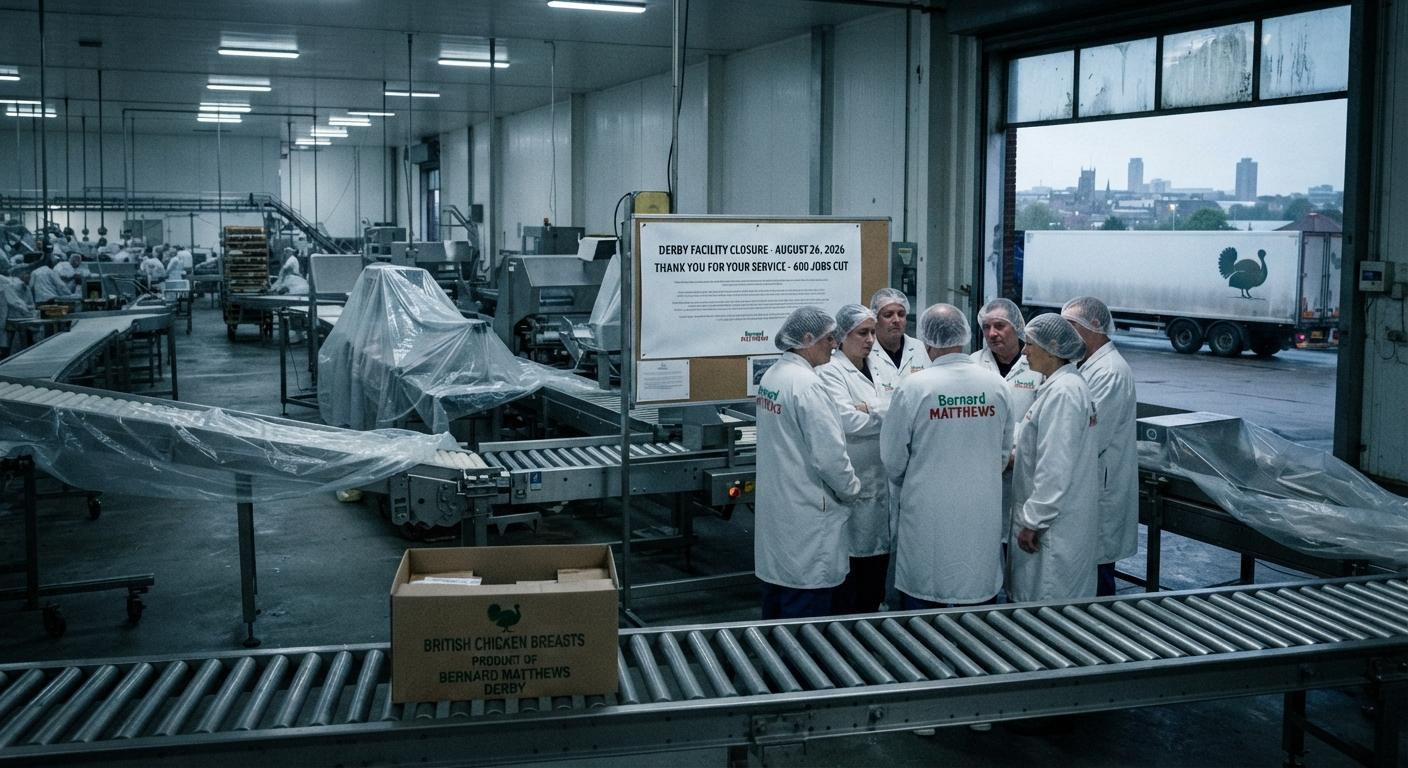

Bernard Matthews, one of the UK’s largest poultry processors, has announced the closure of its Derby processing facility—eliminating 600 jobs in a significant consolidation move that signals deepening margin pressure across the UK poultry sector. The closure marks a watershed moment for UK poultry processing, as rising feed costs, labor expenses, and intense retail competition compress profitability for mid-sized and regional processors.
The Derby facility, historically a high-volume commodity poultry hub, will cease operations as Bernard Matthews consolidates production into remaining UK sites and potentially increases reliance on European processing alternatives.
Table of Contents
The Context: UK Poultry Sector Under Mounting Pressure
The Bernard Matthews closure does not occur in isolation. Multiple structural challenges are converging on UK poultry producers and processors:
Feed Cost Volatility and Fishmeal Supply Constraints
Feed costs remain elevated due to sustained grain price volatility and ongoing fishmeal scarcity. Poultry feed—typically composed of corn, soya, and fishmeal—has faced inflationary pressure since 2022. Fishmeal in particular remains constrained by:
- Limited Peruvian anchovy catches (El Niño impact on fishing season)
- High demand from Asian aquaculture and poultry sectors
- Supply chain delays in feed ingredient distribution
For UK poultry processors operating on thin margins (typically 2-5% in commodity poultry), sustained feed cost elevation directly erodes profitability without corresponding retail price increases.
Turkey Production Tightness Ahead of Holiday Season
Turkey production in the UK remains tight heading into the critical holiday season (October-December). Key factors:
- Slower flock rebuilding: Following previous avian influenza outbreaks and industry uncertainty, UK turkey producers have not fully rebuilt flocks to pre-2022 levels
- Elevated pricing risk: Limited supply and strong holiday demand (Christmas, Thanksgiving in retail and foodservice) are driving turkey prices higher
- Processing bottleneck: With Derby closure reducing overall poultry processing capacity, turkey processing slots will become scarcer and more expensive
UK buyers relying on domestic turkey supply should anticipate 8-15% price increases and tighter delivery schedules into Q4 2024.
Retail Price Competition and Consumer Demand for Affordable Protein
UK retailers—particularly supermarket chains like Tesco, Sainsbury’s, and Asda—are intensifying price competition to maintain market share and consumer traffic. This creates a “squeeze from below”:
- Retailers demand lower wholesale poultry prices to maintain competitive retail pricing
- Consumers prioritize affordable protein, limiting retailers’ ability to pass costs downstream
- Processors, caught in the middle, absorb margin compression
Bernard Matthews’ closure reflects inability to sustain profitability under this retail price ceiling, even at scale.
Labor Cost Pressure and Post-Brexit Immigration Changes
UK wages in food processing and meat handling have risen substantially post-Brexit due to:
- Reduced Eastern European labor supply (visa restrictions, wage competition from home markets)
- Increased automation investment costs to offset labor scarcity
- Wage inflation in processing roles (5-8% annually in some regions)
- Health & safety compliance costs (particularly post-COVID)
Smaller and mid-sized processors like Bernard Matthews’ Derby facility struggle to absorb these labor costs without volume leverage or pricing power.
Consolidation Signal: The Broader UK Poultry Sector Realignment
Bernard Matthews’ Derby closure is part of a broader consolidation wave reshaping UK poultry processing:
Industry Consolidation Drivers
Capacity Rationalization:
- Smaller regional processors (operating 1-2 facilities) lack economies of scale to compete with integrated poultry conglomerates
- Larger players (like 2 Sisters, Cranswick) can absorb cost inflation and invest in automation; smaller players cannot
- Regional facilities often operate on legacy infrastructure, making automation and efficiency upgrades capital-prohibitive
Margin Compression Driving M&A:
- Processors with profitability below 3% EBITDA are acquisition targets or face closure
- Larger acquirers absorb struggling facilities to reduce competition and consolidate capacity
- Standalone mid-tier processors increasingly face “acquire or exit” decisions
Consolidation Outcome: Increased Pricing Power for Remaining Processors
This consolidation trend concentrates processing supply with fewer, larger players:
- Reduced competition among processors for raw bird supply (live poultry)
- Increased processor leverage over retailers and foodservice buyers (fewer alternatives)
- Pricing power concentration: Large processors can demand higher processing fees and wholesale prices
- Downstream cost pass-through: Buyers will face 5-12% wholesale poultry price increases over 12-18 months as consolidation proceeds
Implication for buyers: Diversification away from UK domestic poultry becomes strategically necessary. Over-reliance on UK poultry leaves buyers vulnerable to price volatility and supply allocation decisions by consolidated processors.
Employment Impact: 600 Jobs and UK Processing Capacity Loss
The closure of Bernard Matthews’ Derby facility eliminates 600 direct processing jobs—a significant loss for regional employment and a signal of broader sector contraction.
What Derby Facility Handled
The Derby facility historically processed high-volume commodity poultry:
- Chicken breast fillets for retail packs (Tesco, Sainsbury’s own-brand chicken)
- Chicken thighs and legs for retail and foodservice (HoReCa)
- Ground chicken and processed chicken products
- Mixed poultry packs (mixed cuts for family meals)
The facility likely processed 150,000-200,000 birds weekly at peak capacity, making it a high-throughput commodity hub rather than a specialized or value-added facility.
Processing Capacity Loss and Supply Chain Implications
Derby closure reduces UK domestic poultry processing capacity by approximately 7-10 million birds annually (assuming ~150,000 birds/week × 52 weeks). This creates:
- Tight UK processing schedules: Remaining UK processors will operate closer to full capacity, reducing flexibility for buyers seeking expedited processing
- Shift toward imported processed poultry: UK retailers and foodservice buyers will source more pre-processed poultry from France, Netherlands, Poland, and Belgium
- Import dependency risk: Buyers become reliant on European supply chains and subject to EU labor costs, transport logistics, and tariff changes
Regional Economic Impact
Derby region will experience:
- Loss of 600 direct jobs (plus indirect job losses in transport, logistics, and service providers)
- Reduced processing wages and employment in local labor market
- Potential downward pressure on other regional food manufacturing wages (competing for reduced labor pool)
Buyer Implications: What Procurement Directors and Supply Chain Managers Must Do Now
1. UK Poultry Supply Will Tighten—Plan for Price Increases
Action items:
- Lock in pricing: Negotiate fixed-price contracts with remaining UK poultry processors before Q4 2024
- Hedge against volatility: Consider forward contracts for poultry (especially turkey for holiday season)
- Expect 5-12% price increases over next 12-18 months as processing consolidation proceeds
- Review volume commitments: Larger buyers can negotiate better terms; consolidate supplier base if possible
2. Consolidated Processors Will Exercise Pricing Leverage
Buyer risk:
- Fewer UK poultry processors = reduced negotiating power for buyers
- Processors can allocate scarce capacity to highest-paying buyers (likely large retail chains)
- Mid-tier and smaller buyers may face supply allocation or “take-it-or-leave-it” pricing
Mitigation:
- Diversify supplier base: Don’t rely on single UK processor for poultry supply
- Build direct relationships with European processors (France, Netherlands) as backup suppliers
- Explore alternative poultry sources: Brazil, Thailand for imported processed poultry
3. Diversification Toward European Poultry Is Now Strategic Necessity
European poultry advantages:
- France: Large-scale poultry production; established relationships with UK buyers; EU tariff flexibility
- Netherlands: Efficient processing, strong logistics infrastructure to UK
- Poland: Cost-competitive poultry processing; growing processing capacity; EU supply chain stability
- Belgium: Specialized processing for retail and foodservice poultry products
Action items:
- Audit current poultry suppliers: What % of total poultry spend is UK vs. European?
- Identify 2-3 European processors for trial shipments (1-2 containers)
- Negotiate trial pricing: European suppliers may offer competitive terms to build UK relationships
- Review import logistics: Tariff implications, transport time, shelf-life (fresh vs. frozen poultry)
4. Turkey Supply Remains Critically Tight—Holiday Procurement Is Urgent
Turkey season reality (Aug-Dec 2024):
- UK turkey production 8-15% below pre-avian influenza levels
- Derby closure eliminates high-capacity turkey processing facility
- Holiday demand (Christmas, Thanksgiving) peaks in September-November
- Processing slots will fill up; late buyers face allocation shortages
Immediate actions:
- Issue turkey purchase orders by end of August (if not already placed)
- Lock in pricing for Q4 delivery: 8-15% premium expected vs. 2023
- Confirm delivery dates: Processing delays likely; specify delivery windows
- Plan European turkey backup: French and Dutch turkey supply available if UK domestic unavailable
- Communicate with end customers: Be transparent about turkey availability and pricing pressures for holiday season
5. Processing Capacity and Lead Times Will Lengthen
Expected impact on buyers:
- Longer processing lead times: Instead of 5-7 days, expect 10-14 days for commodity poultry processing
- Reduced flexibility: Processors will be less accommodating for expedited or custom orders
- Higher processing fees: Competition for processing slots will push fees upward
- Quality trade-offs: Faster throughput (operating at higher capacity) may reduce quality consistency
Buyer mitigation:
- Plan procurement 3-4 weeks in advance (vs. 2 weeks historically)
- Build inventory buffers: Hold extra safety stock to absorb processing delays
- Negotiate lead time commitments: Lock in processing windows before consolidation drives scarcity pricing
Market Data: UK Poultry Sector at a Glance
| Metric | Current Status | Trend |
|---|---|---|
| UK Poultry Processing Capacity | ~1.4 billion birds/year | Declining (-7-10M birds from Derby closure) |
| Retail Poultry Price (Chicken) | £4.50-5.20/kg | Rising (inflation + consolidation) |
| Feed Cost Index | 115-125 (2020=100) | Elevated but stable |
| Turkey Supply (UK) | 8M birds 2024 | Tight (below historical average) |
| Processing Margin (typical) | 2-5% EBITDA | Compressed (pressure to consolidate) |
| Labor Cost (processing role) | £11-13/hour + benefits | Rising 5-8% annually |
| Import Poultry % of UK Supply | ~35-40% | Rising (filling domestic capacity gap) |
Strategic Outlook: What’s Next for UK Poultry and Buyers?
Short-term (Q4 2024):
- Holiday season will see acute turkey shortages and elevated pricing
- Remaining UK processors operate at near-full capacity; processing delays common
- European poultry imports rise as UK supply tightens
- Smaller foodservice and retail buyers face allocation decisions
Medium-term (2025-2026):
- Further processor consolidation as weaker players exit or merge
- UK poultry processing concentrated among 3-4 large players (2 Sisters, Cranswick, Bernard Matthews successor facilities)
- Persistent pricing power held by consolidated processors
- Import dependency increases; UK poultry import share rises to 45-50%
- Automation investment by large processors (labor cost mitigation) reshapes workforce needs
Long-term (2027+):
- UK poultry sector stabilizes at lower capacity but higher efficiency
- UK domestic poultry pricing maintained 8-12% above European competitors (due to labor costs, regulations)
- Buyers maintain blended UK/European poultry supply to manage pricing and supply risk
- Further consolidation possible: Acquisition of struggling processors by European conglomerates
Buyer Checklist: Immediate Actions
This week:
- Review current poultry supplier concentration: Single supplier risk?
- Lock in Q4 turkey orders (if not placed)
- Request pricing commitments from current UK poultry suppliers
- Audit Q4-2024 poultry demand by product (chicken, turkey, specialty cuts)
This month:
- Identify 2-3 European poultry processor alternatives (France, Netherlands, Poland)
- Request trial quotes from European suppliers
- Assess import logistics: Transport time, tariff impact, regulatory compliance
- Communicate supply tightness to finance and commercial teams; set pricing expectations
This quarter:
- Negotiate multi-year poultry supply agreements with diversified suppliers (UK + European blend)
- Build 2-4 week safety stock for critical poultry products
- Develop supplier contingency plan if processing delays occur
- Monitor EU poultry pricing trends; benchmark vs. UK suppliers
Conclusion
Bernard Matthews’ Derby closure signals a critical inflection point for UK poultry processing. Consolidation, margin compression, and processing capacity loss are reshaping buyer options and pricing dynamics.
The key message for procurement leaders: Diversify poultry supply away from UK-only reliance. European alternatives—France, Netherlands, Poland—are no longer optional; they are strategic necessity to hedge against UK processing tightness and consolidated processor pricing power.
For buyers in retail, foodservice, and food manufacturing, the next 12-18 months will define supply chain resilience. Act now to secure supplier relationships and lock in pricing before the market fully reprices the new reality of a more consolidated, less flexible UK poultry supply chain.