
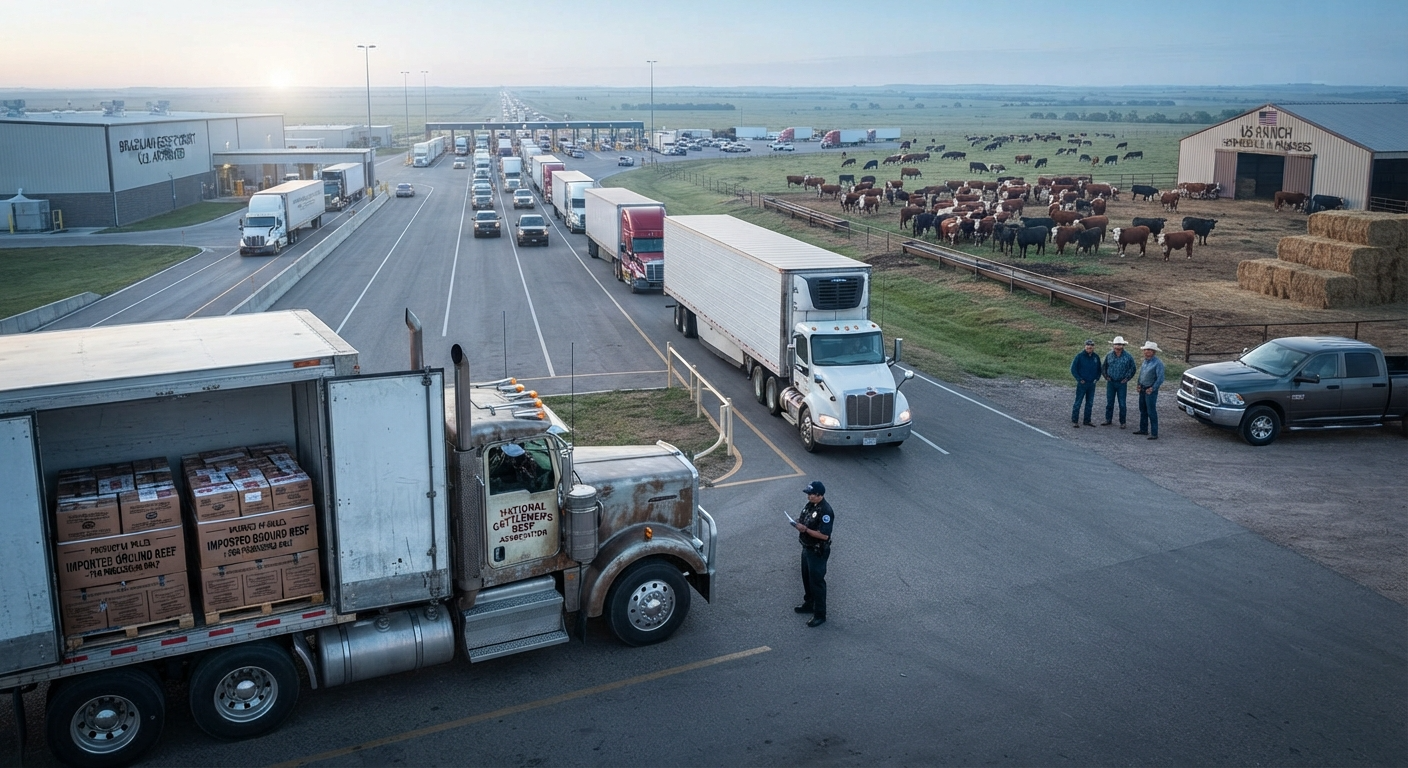

President Trump’s August 21 announcement of 90-day tariff relief on 300,000 metric tons of ground beef is drawing explicit warnings from the dairy industry that the policy will depress an increasingly critical revenue stream: cull cow and calf sales. The National Milk Producers Federation (NMPF) emphasized that cull cow and calf sales represent approximately 20% of annual dairy farm income and that greater than 20% of U.S. beef production is now supplied by dairy farms. NMPF President Gregg Doud warned that the tariff relief will suppress domestic cull cow prices, harm dairy farm economics at a time when milk prices remain historically low, and most critically, will send the wrong economic signal to cattle producers—discouraging domestic beef production rebuild at precisely the moment when the U.S. cattle herd sits at a 75-year low (86.2 million head as of January 2026). The policy, intended to lower consumer ground beef prices, may instead entrench industry distress by depressing producer margins.
Table of Contents
Trump Policy Recap: 300,000 MT Tariff Relief, 90-Day Duration
On August 21, 2026, President Trump announced via Truth Social a temporary waiver on out-of-quota tariffs for imported ground beef, intended to lower consumer prices amid record beef costs. The policy details:
Trump Ground Beef Tariff Relief Policy:
- Volume: 300,000 metric tons of ground beef eligible for tariff-free entry
- Duration: 90 days (temporary measure)
- Tariff Rate: Out-of-quota tariff (26.4%) waived for eligible imports
- Price Commitment: “25% below market prices” stated by Trump
- Rationale: Reduce consumer prices while US cattle herd rebuilds
- Announcement Date: August 21, 2026
- Executive Action Timeline: Within 2 weeks of announcement
- Source Nations: Primarily Brazil, Argentina (assumed; not formally disclosed)
Trump framed the decision as consumer-focused: “Today, I concluded a deal to substantially lower the price of ground beef for working American families.” The announcement came amid midterm election season (November 2026) and reflected political pressure to address ground beef prices that have climbed to record levels.
Context of Announcement: The policy came approximately two weeks after the NCBA and other industry groups had opposed a similar tariff relief proposal (August 5-7), demonstrating the administration’s willingness to override industry objections if it perceived consumer benefits. The announcement also triggered immediate market disruption—feeder cattle futures fell roughly $20 per hundredweight within days.
The Dairy-Beef Linkage: Cull Cows Represent 20% of Farm Income
The critical insight in NMPF’s response is the dairy-beef economic linkage that many policymakers overlook:
Key Statistic from NMPF (August 24, 2026):
- Cull cow and calf sales = 20% of annual dairy farm income
- Greater than 20% of U.S. beef production now supplied by dairy farms
- Most dairy cows in US since 1992 (currently active herd)
What Are Cull Cows and Calves? Dairy farms remove animals from their milking herds for two key reasons: (1) older dairy cows that have aged out of productive milking life (typically 6-8 years old), and (2) bull calves born to dairy cows (removed at birth because dairy operations need heifers for future breeding, not bulls). These animals enter the beef supply chain as:
- Cull Dairy Cows: Typically processed into ground beef, manufacturing beef (lower quality/cheaper cuts), or processed meat products
- Dairy Bull Calves: Sold as calves (bob calves) to feedlots or processors, eventually processed as beef or veal products
Historically, cull dairy animals represented a small portion of US beef supply. However, as the beef cattle herd has contracted over the past decade due to drought, rising feed costs, and economic pressures, dairy farms have become increasingly important beef suppliers. NMPF’s statement that dairy now supplies “greater than 20% of U.S. beef production” underscores how much the industry structure has shifted.
Income Sensitivity: For dairy farmers operating on thin milk price margins (milk prices remain “low by historical standards,” per NMPF), the 20% revenue contribution from cull livestock sales is material. When cull cow prices decline, farm margins compress materially. NMPF emphasized: “U.S. dairy farmers’ appreciation for the strength that beef prices have provided to their operations cannot be overstated, as milk prices continue to be low by historical standards.”
NMPF President Doud’s Statement: Concerns & Economic Signals
On August 24, 2026, NMPF President and CEO Gregg Doud released a formal statement expressing concerns about the tariff relief policy. Key quotes:
On Unintended Consequences: “NMPF is concerned by the Trump Administration’s decision to increase imports of foreign-raised beef, which will have unintended consequences for U.S. cattle and dairy producers alike.”
On Herd Dynamics: “Current beef prices are an important reason why we have the most dairy cows in the United States since 1992; meanwhile, U.S. milk production is up 2.7% versus last year.” This statement is critical: strong beef prices have incentivized dairy farmers to maintain and expand their herds because the marginal revenue from cull livestock sales makes herd retention economically viable. Tariff relief threatens to reverse this dynamic.
On Economic Signals: “The more consequential impact will be a delay in the necessary economic signal sent to U.S. beef producers to increase production, which may reduce domestic supplies in the longer term.” This directly challenges Trump’s stated goal. Tariff relief is intended to fix supply constraints, but NMPF argues it accomplishes the opposite: by suppressing prices through imports, it discourages the domestic production expansion needed to solve the shortage.
On Enforcement & Consumer Benefit: “Removing the tariff isn’t likely to lower consumer prices, as the price of this imported product is already well below that of the comparable domestically produced product derived from U.S. cull dairy and beef cows, but it will certainly improve the profit margin for the exporter.” This is a critical insight: imported lean ground beef from Brazil and Argentina already trades at approximately 25% below domestic prices. Removing tariffs won’t create incremental consumer savings because the price differential already exists. The tariff removal primarily benefits foreign exporters’ margins.
On Broader Impact: “Policy-created disruption threatens the billions of dollars invested by U.S. dairy farmers and manufacturers to grow supply of beef and dairy products.” NMPF is signaling that the dairy industry has made strategic investments (breeding decisions, herd expansion, capital expenditure) based on the current competitive environment. Sudden policy shifts disrupt these investments.
US Cattle Herd Crisis: 75-Year Low & Processing Capacity Mismatch
Understanding NMPF’s response requires context on the cattle market crisis:
Cattle Herd Size:
- Current US cattle herd: 86.2 million head (as of January 2026)
- Lowest level since: 1951 (75-year low)
- Peak historical herd: ~96 million head (1975)
- Decline driver: Multiyear drought (2020-2024), rising feed costs, economics
Why the Herd Declined: Ranchers facing historical drought in Western US coupled with rising feed, fuel, and input costs made rational economic decisions: liquidate herds rather than absorb losses. This produced a supply shock that compressed beef availability and sent prices soaring.
Processing Capacity Crisis: US beef processing infrastructure was sized for much larger cattle herds (90+M head). As herds contracted, processing plants faced chronic underutilization—operating at 60-70% capacity with fixed overhead costs. This created pressure for closures.
Trump’s tariff relief policy is intended to address this supply shortage through imports, theoretically stabilizing prices while domestic herds rebuild. However, NMPF argues this logic is flawed: depressed prices (caused by imports) discourage ranchers from making the investments needed to rebuild herds. It’s a policy paradox.
Tyson Plant Closures (August 2026): Industry Distress Signal
Reinforcing NMPF’s concerns, Tyson Foods announced major beef plant closures on August 13, 2026—just days before Trump’s tariff relief announcement:
Tyson’s August 2026 Closures:
- Joslin, Illinois: Capacity: ~3,000 head/day | Employees: 2,500 | Closure effective immediately
- Eagle Mountain, Utah: Case-ready facility | Closure announced
- Pasco, Washington: Capacity: ~2,000 head/day | Facility to be sold
- Combined Capacity Loss (2026): ~7,000 head/day (additional to prior closures)
Prior 2026 Closures: Tyson also closed its Lexington, Nebraska facility in January 2026 (capacity 5,000 head/day, 3,200 employees). Combined with August closures, Tyson has eliminated approximately 10,000 head/day of capacity—roughly one-third of its pre-2026 beef processing capacity.
Financial Impact: Tyson expected beef segment losses of up to $650 million for fiscal 2026 (revised upward from $500M projection). CEO Donnie King stated the closures reflect “limited signs of cattle ranchers expanding their herds” based on USDA data—confirming that pricing signals are not encouraging production expansion.
What Tyson’s Closures Signify: The plant closures underscore that processing capacity is genuinely constrained by cattle supply, not demand. Tyson is not closing plants due to weak beef demand but due to inability to source sufficient cattle at economically viable prices. The closures demonstrate industry distress that tariff relief on imports is intended to address.
The Paradox: Policy Aims to Lower Prices But Discourages Production
The core argument in NMPF’s response highlights a fundamental policy paradox:
The Policy Paradox:
- Trump’s Goal: Increase ground beef supply and lower consumer prices
- Mechanism: Import 300,000 MT tariff-free to supplement domestic supply
- NMPF’s Concern: Imports will depress prices, which discourages domestic production expansion—the opposite of the long-term goal
- Result: Short-term consumer price relief, but potentially reduced domestic supplies in the longer term
- Winners: Foreign beef exporters (improved margins), foreign ranchers (higher volume demand)
- Losers: US cattle ranchers, dairy farmers (depressed prices, weaker signals), US processing workers (plant closures continue)
Cattle Herd Rebuild Economics: Ranchers decide whether to expand herds based on expected future prices. If current policy signals that prices will remain depressed due to imports, ranchers won’t invest in herd expansion. Paradoxically, imports intended to solve a supply shortage may entrench the shortage by discouraging production expansion.
NMPF directly quoted this concern: “The more consequential impact will be a delay in the necessary economic signal sent to U.S. beef producers to increase production, which may reduce domestic supplies in the longer term.”
Timing Aggravates Problem: August-September is when ranchers make critical herd management and culling decisions for the coming year. Trump’s announcement and the resulting market uncertainty make it harder for ranchers to plan. Some may accelerate culling, further reducing the herd—the opposite of rebuild objectives.
Imported Beef Sourcing: Brazil, Argentina Already Trading 25% Below Domestic
A critical detail in NMPF’s statement concerns the baseline pricing of imported beef:
NMPF Quote: “The price of this imported product is already well below that of the comparable domestically produced product derived from U.S. cull dairy and beef cows, but it will certainly improve the profit margin for the exporter.”
This statement implies that imported lean ground beef from Brazil and Argentina already trades at approximately 25% below domestic prices, even with tariffs in place. Removing tariffs doesn’t create new price gaps—it widens existing ones slightly and improves exporter margins.
Assumed Import Sources: While Trump’s announcement did not formally identify source nations, industry observers assume:
- Brazil: Primary supplier — large beef export volumes, lean ground beef specialty, already subject to 26.4% out-of-quota tariff
- Argentina: Secondary supplier — established beef exporter, tariff relief attractive
- Other potential sources: Uruguay, Paraguay (South American beef economies)
Price Differential Context: Lean ground beef imported from Brazil trades at lower prices than US domestic ground beef due to:
- Lower labor costs in Brazil
- Lower environmental compliance costs
- Economies of scale in large-volume feedlot operations
- Tariff burden (currently 26.4% out-of-quota)
Removing the tariff narrows the price gap from ~25% to perhaps 20-23%, but doesn’t eliminate it. The consumer benefit is marginal because the gap already existed. The primary beneficiary is Brazilian exporters, whose profit margins improve substantially.
Enforcement Questions: How Will “25% Below Market” Commitment Be Monitored?
Trump stated that the imported ground beef would be priced at “25% below market prices.” However, significant questions remain about enforcement:
⚠️ ENFORCEMENT CONCERNS:
- No mechanism disclosed for verifying “25% below market” pricing
- Who monitors compliance? USDA, CBP, or private importers?
- How is “market price” defined? Wholesale, retail, average across regions?
- What penalties exist for non-compliance? Tariffs reimposed if threshold not met?
- Will retailers pass savings to consumers? Or retain margin improvements?
The NMPF statement suggests that the “25% below market” commitment likely describes current status quo (imported beef already trades ~25% below domestic), not a new price target. This implies the commitment is essentially meaningless—it formalizes existing market dynamics rather than creating new consumer protections.
Without formal enforcement mechanisms, there is no guarantee that consumers will see meaningful price relief. Retailers and importers may pocket the tariff savings rather than pass them to consumers. This concern is amplified by the fact that US retail beef prices are driven more by retail supply/demand dynamics than by wholesale import prices.
Impact on Dairy Farm Economics: Low Milk Prices + Depressed Cull Cow Revenue
For US dairy farmers, the tariff relief creates a two-pronged economic pressure:
Pressure #1: Milk Prices Remain Historically Low
- Current milk prices: “Low by historical standards” (NMPF quote)
- Margin compression: Dairy farms operating on thin or negative margins
- Feed costs remain elevated: Despite some decline from 2021-2022 peaks, still higher than pre-2020
Pressure #2: Cull Livestock Revenue Threatened
- Cull cow/calf sales = 20% of annual dairy farm income
- Tariff relief will depress cull cow prices through increased imported beef supply
- Combined pressure: Low milk prices + depressed cull livestock prices = margin compression on both sides
Specific Farm Economics Example (Hypothetical): A 500-cow dairy farm might generate:
- ~1,000+ cull cows/calves annually (replacements, culling)
- At ~$1,500/head for cull cows, that’s ~$1.5M+ in annual cull livestock revenue
- If cull prices fall 10-15% due to tariff relief, that’s $150-225K in lost annual farm income
- For farms operating on $50-100K annual profit margins (after costs), this is material
This economic pressure is particularly acute because dairy is already under financial stress. NMPF noted that milk prices are “low by historical standards”—meaning farms are already operating on compressed margins and cannot absorb further revenue pressure from secondary income sources.
Critical Timing: August-September Herd Management Decisions at Risk
NMPF and other industry groups emphasized that Trump’s announcement comes at a critical moment in the livestock production cycle:
Why August-September Matters:
- Annual Herd Planning: Ranchers finalize breeding, culling, and expansion decisions in late summer for the coming year
- Feeder Calf Sales: August-September typically sees peak feeder cattle sales as ranchers liquidate or place young animals
- Budget Planning: Farmers finalize capital investment, feed purchases, and staffing for upcoming year
- Market Signals Are Critical: Ranchers rely on current price trends to project future profitability
Impact of Policy Timing: Trump’s August 21 announcement and resulting market volatility (feeder cattle futures down $20/cwt) created uncertainty precisely when ranchers were making critical decisions. Some likely accelerated culling or reduced breeding plans due to the perceived price pressure. This could reduce herd sizes in the near term, aggravating supply constraints.
Iowa Cattlemen’s Association President Craig Moss characterized it explicitly: “The President’s comments and decisions have created unnecessary market volatility today. The drop in the markets will directly impact their profitability and bottom line, and in turn impacts decisions our producers are making about expanding their cattle herds.”
Sources & References
| Source | URL | Publication Date |
|---|---|---|
| NMPF – Statement on Plan to Increase Beef Imports | https://www.nmpf.org/nmpf-statement-on-plan-to-increase-beef-imports/ | August 24, 2026 |
| Feedstuffs – Trump’s beef import plan rankles U.S. industry | https://www.feedstuffs.com/policy/trump-s-beef-import-plan-rankles-u-s-industry | August 24, 2026 |
| Wire Service Canada – U.S. Dairy Group Warns Beef Import Plan | https://www.wireservice.ca/u-s-dairy-group-warns-beef-import-plan-could-pressure-farm-revenues/ | August 24, 2026 |
| Drovers – Trump Announces Deal to Slash Ground Beef Prices by 25% | https://www.drovers.com/news/ag-policy/trump-announces-deal-slash-ground-beef-prices-25-sends-markets-lower | August 22, 2026 |
| CNBC – Trump to allow import of 300,000 metric tons of ground beef without tariff | https://www.cnbc.com/2026/08/21/trump-ground-beef-import-tariff.html | August 21, 2026 |
| DTN/Progressive Farmer – Tyson Shutters Joslin Beef, Utah Plants | https://www.dtnpf.com/agriculture/web/ag/livestock/article/2026/08/17/tyson-shutters-joslin-beef-utah-low | August 17, 2026 |
| Quartz – Tyson Foods is closing two more beef plants | https://qz.com/tyson-foods-beef-plant-closures-cattle-shortage-081426 | August 14, 2026 |
| Tyson Foods – Network Restructuring for Beef Business | https://www.tysonfoods.com/news/news-releases/2026/8/tyson-foods-announces-network-restructuring-beef-business-strengthen-long | August 13, 2026 |
| Bloomberg – Tyson to close more beef plants as U.S. cattle shortage deepens | https://www.bloomberg.com/news/articles/2026-08-13/tyson-to-close-more-beef-plants-as-us-cattle-shortage-drags-on | August 13, 2026 |
| TT News – Tyson to close more beef plants | https://www.ttnews.com/articles/tyson-close-more-beef-plants | August 14, 2026 |
| Dairy Herd – Gregg Doud on the Future of Dairy | https://www.dairyherd.com/news/nmpfs-gregg-doud-future-dairy-trade-enforcement-biosecurity-and-11-billion-boom | May 22, 2026 |
| University of Nebraska-Lincoln – Understanding Tyson Lexington Plant Closure | https://cap.unl.edu/news/understanding-tyson-lexington-plant-closure-what-it-means-cattle-producers | 2026 |
Frequently Asked Questions (FAQ)
❓ How much of US beef production comes from dairy farms?
According to NMPF (August 2026), greater than 20% of U.S. beef production is now supplied by dairy farms—primarily through cull cow (older dairy cows removed from herds) and calf (dairy bull calves) sales. This represents a significant increase from historical norms, reflecting the contraction of the beef cattle herd and rising importance of dairy-beef integration.
❓ What percentage of dairy farm income comes from cull livestock sales?
Cull cow and calf sales represent approximately 20% of annual dairy farm income, according to NMPF. For a dairy farm with $1 million annual revenue, this equates to ~$200,000 in cull livestock revenue—a material portion of farm profitability, particularly at a time when milk prices are “low by historical standards.”
❓ Will the tariff relief lower consumer beef prices?
Likely minimal consumer price relief, according to NMPF. Imported lean ground beef from Brazil and Argentina already trades at approximately 25% below domestic prices even with tariffs in place. Removing the 26.4% out-of-quota tariff narrows the gap slightly but doesn’t create substantial new consumer savings. Most benefit accrues to foreign exporters’ profit margins, not consumers.
❓ Why does NMPF say the policy discourages domestic production?
NMPF argues that imports suppress domestic beef prices, which sends the wrong economic signal to cattle ranchers. If ranchers expect prices to remain depressed due to import competition, they won’t invest in herd expansion. This creates a paradox: tariff relief intended to increase supply actually discourages the domestic production expansion needed to solve the shortage long-term.
❓ What is the current US cattle herd size?
As of January 2026, the US cattle herd was approximately 86.2 million head—the lowest level since 1951 (a 75-year low). This represents a significant decline from historical peaks of ~96 million head in 1975, driven primarily by multiyear drought and rising input costs.
❓ Why did Tyson close beef plants in August 2026?
Tyson closed its Joslin, Illinois (3,000 head/day) and Eagle Mountain, Utah facilities due to historic cattle shortages and lack of sufficient supply to keep plants running profitably. CEO Donnie King cited USDA data showing “limited signs of cattle ranchers expanding their herds.” The closures represent about one-third reduction in Tyson’s pre-2026 beef processing capacity.
❓ How much processing capacity did Tyson eliminate in 2026?
Tyson eliminated approximately 10,000 head/day of beef processing capacity in 2026: Lexington, Nebraska (5,000 head/day, January closure) plus Joslin, Illinois (3,000 head/day) and other facilities (August closures). This represents about one-third of Tyson’s total pre-2026 beef processing capacity.
❓ What are “cull cows” and why do dairy farms sell them?
Cull cows are older dairy cows removed from milking herds (typically 6-8 years old) after productive lives end. Dairy farms also sell bull calves born to their herds since dairy operations need heifers (females) for breeding, not bulls. These animals enter the beef supply chain and are processed into ground beef or manufacturing products.
❓ How does milk price pressure connect to tariff policy concerns?
Milk prices are currently “low by historical standards” per NMPF, meaning dairy farms already operate on thin profit margins. Cull livestock sales (20% of farm income) provide essential secondary revenue. Tariff relief that depresses beef prices compounds the margin compression—farms lose income on both milk and livestock sides simultaneously.
❓ Why did NMPF state the policy “delays economic signals”?
NMPF argued that tariff relief imports will temporarily depress domestic beef prices, which delays/prevents the price signals needed to encourage US cattle ranchers to expand production. Without strong price incentives, ranchers won’t invest in herd growth. Paradoxically, policy intended to increase supply discourages the production expansion actually needed to solve shortages long-term.