
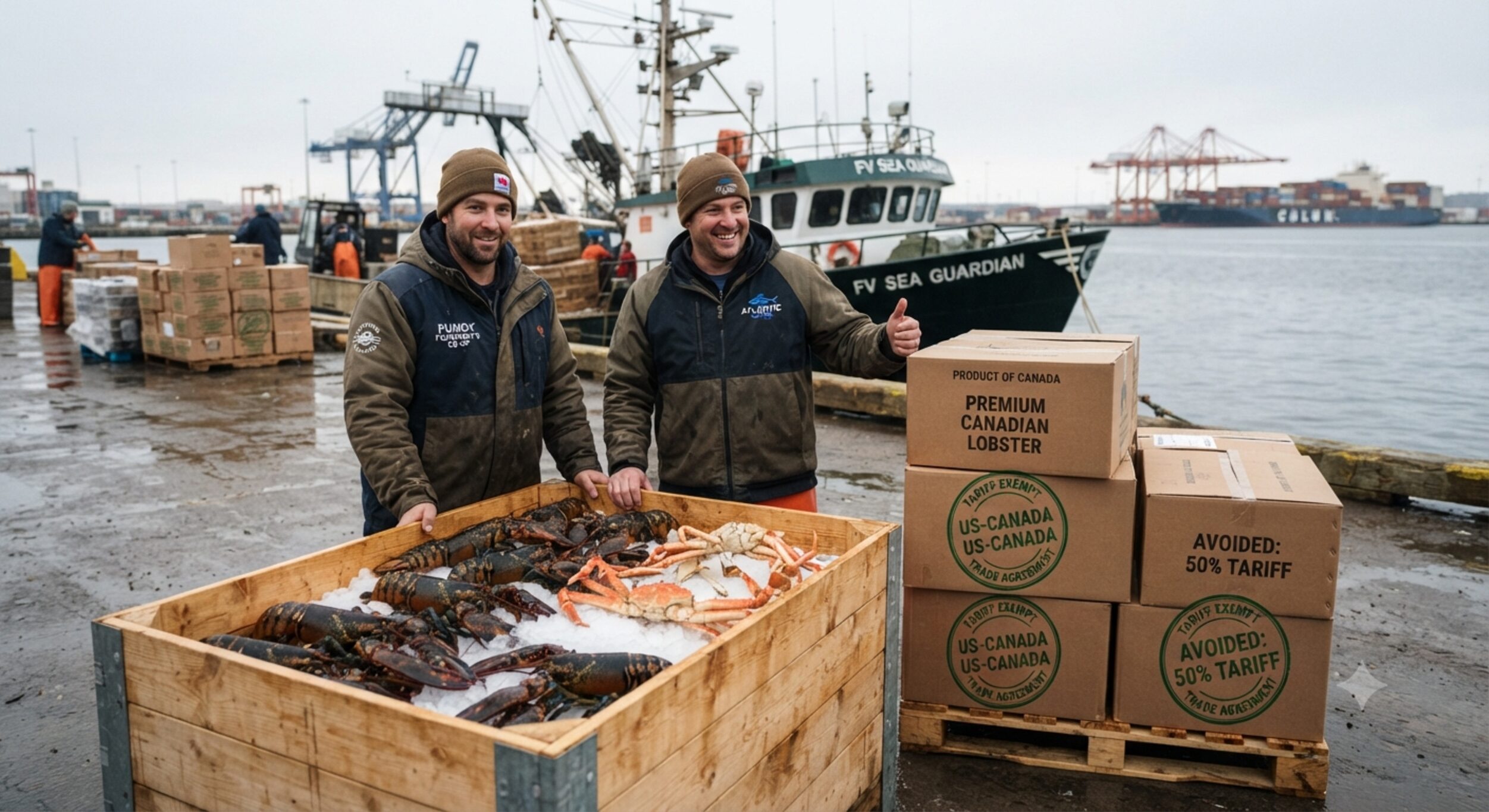
Trump’s new 50% tariffs on Canadian goods conspicuously exclude fish and seafood, continuing a pattern of protection that has shielded the sector through every round of US-Canada trade dispute—but the exemption is fragile and operators sourcing Canadian seafood should plan for tariff exposure anyway.
Canadian Seafood Tariffs: The Exemption That Defied Trump’s Retaliatory Blitz
<cite index=”12-1″>The new 50% tariffs would exclude energy products, potash, fish and critical minerals, but they would include goods that had previously been protected from import taxes by the United States-Mexico-Canada Agreement, or USMCA.</cite>
On July 20, 2026, President Trump signed three separate proclamations imposing 50% tariffs on Canadian goods. The targets were specific: discriminatory treatment of U.S. motor vehicles, Canadian provincial restrictions on U.S. alcoholic beverages, and unequal dairy tariff-rate quota access compared to EU producers.
What’s conspicuous by absence: fish and seafood do not appear in any of the three proclamations. This exemption represents a significant reprieve for one of Canada’s largest export sectors, and a dramatic reversal from rhetoric suggesting seafood would face the same tariff treatment as other Canadian goods.
For seafood importers, foodservice operators, and retailers sourcing Canadian fish and shellfish, the exemption is welcome. But it’s also precarious—and understanding why seafood escaped tells you everything about navigating tariff risk going forward.
Canadian Seafood Tariffs: Why Fish Escaped When Automotive, Alcohol, and Dairy Did Not
The White House justified its 50% Canadian tariffs through three specific grievances:
1. Motor vehicles: The administration claims Canada has discriminated against U.S. auto manufacturers, imposing restrictions on vehicle imports and capabilities that disadvantage U.S. producers.
2. Alcoholic beverages: <cite index=”17-1″>All but two Canadian provinces and territories have halted the purchase, distribution, or retailing of U.S. alcoholic beverages, and have not imposed similar restrictions on other countries. From March 2025 through February 2026, Canadian imports of U.S. alcoholic beverages decreased by about 81%, or $582 million, compared to the same period in 2024-2025.</cite>
3. Dairy products: <cite index=”17-1″>As part of its complicated and protectionist dairy system, Canada established tariff-rate quotas on U.S. cheese that are much more restrictive than the tariff-rate quotas imposed on similar imports of cheese into Canada from the EU, despite Canada having trade agreements with both the U.S.</cite>
The critical difference: seafood is not part of any of these three grievance categories. Trump’s proclamations were narrowly tailored to address specific trade disputes. Seafood didn’t trigger the investigation, so it didn’t land on the tariff list.
That narrowness is important. Trump could theoretically expand the proclamations to include seafood if political leverage shifts or if the Canadian government takes actions he perceives as retaliatory in the seafood space specifically. The Canadian seafood tariffs exemption is conditional, not permanent.
Canadian Seafood Trade: What’s at Stake
Canada is a major U.S. seafood supplier. Atlantic Canada—Newfoundland and Labrador, Nova Scotia, Prince Edward Island, New Brunswick—dominates Canadian seafood exports, particularly in lobster, snow crab, and groundfish products.
<cite index=”29-1″>Quebec and Atlantic Canada in 2023 together exported about $1.6 billion worth of lobster to the United States.</cite> That’s lobster alone. Add snow crab, scallops, ground fish, farmed salmon from British Columbia, and total Canadian seafood imports into the U.S. reach several billion dollars annually.
If the Canadian seafood tariffs exemption were removed and 50% tariffs imposed, the economic impact would be catastrophic for Atlantic Canadian coastal communities. Fishing employment, processing facility operations, and export-dependent infrastructure would all face contraction. The lobster industry specifically—a cultural and economic cornerstone of Atlantic Canada—would be devastated.
This economic gravity explains why Canadian seafood has been protected: political cost of tariffing seafood exceeds the negotiating leverage gained.
How Canadian Seafood Tariffs Relate to USMCA Protection
The Canadian seafood tariffs exemption connects directly to USMCA (United States-Mexico-Canada Agreement), the successor to NAFTA. <cite index=”21-1″>As seafood is covered under the USMCA, Trump’s latest decision should leave it tariff free for the time being.</cite>
Here’s the critical distinction: Trump’s proclamations technically apply to all Canadian goods, “regardless of whether they qualify for preferential treatment under the USMCA.” This means the tariffs are written to override USMCA protection in principle.
However, by explicitly exempting fish from the proclamations, Trump effectively preserved USMCA protection for seafood. The exemption is narrow: it’s not a statement that USMCA protects seafood from these tariffs. It’s a direct, explicit carve-out from the 50% tariff orders themselves.
For operators sourcing Canadian seafood, this distinction matters. As long as Canadian seafood qualifies for USMCA origination status (which most does—it’s “wholly obtained” in Canada), it gets both the explicit tariff exemption AND USMCA protection. That’s a double layer of defense.
But if Trump expands tariff proclamations in future rounds, that double layer could collapse.
Canadian Seafood Tariffs: The Pattern of Protection Across Trade Disputes
The Canadian seafood tariffs exemption didn’t emerge from this July 2026 action alone. Seafood has been protected through every round of US-Canada trade disputes under the Trump administration.
When Trump first imposed 25% tariffs on Canadian goods in February 2025, seafood was delayed or exempted. When tariffs were threatened throughout 2025 and early 2026, seafood remained protected. Now, in July 2026, when Trump escalated to 50% tariffs, seafood escaped again.
This pattern reflects political economy: <cite index=”29-1″>Geoff Irvine, director of the Lobster Council of Canada, said in an interview that the new U.S. administration is nonetheless sending a message that Canada’s seafood industry should shift its focus to other international markets.</cite>
The message is clear: while Canadian seafood tariffs are currently protected, the protection is not guaranteed to persist indefinitely. The Lobster Council and other industry groups have begun developing alternative markets (Europe, Asia, Middle East) precisely because they don’t expect tariff exemption to hold forever.
Canadian Seafood Tariffs: What About the 30-Day Implementation Window?
The Canadian seafood tariffs exemption applies to tariffs effective August 19, 2026—30 days after the July 20 proclamation. This creates a negotiation window: Trump has stated he’s open to trade discussions, and the 30-day delay theoretically allows Canada to reach new agreements that might resolve the disputes (vehicles, alcohol, dairy) without escalation to additional sectors like seafood.
However, the delay window is narrow. For operators sourcing Canadian seafood, the relevant timeline is:
- Now through August 19, 2026: Canadian seafood remains tariff-free
- August 19 onward: 50% tariffs take effect on non-exempted Canadian goods; seafood remains exempted IF Trump doesn’t expand proclamations
- Post-August: Trade negotiations may reshape tariff landscape entirely
Procurement teams should monitor weekly for developments. The Canadian seafood tariffs exemption could change rapidly if negotiations accelerate or break down.
Procurement Strategy: Canadian Seafood Tariffs and Supply Chain Risk
Given the Canadian seafood tariffs exemption’s fragility, procurement teams should implement a three-layered strategy:
Layer 1: Current sourcing assurance Document all Canadian seafood sourcing, pricing, and supply agreements. Confirm supplier USMCA qualification status. The exemption is current; take advantage of tariff-free access while it exists.
Layer 2: Tariff exposure modeling Model cost impact if 50% Canadian seafood tariffs were imposed. Lobster, snow crab, and scallops would face 50% import duties. This drives retail/foodservice menu pricing, margins, and competitiveness. Run sensitivity analysis: What’s the margin impact if Canadian seafood costs jump 50%?
Layer 3: Alternative sourcing evaluation Begin supplier relationship development with non-Canadian seafood sources: U.S. domestic (Maine lobster, wild Alaska salmon), Mexico (shrimp), Iceland (groundfish), Norway (farmed salmon). The Canadian seafood tariffs exemption may not last; building alternative supply relationships now reduces switching costs if tariffs hit.
Related
Frequently Asked Questions
Why did Trump exempt Canadian seafood from 50% tariffs while hitting alcohol, autos, and dairy?
Trump’s proclamations were narrowly tailored to three specific grievances: discriminatory treatment of U.S. autos, Canadian provincial restrictions on U.S. alcohol, and unequal dairy tariff quotas. Seafood wasn’t part of any of these disputes, so Trump didn’t include it in the tariff orders. The exemption is conditional on seafood remaining outside the stated grievance categories—if Canada restricts U.S. seafood imports or other issues arise in that sector, Trump could expand the tariffs. Political economy also matters: Atlantic Canada’s seafood industry wields significant political influence, and tariffing a culturally important sector like lobster carries high political cost relative to the negotiating leverage gained.
Is the Canadian seafood tariffs exemption permanent?
No. The exemption is explicit but conditional. Trump has demonstrated willingness to expand or modify tariff orders throughout 2025–2026. If trade negotiations stall, if Canada retaliates in ways Trump perceives as targeting seafood, or if political priorities shift, tariffs could expand to include fish. The 30-day implementation window (through August 19, 2026) creates a time-limited reprieve, but beyond that, the exemption depends on Trump’s continued policy decision. Operators should plan for tariff exposure as a medium-term risk, not assume perpetual exemption.
Should I lock in Canadian seafood contracts now to avoid future tariffs?
If your operation sources significant volumes of Canadian seafood (lobster, crab, scallops, salmon), securing fixed-price contracts through 2027 makes sense. You lock in tariff-free access and lock out future price increases. However, weigh inventory carrying costs against tariff risk. If you can’t consume inventory quickly, forward-buying may create working capital problems. A middle ground: secure supply commitment (not necessarily full inventory) with fixed pricing for 12–24 months, and develop alternative supplier relationships in parallel. This hedges tariff risk without over-committing capital.
Sources
| Source | URL | Details |
|---|---|---|
| NPR | https://www.npr.org | “Trump imposes 50% tariffs on Canadian goods”; July 21, 2026; exemptions for energy, potash, fish, critical minerals |
| The White House | https://www.whitehouse.gov/fact-sheets/2026/07/ | Fact Sheet: President Donald J. Trump Imposes Additional Tariffs on Canada; three proclamations; July 20, 2026 |
| Al Jazeera | https://www.aljazeera.com/news/2026/7/21/ | “Trump’s new 50 percent Canada tariffs: What products are affected and why?”; July 21, 2026 |
| International Trade Insights | https://www.internationaltradeinsights.com | “President Trump Imposes 50% Tariffs on Certain Canadian Products Under Section 338 of the Tariff Act”; proclamation details |
| SeafoodSource | https://www.seafoodsource.com/news/supply-trade/ | “Trump delays tariffs on swath of Canadian goods, including seafood”; USMCA exemption analysis |
| Fish Farmer Magazine | https://www.fishfarmermagazine.com/news/ | “Seafood escapes new Trump tariff attack on Canada”; July 21, 2026 |
| Intrafish | https://www.intrafish.com/trade/ | “Fish escapes Trump’s 50% tariff on Canada goods”; tariff exemptions tracking |
| Global News | https://globalnews.ca | “As Trump takes power, Atlantic Canadian seafood firms look to diversify export market”; lobster export volumes; diversification strategy |
| Baker Botts | https://ourtake.bakerbotts.com | Trump Tariff Tracker – July 21, 2026; Section 338 exemptions analysis |

