
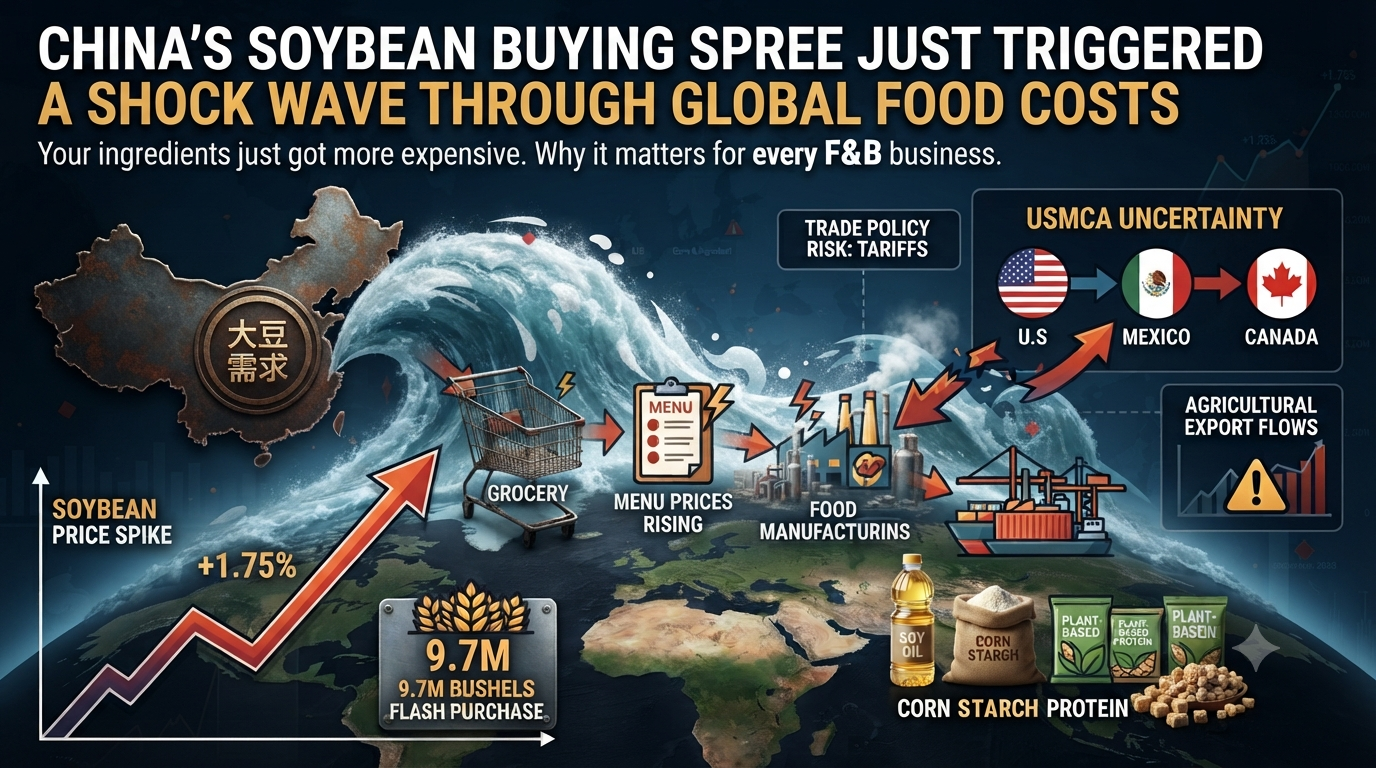
Your ingredients just got more expensive. Here’s why China’s latest commodity purchases matter for every F&B business—and what to do about it.
China’s aggressive soybean purchases are reshaking global commodity markets, pushing prices up and forcing food manufacturers, distributors, and operators to reassess procurement strategies. As agricultural trade faces fresh uncertainty from USMCA tensions, the ripple effects are already hitting ingredient costs across the food and beverage value chain.
The China Effect: Why Soybean Prices Just Spiked
On Monday, China announced a flash purchase of 9.7 million bushels of soybeans, sparking a rally that lifted most soybean contracts up around 1.75% in a single session. A second sale to unknown destinations added another 4.0 million bushels to the books. For context, China’s buying activity directly influences global soybean pricing—and when China buys, the market listens.
Why this matters for F&B: Soybean oil, lecithin, textured soy protein, and animal feed all trace back to soybean costs. Every time global soybean prices spike, your input costs follow within weeks. Manufacturers of plant-based proteins, salad dressings, bakery products, and snack foods are already feeling the pressure.
The rally also lifted corn prices, with September futures up 4.75 cents to $4.4950 and December futures climbing 5.5 cents to $4.73. Corn-derived ingredients—sweeteners, starches, thickeners, and animal feed—will see cost pressure reflected in your next purchasing cycle.
USMCA Uncertainty: The Hidden Threat to Your Supply Chain
While commodity prices grab headlines, a quieter threat looms in trade policy. The United States-Mexico-Canada Agreement (USMCA) is now in annual review mode after the U.S. opted not to renew the agreement for another 16 years. This decision has injected unprecedented uncertainty into agricultural trade with two of America’s top trading partners.
Consider the numbers: Canada and Mexico purchase a combined $60 billion annually from U.S. agricultural producers. Disruption to these flows doesn’t just affect farmers—it cascades through food processors, distributors, and retailers who depend on reliable, predictable ingredient sourcing and cross-border logistics.
What procurement teams need to know: USMCA uncertainty means tariff risk on imported ingredients from Mexico and Canada, as well as potential cost increases on U.S. exports if retaliatory measures emerge. Diversifying sourcing geography and locking in long-term contracts now may protect you from mid-year price shocks.
The Broader Market Picture: Corn, Wheat, and Your Plate
While soybeans stole the spotlight, corn and wheat prices also moved materially on Monday. Winter wheat fell 8.75 cents as geopolitical concerns (U.S. airstrikes in Iran, rising energy futures) weighed on sentiment. Wheat export inspections slumped 46% below the prior week, suggesting softer demand despite prices remaining near six-week highs.
Corn export inspections, by contrast, reached 61.0 million bushels for the week ending July 16—toward the higher end of analyst forecasts. Mexico, Japan, South Korea, Spain, and Venezuela led demand. This strong export pace supports prices, but also signals tightening supplies as the year progresses.
For beverage and snack producers: Corn sweeteners, corn syrup solids, and corn flour are staple ingredients. Steady export demand keeps prices firm heading into late summer. Budget accordingly for Q3 and Q4 procurement.
What This Means for Your Bottom Line
Food Manufacturers: Rising soybean and corn costs will compress margins unless you can pass increases to customers. Now is the time to review formulations—can you reduce soy content without sacrificing quality? Can you source alternative oils or proteins at lower cost? Consider hedging strategies or locking in prices with suppliers.
Distributors & Wholesalers: Your procurement costs are rising. Monitor weekly USDA export data and CFTC positioning reports to anticipate further price moves. Build in buffer inventory for high-cost ingredients while managing working capital carefully.
Foodservice Operators & Retailers: Menu price adjustments may be necessary to protect margins. Track commodity indices and communicate transparently with customers about cost pressures. Promotional mix, portion sizes, and product mix are levers to manage profitability.
Supply Chain & Procurement Professionals: Diversify suppliers and geographies. Hedge exposures where possible. Strengthen relationships with agricultural brokers and logistics partners who can navigate tariff and trade policy changes. The USMCA uncertainty demands proactive contingency planning.
Related
FAQ
Q: How quickly will rising soybean prices show up in my ingredient costs?
A: Typically within 2–4 weeks. Commodity futures markets move first; input costs follow as suppliers replenish inventory and pass through increases. Lock in prices now if you haven’t already for Q3 and Q4 delivery.
Q: What’s the real risk from USMCA uncertainty?
A: The real risk is tariff implementation if trade negotiations falter. A 10–25% tariff on Mexican or Canadian imports would immediately raise costs on grains, oils, proteins, and logistics. The uncertainty alone may cause suppliers to raise prices as a hedging buffer.
Q: Should I be switching away from corn and soybean ingredients?
A: Not necessarily. But it’s wise to audit your formulations, test alternative sources (wheat, sunflower oil, alternative proteins), and understand your price elasticity. Some small changes to recipes can materially improve cost resilience without sacrificing taste or nutrition.
Sources
- USDA NASS – Corn and soybean export inspections data: https://www.usda.gov/nass
- CFTC Commitment of Traders Report (weekly): https://www.cftc.gov/market-reports/commitments-traders-reports
- Farm Futures – Afternoon Market Recap (July 20, 2026): https://www.farmprogress.com
- Virginia Tech Agricultural Policy Research – USMCA analysis: https://www.policyvoices.vt.edu
- NOAA Weather & Precipitation Outlook (72-hour and 8–14-day forecasts): https://www.noaa.gov

