
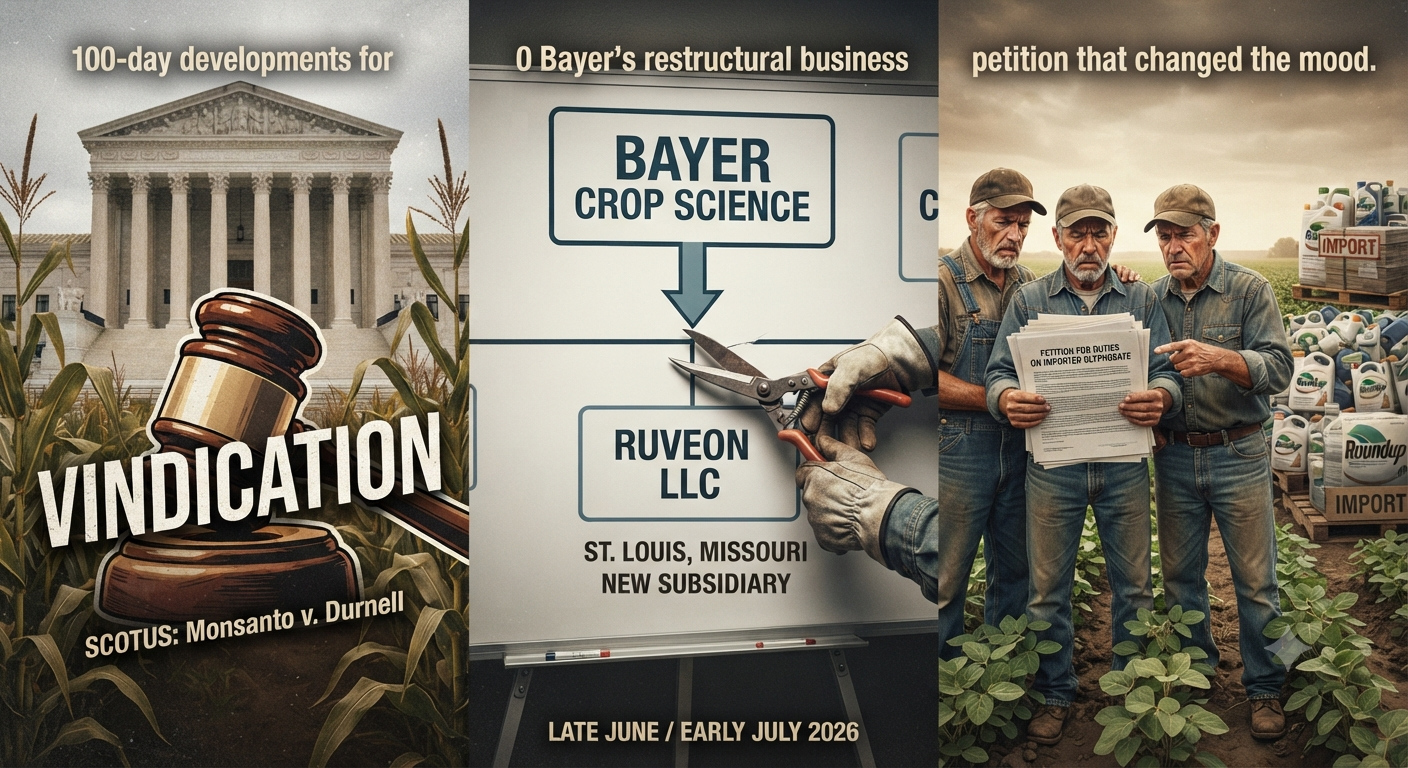
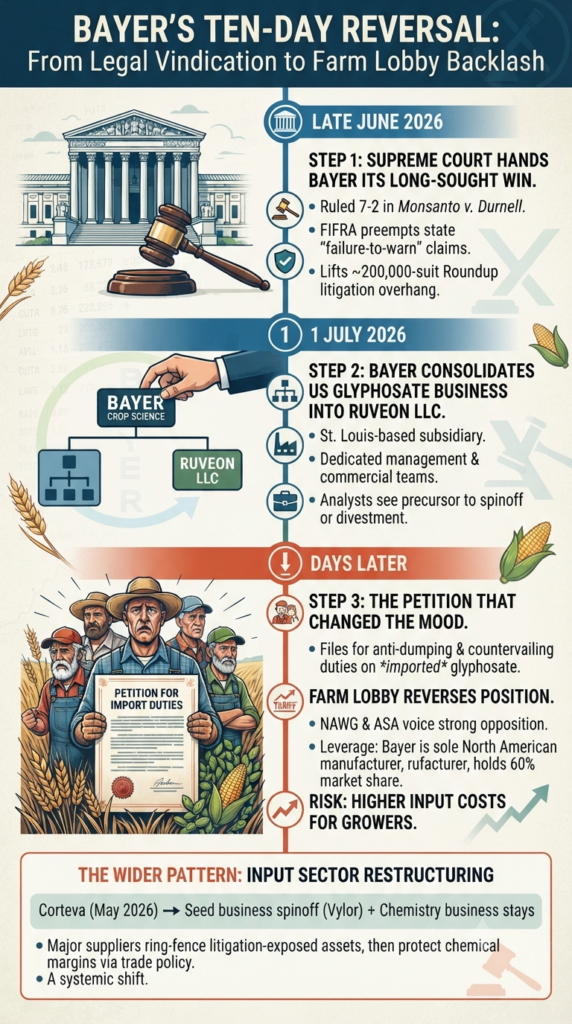
In the space of ten days, Bayer went from being the agricultural input sector’s biggest winner to the target of the farm lobby’s sharpest criticism in years. The sequence matters more than any single event in it.
First came vindication at the highest court in the United States. Then came a corporate restructuring that analysts read as preparation for an exit. Then came a petition that would raise the price of the very product at the centre of both.
For growers already operating on negative margins, the third step erased whatever goodwill the first had earned.
Table of Contents
The Supreme Court hands Bayer its long-sought win
In late June, the US Supreme Court ruled 7-2 in Monsanto v. Durnell that the Federal Insecticide, Fungicide, and Rodenticide Act (FIFRA) preempts state failure-to-warn claims where the Environmental Protection Agency has reviewed a product and declined to require a cancer warning on its label.
The practical effect is enormous. Roughly 200,000 Roundup-related claims have been filed against the company since its 2018 acquisition of Monsanto, and the ruling is expected to lead to the dismissal of a large share of them. It is the outcome Bayer has pursued through years of litigation, provisioning and shareholder pressure — an eight-year overhang lifted in a single decision.
Bayer has said it still intends to proceed with a proposed $7.25 billion class-action settlement to resolve the claims that remain outside the ruling’s reach.
For a company that had, at points, publicly floated discontinuing Roundup sales in the United States altogether because of the litigation burden, the decision changed the strategic calculus entirely.
Enter Ruveon
One week later, on 1 July, Bayer announced that it was consolidating its entire US glyphosate business into a new standalone subsidiary: Ruveon LLC.
Based in St. Louis, Missouri, and led by chief executive Alfonso Alba Ordonez, Ruveon takes sole responsibility for the US glyphosate business — pricing, go-to-market strategy, production and logistics — operating with its own dedicated product and commercial teams covering Roundup and other glyphosate products across agricultural, industrial, turf and ornamental markets.
Bayer framed the move as an execution step within its previously announced Five-Year Framework, the broader plan to reshape Crop Science around growth, resilience and profitability. The company was explicit that the consolidation applies only to the US business and does not affect glyphosate operations in other markets; Canadian product, for instance, will continue to be manufactured in the US by Ruveon and purchased by Bayer Crop Science Canada, with no changes to brands or products.
Analysts read it differently. Reuters reported that some see the Ruveon consolidation as a possible precursor to a spinoff or divestment of the glyphosate business — a structure that would further insulate the parent from residual litigation risk.
The reading is not unreasonable. Ring-fence the asset, establish it as a discrete commercial entity with its own P&L and management, and you have created something that can be sold, spun or retained depending on what the next few years look like. It is also, notably, the same architecture Bayer’s largest competitor is building.
The petition that changed the mood
Then came the third step.
Days after the Ruveon announcement, Bayer’s Monsanto subsidiary and Ruveon filed a petition with the US Department of Commerce and the International Trade Commission seeking anti-dumping and countervailing duties on imported glyphosate products.
Farm groups that had spent the previous week welcoming Bayer’s Supreme Court victory reversed position almost immediately.
The National Association of Wheat Growers and the American Soybean Association both raised objections, pointing to prior trade cases — including duties imposed on imported phosphate fertiliser, and Corteva’s 2024 case on 2,4-D herbicide imports from China and India — that they argue raised costs for growers without delivering proportional benefit. ASA said it strongly opposes the petition and is reviewing the implications for soybean growers.
One farm leader described the move as “highly concerning,” arguing that Bayer was acting for the benefit of its own shareholders at the expense of American farmers.
Why the objection has force
The complaint is not abstract, because the market structure gives Bayer unusual leverage.
Bayer/Monsanto is the only company that manufactures glyphosate from scratch in North America. It produces roughly 60% of the glyphosate sold in the United States and approximately 40% of global sales. Glyphosate generated $2.4 billion in revenue for Bayer in 2024.
Duties on imported glyphosate would, by design, raise the landed cost of the alternatives to a product Bayer already dominates domestically. Whatever the merits of the dumping claim itself, the commercial logic is not subtle.
And the timing lands badly. The Purdue/CME Ag Economy Barometer fell six points this month to its lowest reading since January, with agricultural economists pointing to high input costs and negative margins driving record government payments. The National Corn Growers Association has separately called for input price transparency after research showed US farmers paying more than Brazilian counterparts for seeds and chemicals — in some cases double for certain crop protection products.
Into that environment, a petition to raise the cost of the most widely used herbicide in world agriculture was never going to be received quietly.
The wider pattern: the input sector is restructuring
Bayer is not moving alone, and that context is the more important story.
Corteva Agriscience is executing the same two plays simultaneously. It is splitting its seed and crop protection operations, with the seed and genetics business spinning off under the name Vylor Inc. — announced in May, with separation targeted for the fourth quarter of 2026, and current Corteva chief executive Chuck Magro set to lead it. Vylor will launch with more than 4,000 germplasm patents and over 2,000 biotechnology patents, built on the Pioneer, Brevant and Hoegemeyer brands. Corteva retains the crop protection and digital agriculture businesses.
Corteva also successfully filed a trade petition of its own on 2,4-D imports — the precedent the wheat and soybean growers are now citing against Bayer.
The pattern across both companies is the same: separate the litigation-exposed and commodity-exposed chemistry from the high-margin genetics, then defend the chemistry’s pricing power through trade policy rather than the market.
For growers, that is two of the three largest input suppliers in the world reorganising around margin defence at the same moment margins in the field are negative.
What to watch
Three things will determine how this resolves:
- The ITC’s preliminary determination. The phosphate and 2,4-D cases both went the petitioner’s way. If glyphosate follows, growers should expect input costs to move before the 2027 season.
- Whether Ruveon becomes a spinoff. A divestment would confirm the analyst reading and reshape the herbicide market’s ownership structure.
- Whether the farm lobby’s opposition has teeth. NAWG and ASA objecting is meaningful, but trade petitions are rarely defeated by producer opposition alone.
The Supreme Court removed the risk that had capped Bayer’s Crop Science division for eight years. What the company did with the following ten days tells you what it intends to do with the freedom.
FREQUENTLY ASKED QUESTIONS
What did the Supreme Court decide in Monsanto v. Durnell?
The Court ruled 7-2 that the Federal Insecticide, Fungicide, and Rodenticide Act preempts state failure-to-warn claims where the EPA has reviewed a product and not required a cancer warning on its label. The decision is expected to result in the dismissal of a large share of the roughly 200,000 Roundup-related claims filed against Bayer since 2018.
What is Ruveon LLC?
Ruveon LLC is a new Bayer Group subsidiary, announced on 1 July 2026, that consolidates Bayer’s entire US glyphosate business — including pricing, go-to-market strategy, production and logistics. It is based in St. Louis, Missouri, and led by chief executive Alfonso Alba Ordonez. It remains part of Bayer Group.
Is Bayer selling its glyphosate business?
Bayer has not announced a sale. The company describes Ruveon as an execution step within its Five-Year Framework for Crop Science. However, Reuters has reported that some analysts view the consolidation as a possible precursor to a spinoff or divestment.
Why are farm groups opposed to Bayer’s glyphosate petition?
Bayer/Monsanto is the only from-scratch glyphosate manufacturer in North America, producing around 60% of US supply. Farm groups including the National Association of Wheat Growers and the American Soybean Association argue that duties on imported glyphosate would raise input costs for growers already facing negative margins, citing prior trade cases on phosphate fertiliser and 2,4-D as precedent.
How much glyphosate does Bayer produce?
Bayer/Monsanto produces roughly 60% of the glyphosate sold in the United States and approximately 40% of global sales. The business generated $2.4 billion in revenue in 2024.
What is Vylor?
Vylor Inc. is the name of Corteva Agriscience’s planned seed and genetics spinoff, announced in May 2026 with separation targeted for the fourth quarter of 2026. Corteva will retain its crop protection and digital agriculture businesses.
SOURCES
| Publication | Article | Date |
|---|---|---|
| DTN/Progressive Farmer | Bayer Consolidates Its Glyphosate Business Into Subsidiary Ruveon | 2 July 2026 |
| American Ag Network | Bayer Consolidates U.S. Glyphosate Business Into Subsidiary Ruveon | 2 July 2026 |
| RealAgriculture | Bayer consolidating U.S. glyphosate business into “Ruveon” | July 2026 |
| Dakota News Network | Bayer Consolidates U.S. Glyphosate Business Into Subsidiary Ruveon | 2 July 2026 |
| Reuters (via syndication) | Analyst commentary on Ruveon spinoff potential | July 2026 |
| DTN/Progressive Farmer | Corteva Names Seed Spinoff Vylor, Targets Q4 2026 Separation | 5 May 2026 |
| Farm Policy News (University of Illinois) | Bayer Seeks Glyphosate Import Duties, Angering Farmers | July 2026 |
| AgWeb | USDA Makes Friendly Cut to Corn Stocks in WASDE | 10 July 2026 |
| Purdue University / CME Group | Ag Economy Barometer | July 2026 |

