
Cold chain demand is surging, but so are the disruptions — from new Suez Canal surcharges and Panama Canal draft restrictions to tariff-driven route diversification. Here’s the full storage, transport and shipping picture for F&B.
Two Major Canal Disruptions Are Hitting F&B Freight at the Same Time
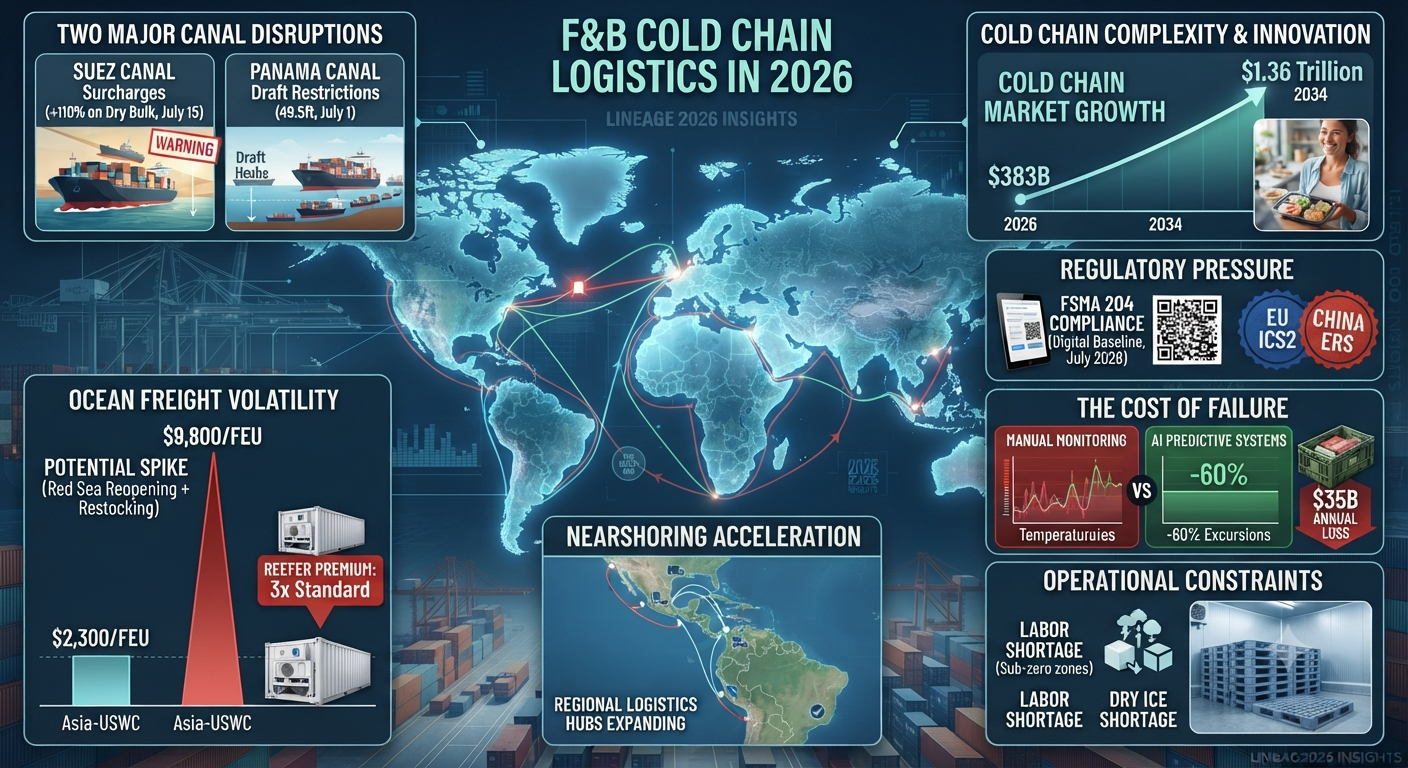
The most urgent development for F&B shippers right now is a collision of two separate canal disruptions landing in the same week. The Suez Canal Authority announced on June 7 a sweeping increase in “temporary surcharges” across nearly all commercial vessel classes, effective July 15, 2026 — with dry bulk carrier surcharges more than doubling from 10% to 22%. Simultaneously, the Panama Canal Authority confirmed it will reduce the maximum allowable draft for Neopanamax locks to 49.5 feet effective July 1, 2026, a climate-driven restriction that will force some vessels to carry less cargo or reroute through transshipment, adding delays particularly for US East Coast and Midwest-bound shipments.
Carriers are already passing these costs directly to shippers via Emergency War Risk Surcharges and Peak Season Surcharges, regardless of whether a vessel transits Suez or reroutes around Africa. Industry analysts warn that any Q3 import pricing built on freight assumptions from before March 2026 is likely underestimating landed container costs by 30-50%, and are urging shippers to lock in space allocations now rather than risk being priced out of the peak shipping season entirely.
Ocean Freight Rates: A Volatile Middle Ground
Broader container shipping data shows a market caught between competing pressures. Base forecasts for 2026 pointed to average rates declining 30-35% compared to 2025, potentially bringing 40-foot container costs from Asia to the US West Coast down to the $2,200-3,200 range. But that outlook assumed relative stability — and analysts specifically flagged that a sudden Red Sea reopening combined with mass US restocking could push rates back up to $9,500 or higher within weeks, echoing the 2022 supply chain crisis. As of Q2 2026, Asia-US West Coast rates were tracking around $2,100-2,700/FEU, with Asia-Mediterranean rates up 15% in recent weekly data — reflecting how the Red Sea diversion continues absorbing global vessel capacity and indirectly propping up rates across other lanes.
For reefer-specific freight specifically, refrigerated containers already carry a 2.5-4x premium over standard containers due to specialized power and maintenance requirements, and that premium is compounding with the current environment of tight capacity and rerouted vessels. Global container fleet capacity is expected to grow around 5-8% in 2026, but with demand growth projected at only 3%, carriers have shown consistent discipline in managing capacity through blank sailings rather than letting rates collapse — meaning shippers shouldn’t expect much structural relief even with fleet growth outpacing demand.
Cold Chain Demand Is Surging Even as Complexity Increases
Despite the freight volatility, underlying demand for temperature-controlled logistics keeps climbing. The global cold chain logistics market is projected to reach $383 billion in 2026, driven primarily by food, beverage and pharmaceutical demand, with the broader market forecast to grow to $1.36 trillion by 2034 at a 13.5% annual rate. Lineage’s 2026 Cold Chain Insights survey of 1,000 supply chain decision-makers across the US, Canada and Mexico found that 72% of organizations report rising demand for refrigerated and frozen foods specifically — reinforcing that this growth is a genuine structural shift in consumer buying patterns, not a temporary spike.
That same survey found geopolitical uncertainty and tariff policy are now among the biggest factors shaping supply chain decisions, with 73% of respondents expecting tariffs to continue negatively affecting their finances through 2026. The practical effect is more temperature-controlled truckload freight and tighter cold storage capacity specifically near borders and ports, as food companies rework sourcing and distribution networks to manage tariff exposure along the US-Mexico and US-Canada corridors.
Regulatory Pressure Is Reshaping How Cold Chain Operators Must Document Everything
FSMA 204 — the FDA’s Food Traceability Rule — continues to be the defining US regulatory driver for food logistics, requiring digital recordkeeping of critical tracking events for high-risk foods including leafy greens, shell eggs, soft cheeses and certain seafood. While enforcement has been delayed to July 2028, industry analysts are consistent in warning that companies building compliant systems now gain real competitive advantage — faster incident response, stronger positioning to win contracts requiring FSMA readiness, and avoidance of costly last-minute scrambles closer to the enforcement date.
This regulatory pressure isn’t isolated to the US. The EU’s Import Control System 2 (ICS2) made electronic pre-notification of shipment data mandatory as of September 2025, and China significantly tightened its food exporter registration and customs procedures through 2025 updates to its Import Food Enterprise Registration system. Collectively, these shifts mean 2026 marks digitalization becoming a baseline regulatory requirement across major trading regions, rather than an optional operational upgrade — isolated systems and manual controls increasingly fail to meet current compliance requirements outright.
The Cost of Getting It Wrong Remains Enormous
The financial stakes for cold chain failures are substantial and well-documented. The industry loses an estimated $35 billion annually to temperature excursions — shipments that arrive spoiled, damaged or unusable due to breakdowns between pickup and delivery. Roughly 20% of temperature-sensitive products are damaged in transit, with causes ranging from equipment malfunction and human error to inadequate pre-cooling and handoff gaps between supply chain partners. Fleets that have implemented comprehensive real-time monitoring report 20-30% reductions in product loss, while AI-powered predictive systems specifically show 45-60% reductions in temperature excursions compared to manual monitoring — a return on investment substantial enough that food waste reduction more broadly is estimated to return $14 in savings for every $1 invested.
AI and Automation Are Delivering Measurable Results, Not Just Promise
Unlike some corners of food tech where AI adoption remains largely aspirational, cold chain logistics is showing genuine measurable returns. In the Lineage survey, 60% of respondents ranked data and AI among the top forces transforming their operations in 2026, with AI most frequently cited as improving planning coordination (45% of respondents), productivity and efficiency (37%), and spoilage reduction specifically (34%). Notably, 24% of companies reported AI investments already exceeding ROI expectations, with most others reporting they were meeting or nearing targets — a genuinely strong early return profile for a technology category still being actively rolled out.
Practical applications already in deployment include AI-driven route optimization that adjusts delivery schedules around weather and traffic disruptions to reduce temperature excursion risk, predictive maintenance scheduling for refrigeration units to reduce downtime, and machine-learning demand forecasting that helps allocate cold storage space and transport resources more efficiently ahead of demand spikes.
Labor and Physical Infrastructure Remain Persistent Constraints
Even as digital tools advance, the physical and human side of cold chain operations continues facing real constraints. Recruiting and retaining workers willing to operate in sub-zero conditions remains a chronic challenge, pushing more 3PLs toward part-time and shorter shift structures that let workers rotate in and out of cold zones without burnout. Dry ice and coolant materials are also in genuinely short supply, with a limited number of suppliers and narrow product shelf life forcing operators to be far more deliberate about usage and timing than in previous years.
On the equipment side, pallet standardization has emerged as a specific operational focus for 2026 — plastic pallets are increasingly favored over wood in refrigerated environments because they provide the uniform, non-porous platforms that automation systems and consistent temperature control require, with pallet pooling helping eliminate empty return inefficiencies and quality variability across multi-partner cold chains.
Nearshoring and Route Diversification Are Accelerating
With Middle East tensions, Red Sea disruptions and Panama Canal restrictions all converging, nearshoring is gaining real momentum as a structural response rather than a temporary workaround. Mexico and South America are increasingly highlighted as beneficiaries, with growing investment in coastal shipping, bioceanic corridors and regional logistics hubs specifically designed to reduce dependency on the most disrupted long-haul routes. Latin America already accounts for roughly 25% of global food exports, and cold storage operators in the region are actively expanding logistics hubs near ports and major consumption centers specifically to capture this shift, reducing food loss and building resilience into increasingly volatile long-haul networks.
What This Means for F&B Supply Chain Teams
- Lock in ocean freight capacity now, not closer to Q3 peak season. With Suez surcharges landing July 15 and Panama draft restrictions already in effect, waiting to book is likely to mean paying significantly more or losing space entirely.
- Treat FSMA 204 compliance as a 2026 priority despite the 2028 enforcement delay. The competitive and risk-mitigation case for building traceability systems now is strong regardless of the regulatory deadline.
- Evaluate cold storage partners on technology and flexibility, not just capacity. Nearly half of surveyed supply chain leaders say their current providers are least prepared on up-to-date technology — a clear differentiation opportunity for providers and a due-diligence priority for shippers.
- Build tariff and route diversification into standing logistics strategy, not just crisis response — nearshoring toward Mexico and South America is increasingly a structural hedge, not a temporary fix.
- Budget for reefer premium volatility specifically. With refrigerated containers already carrying a 2.5-4x cost premium over standard containers, any broader freight rate spike will hit temperature-controlled shipments disproportionately hard.
The Bottom Line
Food and beverage storage, transport and shipping in 2026 is defined by a genuine paradox: demand for cold chain capacity is growing strongly and structurally, even as the routes and regulatory environment supporting that capacity become more volatile and expensive to navigate. The companies managing this well aren’t the ones reacting to each individual disruption — the Suez surcharge, the Panama restriction, a tariff shift — but the ones that have already built the data visibility, route flexibility and compliance infrastructure to absorb whatever comes next as a matter of course rather than a crisis.
Sources
FAQ
Why are ocean freight rates spiking in July 2026?
A combination of new Suez Canal surcharges effective July 15 and Panama Canal draft restrictions effective July 1 is tightening capacity and driving up costs simultaneously, regardless of which route a vessel uses.
How big is the cold chain logistics market in 2026?
The global cold chain logistics market is projected to reach $383 billion in 2026, growing toward $1.36 trillion by 2034, driven primarily by food, beverage and pharmaceutical demand.
What is FSMA 204 and does it affect my business now?
FSMA 204 is the FDA’s Food Traceability Rule requiring digital recordkeeping for high-risk foods like leafy greens, shell eggs and certain seafood. Enforcement is delayed to July 2028, but building compliant systems now provides competitive and risk-mitigation advantages ahead of that deadline.
How much does temperature excursion cost the industry?
The cold chain industry loses an estimated $35 billion annually to temperature excursions, with roughly 20% of temperature-sensitive products damaged in transit due to equipment failure, human error or handoff gaps.
Is nearshoring a real trend or just discussion?
It’s an accelerating structural response. Mexico and South America are seeing genuine new investment in coastal shipping, bioceanic corridors and logistics hubs specifically to reduce dependence on the most disrupted long-haul shipping routes.
How much more expensive are refrigerated containers than standard ones?
Reefer containers typically cost 2.5-4 times more than standard containers due to specialized power and maintenance requirements, meaning any broader freight rate spike disproportionately affects temperature-controlled food and beverage shipments.

