
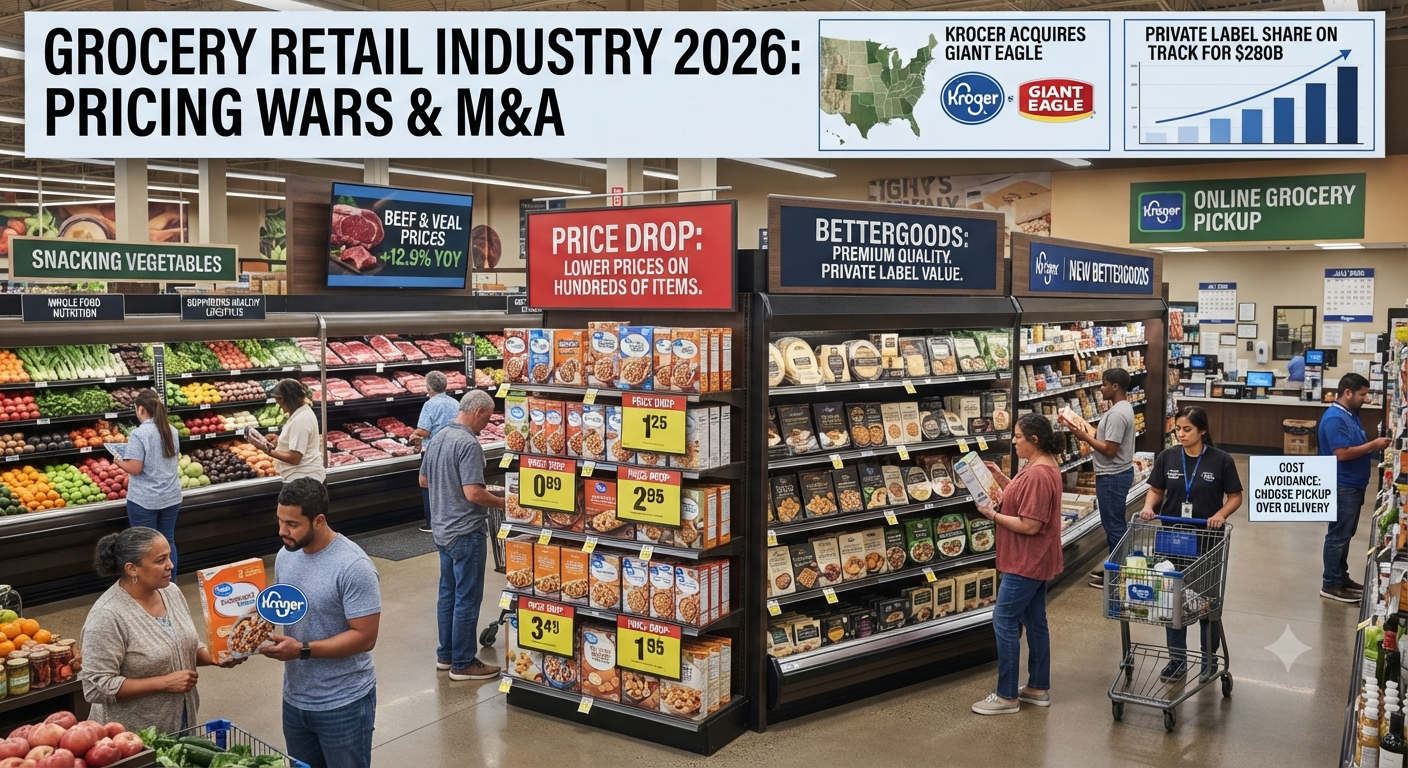
Kroger’s $1.65 billion Giant Eagle acquisition lands in the middle of an industry-wide grocery pricing war, accelerating regional M&A, and a consumer base still squeezed by food inflation and shrinking SNAP support.
Table of Contents
Kroger’s Giant Eagle Deal Signals a New Wave of Grocery M&A
The biggest grocery retail news of the week is also one of the clearest signals of where the industry is heading. Kroger announced on July 1 that it will acquire Pennsylvania-based Giant Eagle for $1.65 billion, expanding its footprint into Indiana, Maryland, Ohio and West Virginia. Giant Eagle generates approximately $9 billion in annual sales, and the deal — Kroger’s first under new CEO Greg Foran, the former head of Walmart U.S. — is expected to close in 2027 pending regulatory approval.
Kroger says it doesn’t anticipate store closures or frontline job losses from the deal, though retail researchers note some corporate-level reduction typically follows acquisitions of this kind. The timing matters: this is the first major grocery consolidation since the collapse of Kroger’s proposed mega-merger with Albertsons at the end of 2024, and industry analysts had already predicted that while national mega-mergers are unlikely to return, M&A activity among smaller and regional chains would accelerate through 2026 as regional players get squeezed between discount and specialty competitors — a dynamic some have described as the “collapse of the middle.”
The Grocery Pricing War Is Intensifying
Kroger’s acquisition lands squarely in the middle of an aggressive industry-wide pricing war. Foran has been explicit about wanting to make Kroger more price-competitive with Walmart and Aldi, telling media the company plans to roll out widespread price reductions. Kroger isn’t alone: Stop & Shop announced in May it had finished rolling out lower everyday prices across its more than 350 stores, and Ahold Delhaize-owned Food Lion recently launched a three-week loyalty savings event offering up to 50% off select products.
The competitive pressure is coming primarily from discount and warehouse formats. Aldi plans to open roughly 180 new US stores in 2026 as part of a broader $9 billion investment strategy, even as Kroger and Albertsons continue closing underperforming locations. Aldi’s chief commercial officer put the ambition bluntly, saying the company is trying to take market share from anyone who sells groceries, with no clear ceiling on how far that expansion goes. Regionally, this dynamic is playing out visibly — in the Richmond, Virginia market, for example, Walmart grew its grocery market share to roughly 17 cents of every dollar spent without opening a single new store, while Aldi grew sales despite no new store openings either, with rising food prices cited as the key driver pushing shoppers toward value formats.
Kroger’s own recent earnings reflect the pressure directly: same-store sales growth slowed to 1% for the quarter, down sharply from 3.2% in the same period a year earlier. Foran attributed the slowdown explicitly to consumer strain, citing high gas prices and reduced SNAP benefits squeezing household budgets and pushing shoppers toward more careful, deliberate spending.
Food Prices Remain a Persistent Pressure Point
USDA’s Economic Research Service data confirms the consumer squeeze is real and ongoing. Food-at-home (grocery) prices rose 2.7% year-on-year as of May 2026, while food-away-from-home prices rose 3.5%. Looking ahead, USDA projects food-at-home prices will rise 2.8% for the full year 2026, faster than the 20-year historical average, with beef and veal, fish and seafood, fresh fruits, fresh vegetables, and sugar and sweets all projected to grow faster than their historical norms. Beef and veal prices specifically were 12.9% higher in May 2026 than a year earlier, directly reflecting the historically tight US cattle supply discussed elsewhere in current agricultural reporting.
Around 70% of shoppers report being extremely or very concerned about rising grocery prices, and a separate survey found 68% say they are struggling to afford groceries outright. This is translating directly into shopping behavior: nearly 80% of shoppers have traded down to lower-priced brands or private label in at least one category, and roughly two-thirds of all shoppers now say they buy store brands often or always.
SNAP Changes Are Adding a New Layer of Financial Strain
Federal changes to SNAP are compounding price pressure for lower-income households specifically. Beyond benefit reductions already affecting consumer spending, new state-level cost-sharing rules take effect starting federal fiscal year 2028: states with SNAP payment error rates above 6% will need to cover at least 5% of benefit costs, rising to 10% for error rates between 8-10%, and 15% for states at or above 10%. States with error rates of 6% or higher must also file improvement plans with USDA. This creates a direct incentive for states to tighten SNAP administration — a shift retailers and food access advocates are watching closely given the program’s role in grocery spending for lower-income households.
Private Label Is Becoming a Core Strategic Battleground
Private label has moved well beyond a defensive cost play and into genuine strategic investment territory. According to McKinsey’s State of Grocery North America 2026 research, 69% of consumers now say private brands innovate as much as national brands, and nearly a third of consumers expect to increase their private label purchases over the next year. Grocers are responding accordingly: roughly 97% expect to increase investment in private label innovation over the next two to three years, with nearly half of merchandising, product design and trend identification work increasingly managed by internal teams rather than outsourced to suppliers.
This is showing up in tiered private label strategies specifically — Walmart, for example, runs both entry-level value lines like Great Value and premium ranges like Bettergoods designed to rival national brand quality. US private label sales were on track to reach a record $280 billion by the end of 2025, and that trajectory is expected to continue through 2026.
Online Grocery and Fulfillment Continue Scaling, But Physical Stores Remain Central
Online grocery sales are projected to reach roughly 20% of the total US grocery market in 2026, up from just 8.1% in 2020 — several years ahead of pre-pandemic projections. Yet physical stores remain firmly central to how Americans shop: 54% of grocery shoppers say they always shop in-store at their primary grocery retailer, and in-person shopping continues to be strongly associated with confidence and control, particularly for perishables like produce and meat.
Fulfillment innovation continues advancing on the delivery side. Walmart marked its one millionth drone delivery in June 2026 as major retailers scale rapid, on-demand delivery capabilities alongside expanded third-party delivery partnerships and subscription-based delivery programs. Notably, 76% of online grocery customers still prefer pickup over home delivery, with cost avoidance — avoiding delivery fees and surcharges — cited as the primary reason.
GLP-1 Medications Are Reshaping the Grocery Perimeter
Consistent with broader food industry trends, GLP-1 weight-loss medications are having a measurable effect on grocery shopping patterns specifically. Perimeter categories — fresh vegetables, salad kits, meat and other nutrient-dense whole foods — are seeing increased demand as GLP-1 users eat less overall but prioritize nutritional density per bite. Retailers report the vegetable snacking category taking off specifically, with pre-cut, ready-to-eat produce options expanding to meet demand from time-pressed, appetite-reduced shoppers. This is reinforcing a broader “back-to-basics” trend toward minimally processed foods and shorter ingredient lists across the shopping basket.
What This Means for Grocery-Adjacent Suppliers and Brands
- Private label capability is now a genuine competitive differentiator, not just a cost play. Suppliers should expect grocers to bring more product development in-house, shifting the nature of retailer-supplier relationships toward strategic partnership rather than pure supply.
- Value positioning and price transparency matter more than ever. With nearly 80% of shoppers trading down in at least one category, brands and suppliers need pricing and promotional strategies built around genuine, visible value rather than complexity.
- Regional grocery M&A activity is likely to continue accelerating, creating both consolidation risk for smaller regional players and partnership opportunity for suppliers positioned to scale with acquiring chains.
- Perimeter categories — produce, fresh meat, prepared foods — deserve continued investment given both GLP-1-driven demand shifts and their role as a genuine differentiator against pure e-commerce and discount formats.
- SNAP-dependent categories and price points need active monitoring, given both current benefit reductions and the incoming state cost-sharing structure set to take effect in fiscal 2028.
The Bottom Line
Grocery retail in 2026 is defined by a genuine price war playing out against a backdrop of real consumer financial strain — and the Kroger-Giant Eagle deal is best understood as a direct response to that environment rather than an isolated event. Discount and value-focused formats are winning share, private label is becoming a serious strategic investment rather than a budget afterthought, and further regional consolidation looks highly likely as squeezed mid-market grocers become acquisition targets. For anyone supplying into or investing in this sector, the throughline is consistent: value, not experience, is currently the primary battleground.
Related
Sources
FAQ
Why is Kroger acquiring Giant Eagle?
Kroger says the $1.65 billion deal expands its footprint into attractive adjacent markets in Indiana, Maryland, Ohio, Pennsylvania and West Virginia, leveraging Giant Eagle’s strong regional reputation in fresh products, pharmacy and private label. It’s Kroger’s first major deal under new CEO Greg Foran.
Is the grocery pricing war affecting all retailers equally?
No. Discount formats like Aldi and warehouse clubs are gaining share fastest, while traditional supermarkets including Kroger, Stop & Shop and Food Lion are actively cutting prices and running promotions to remain competitive.
How much are grocery prices expected to rise in 2026?
USDA projects food-at-home (grocery) prices will rise 2.8% for 2026, faster than the 20-year historical average, with beef, seafood, fresh produce and sugar and sweets among the categories rising fastest.
How is SNAP affecting grocery retail right now?
Reduced SNAP benefits are already squeezing lower-income shoppers’ budgets, and new state cost-sharing rules taking effect in fiscal 2028 will require states with high payment error rates to cover a growing share of benefit costs, adding further pressure to SNAP-dependent grocery spending.
Is online grocery shopping overtaking physical stores?
Not yet. While online sales are projected to reach roughly 20% of the US grocery market in 2026, 54% of shoppers still say they always shop in-store at their primary grocery retailer, particularly for perishables like produce and meat.
Why is private label growing so quickly?
Consumer trust in private label quality has risen sharply — 69% of shoppers now say private brands innovate as much as national brands — prompting grocers to treat private label as a core strategic investment rather than a simple cost-saving measure.

