
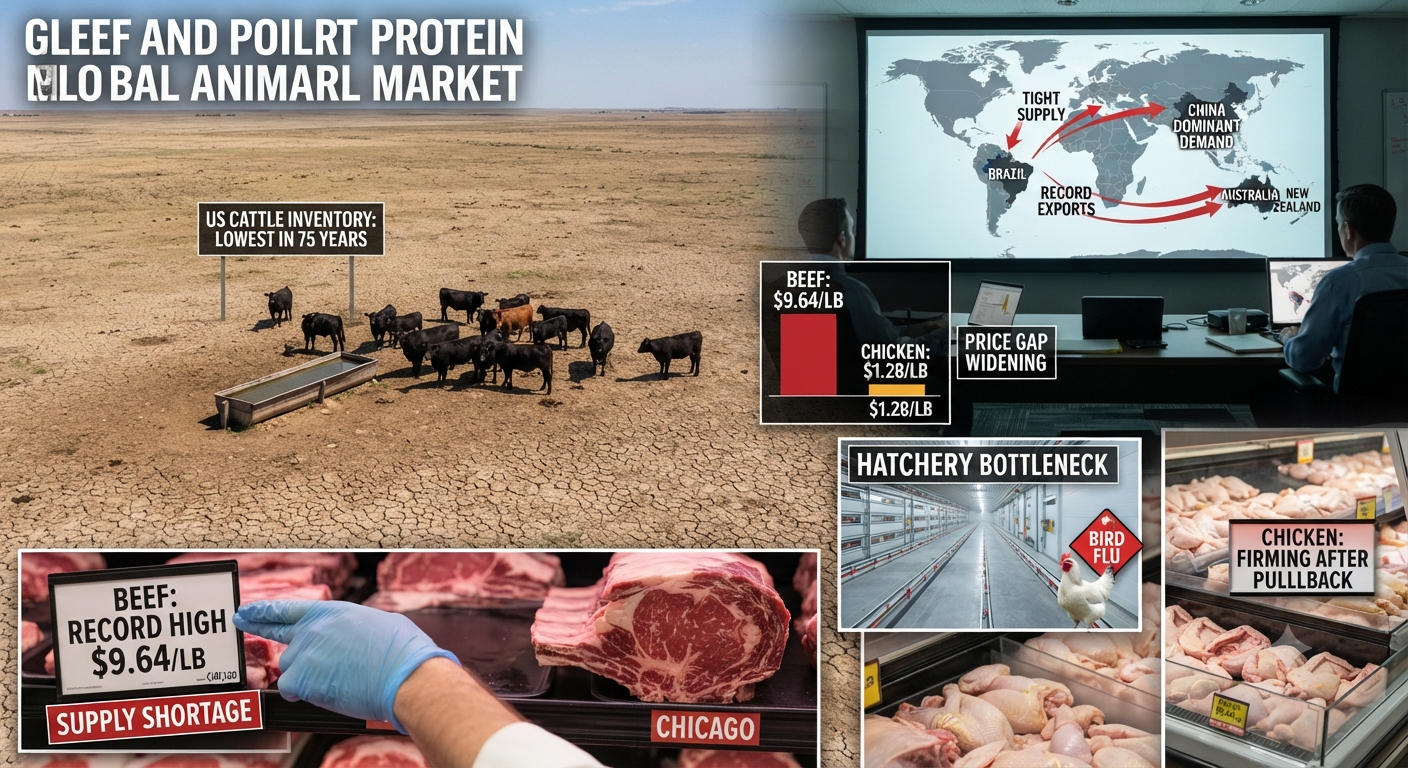
US cattle herds are at their smallest in 75 years and beef prices keep setting records, while poultry battles its own bird flu and hatchery bottlenecks. Here’s the complete global beef and poultry supply and pricing picture.
Table of Contents
Beef: The Tightest Global Supply in Decades
2026 marks a genuine inflection point for global beef. According to Rabobank’s Global Animal Protein Outlook 2026, this year will bring the first contraction in global land-based protein production in six years, with beef leading that decline — a sharp contrast to continued growth in poultry and aquaculture.
United States: Smallest Herd in 75 Years, Record Prices
The core driver is structural. The US cattle inventory currently sits at its lowest level in 75 years, the result of years of drought and elevated operating costs that pushed producers to liquidate herds rather than rebuild them. Total US cow slaughter fell to just below 5 million head in 2025 — down 11% year-on-year and the third consecutive annual decline, with slaughter this low not seen since 2005.
The price impact has been dramatic. The national average retail price for all-fresh beef hit a record $9.64 per pound in April 2026, up 13% year-on-year, and feeder steer prices at the Oklahoma City National Stockyards climbed to an all-time high of $388.06 per hundredweight in early May. USDA’s Economic Research Service has responded by raising its 2026 slaughter steer price forecast to $250.16 per cwt, while lowering feeder steer forecasts slightly to $375.22 per cwt on more recent quarterly data. Analysts at Rabobank expect new highs in underlying cattle markets through 2026 and 2027 before prices begin to stabilize and soften.
US beef production is forecast at 25.438 billion pounds for 2026, continuing a downward trend, while beef imports are expected to keep climbing to help offset domestic shortfalls — imports already hit a record share of 17% of total US beef supply in 2025, up from 14% the year before. Exports are moving the opposite direction: USDA-FAS forecasts a roughly 4% decline in US beef exports in 2026 as tightening domestic supply makes American beef less price-competitive against Australian and Brazilian product, even as Japan and South Korea remain the two largest destination markets.
Herd rebuilding is not expected to meaningfully begin until 2027, and even then only gradually — feeder cattle and calf imports from Mexico, historically around 1.2 million head annually, remain constrained by New World screwworm-related import restrictions, with only 500,000 to 800,000 head expected to resume even if imports restart in early 2026.
Brazil: Lower Production, Record Exports
Brazil enters 2026 at what Rabobank calls a strategic turning point in its cattle cycle. After four consecutive years of production growth, the country is now entering a female retention phase to rebuild its herd — a shift expected to cut Brazilian beef production by 5-6% in 2026, down to roughly 10.5 million tonnes.
Paradoxically, Brazilian beef exports are forecast to hit a new record of 4.4 million tonnes despite the lower output, driven by strong global demand, a weak Brazilian real, and reduced competition from other suppliers. China remains Brazil’s dominant export market, absorbing more than half of the country’s total beef exports. Domestic Brazilian consumption is expected to fall by as much as 9% as high prices push local consumers toward cheaper protein alternatives.
China: Import Demand Cooling Slightly, But Still Dominant
China currently accounts for roughly 30% of global beef consumption via imports and is entering what analysts describe as an adjustment period. After two years of herd liquidation, Chinese domestic beef production is projected to decline slightly in 2026, while Chinese beef imports are expected to ease by 2-3% — not from weaker demand, but because of tighter global supply and higher prices constraining what’s available to buy. Chinese retail beef demand remains resilient, with particular strength in online sales channels, though foodservice recovery has been more modest.
European Union, Australia and New Zealand
EU beef production is expected to stabilize at already-low levels in 2026, with structural livestock decline, strict environmental regulation, and limited short-term room for expansion keeping the bloc reliant on imports — a dynamic that benefits Mercosur exporters like Brazil, even though the EU-Mercosur trade agreement’s initial 2026 impact is expected to be moderate.
Australia is the clear bright spot on the supply side, with production forecast to hold near record highs at 2.85 million tonnes in 2026, supported by large cattle inventories and strong export demand from the US, Japan, South Korea and China. Australian prices are expected to hold firm, with the National Young Cattle Indicator forecast in the A$4.30-4.80/kg range. New Zealand beef output is set to recover gradually, with the cattle population projected to grow 3%, and export prices expected to remain roughly 15% above the five-year average.
US Politics Adding Volatility
US beef markets have also been buffeted by political interference in recent months. Presidential comments about potentially purchasing beef from Argentina to lower domestic prices triggered sharp cattle futures declines despite no actual policy being implemented, and separate comments blaming tariffs for high cattle prices caused a further market pullback. Analysts note that even a proposed expansion of Argentine beef imports from 20,000 to 80,000 metric tons would add only about 0.5% to total US supply — not enough to meaningfully move prices, but enough to inject real uncertainty into futures markets.
Poultry: A Tighter Market Than the “Cheap Chicken” Reputation Suggests
Poultry has traditionally served as the budget-friendly alternative when beef prices rise, but 2026 has brought its own supply-side complications, chiefly avian influenza and a deepening hatchery bottleneck.
Bird Flu and the Hatchery Problem
USDA’s February 2026 WASDE report cut poultry production forecasts, citing persistent Highly Pathogenic Avian Influenza (HPAI) outbreaks combined with disappointing hatchery data. A “pullet bottleneck” has emerged in the data, with breeder flock replenishment lagging what’s needed to support meaningful production growth — a trend analysts attribute to a mix of strategic producer decisions to protect price floors and the biological reality imposed by ongoing HPAI risk.
The math is telling: the US poultry industry produced more than 9 billion broilers last year, requiring roughly 12 billion eggs to meet capacity. If fertility rates continue declining, it would take closer to 15 billion eggs to hatch that same 9 billion viable broiler chicks — a structural efficiency problem layered on top of disease risk. Texas A&M AgriLife Extension specialists note that while broiler farms have been less affected by HPAI than layer flocks and turkey operations, concern about laying facilities supplying fertilized eggs to broiler hatcheries remains the primary risk through the summer.
Prices: Firming After a Mid-2025 Peak and Pullback
As of mid-February 2026, the national composite wholesale broiler price was hovering between 126 and 128 cents per pound, with jumbo wings and boneless skinless breasts seeing sharper price increases than whole birds. Wholesale boneless, skinless chicken breast prices had spiked near $2.77 per pound in mid-2025 before sliding to $1.16 per pound by year-end — and analysts now expect prices to climb again as production slows in response to the hatchery and disease pressures.
Despite these headwinds, USDA’s outlook still calls for higher broiler and turkey production in 2026, with total US chicken consumption forecast at roughly 42.16 billion pounds — up 1% from 2025 and up a striking 26% over the past decade, reinforcing chicken’s position as the most consumed meat in America. Chicken remains structurally the most affordable major protein, a factor helping sustain demand even as beef prices climb to records.
Egg Prices: Recovery Underway, But Fragile
Egg markets tell a somewhat different story than broiler meat. After peaking above $4 per dozen in wholesale terms during 2024’s severe HPAI outbreaks, USDA reported wholesale egg prices had dropped 64% and retail prices had fallen 27% from their peak, aided by a five-pronged federal biosecurity strategy. The 2026 table egg production forecast anticipates a 7.7% increase over 2025, reflecting expectations that laying flocks continue rebuilding without further major HPAI disruption — though that recovery remains contingent on avoiding new large-scale outbreaks, which industry sources say is not guaranteed given HPAI’s continued circulation in wild bird populations.
Canada and Global Poultry Notes
Canada’s early 2026 chicken output faced its own constraint risk from active commercial avian flu cases reported in British Columbia and Ontario, even as import fill rates under CPTPP and CUSMA trade agreements remained near 100% in 2025 and were expected to hold in 2026. Frozen chicken stocks in Canada, adjusted for population growth, were tracking near per-capita lows last seen in 2020 — indicating limited buffer against any further supply disruption.
How Beef and Poultry Prices Compare
The price gap between beef and other proteins continues widening even as poultry and pork supplies remain relatively ample. Despite growing chicken production and lower chicken prices at the meat counter, beef’s structural supply shortage means the retail price differential between beef and its lower-cost protein alternatives is expected to keep growing through 2026 — a dynamic already visible in market data showing broad-based retail fresh meat inflation across categories as of May 2026.
What’s Ahead
Several dynamics are worth tracking closely for the remainder of 2026:
- US herd rebuilding remains a 2027 story, not a 2026 one. With minimal heifer retention so far, expect continued tight US cattle supply and elevated prices through the rest of this year.
- Brazil’s export record depends on continued Chinese demand. Any slowdown in China’s beef import appetite would directly affect Brazil’s ability to hit its projected 4.4 million tonne export target.
- HPAI remains the single biggest wildcard for poultry. A significant new outbreak wave, particularly in layer or breeder flocks, could rapidly reverse the fragile egg price recovery and further squeeze broiler hatchery capacity.
- Political rhetoric around beef prices is likely to keep injecting volatility into futures markets, independent of actual underlying supply and demand fundamentals.
- New price transparency tools are emerging. CME Group’s planned launch of 90CL and 50CL lean beef trim futures contracts, expected around July 20, 2026, pending regulatory approval, will give retailers and foodservice buyers a new exchange-traded tool for managing beef price risk — the first new CME beef trim contracts in decades.
The Bottom Line
Global beef supply is genuinely constrained — not a temporary blip but the product of multi-year herd liquidation across North America colliding with a strategic rebuilding phase in Brazil, the world’s top exporter. That combination points to elevated beef prices persisting through 2026 and likely into 2027, with Brazil, Australia and New Zealand best positioned to capture the resulting trade opportunities. Poultry, while structurally better supplied, is not the frictionless safety valve it once was — bird flu and a hatchery fertility problem mean chicken prices are more likely to firm than fall over the second half of 2026, even as it remains the cheapest major protein on the shelf.
Related
Sources
FAQ
Why are global beef prices so high in 2026?
The US cattle herd is at its smallest in 75 years due to years of drought-driven liquidation, while Brazil — the world’s top exporter — is simultaneously entering a herd-rebuilding phase that’s cutting its own production by 5-6%. Both major supply sources are constrained at the same time.
Will US beef prices come down soon?
Not in the near term. Analysts expect new record highs through 2026 and into 2027, with meaningful herd rebuilding not likely to begin until 2027 at the earliest.
Is poultry still cheaper than beef?
Yes, chicken remains the most affordable major protein and the most consumed meat in the US. However, bird flu outbreaks and a hatchery fertility bottleneck mean poultry prices are expected to firm rather than fall through the rest of 2026.
How is China affecting global beef and poultry markets?
China accounts for roughly 30% of global beef consumption through imports and remains Brazil’s largest beef export market, absorbing more than half of Brazilian exports. Chinese beef imports are expected to ease slightly in 2026 due to tighter global supply and higher prices, not weaker demand.
Which countries have the strongest beef export positions in 2026?
Brazil is forecast to hit a record 4.4 million tonnes of beef exports despite lower production. Australia is expected to maintain near-record production levels, and New Zealand’s output is recovering gradually — all three are positioned to benefit from reduced US export competitiveness.
Is bird flu still a major risk to poultry supply?
Yes. HPAI outbreaks continue to affect laying flocks, turkey operations and, to a lesser extent, broiler farms, and remain the single largest wildcard for both poultry meat and egg supply through 2026.

