
From a shrinking Brazilian orange crop to a surge in South African apple exports to China and a $11 billion US aid request for specialty crop growers, here’s what moved fresh produce markets this week.
Table of Contents
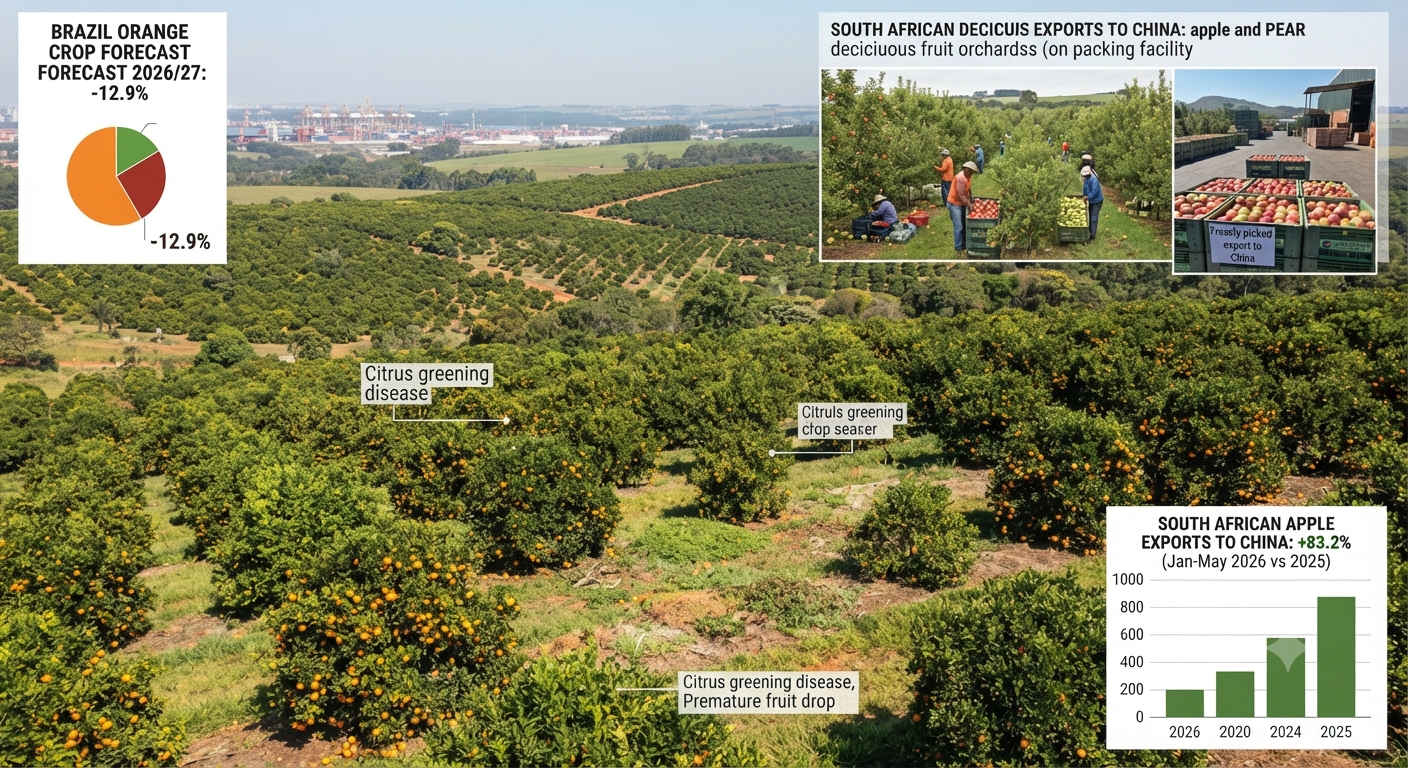
Brazil’s Orange Crop Set to Shrink Nearly 13% for 2026/27
Brazilian citrus data released this week points to a meaningfully smaller orange harvest ahead. According to Fundecitrus, the orange crop forecast for the São Paulo and West-Southwest Minas Gerais belt — Brazil’s main producing region — stands at 255.2 million boxes of 40.8kg each for 2026/27, a 12.9% decline from the current season.
The shortfall comes down to fewer fruits per tree and higher premature fruit drop, outweighing gains from larger fruit size and additional trees. Fundecitrus links the decline in fruit per tree to climatic factors, including the developing El Niño, compounded by ongoing greening disease pressure across the citrus sector.
The timing is notable given demand is already soft. Orange juice concentrate prices (FCA Europe) stood at $2,900 per metric ton as of late May, down 3% month-on-month and 36% year-on-year, with producers under pressure to move high inventory levels. Sources also point to the Middle East conflict as a factor suppressing consumer demand, with buyers prioritizing essential purchases over non-essential items — though a smaller 2026/27 crop could help rebalance supply and demand if consumption stabilizes.
US Specialty Crop Growers in Line for $11 Billion Aid Package
The White House is asking Congress to approve $11.1 billion in supplemental agricultural assistance, with $10 billion earmarked as temporary economic aid for row and specialty crop producers who planted in 2026, plus $1.1 billion in targeted disaster assistance for Florida growers recovering from severe winter storm damage.
The request, submitted by the White House Office of Management and Budget as part of an $87.6 billion supplemental spending package, comes as specialty crop growers contend with elevated production costs, labor expenses and ongoing market uncertainty. If approved, this would supplement the roughly $12 billion in farm assistance already distributed this year, meaningfully increasing total USDA direct payments to farmers for 2026 and reinforcing the current administration’s reliance on direct financial support for the farm economy.
South African Fruit Exports to China Post Strong Growth
South African apple imports into China are up sharply this year. Customs data shows China imported 9,297.3 metric tons of South African apples between January and May 2026, an 83.2% increase over the 5,075.7 metric tons imported over the same period last year. Pear imports also grew, up 26.6% year-on-year to 1,017.1 metric tons.
Importer Jiafeng Agricultural Products Trading recently ran a two-week promotional campaign across 50 Uncle Fruit stores in Guangzhou and Foshan to capitalize on peak South African apple and pear season, which runs from February through late autumn in the Northern Hemisphere — timed to bridge the gap when domestic Chinese apples are out of season. The company expects to expand import volumes further as China’s zero-tariff policy for African countries reduces import costs, and plans to introduce additional varieties, including Royal Gala, this year.
This bright spot comes even as South African apple exporters face separate tariff uncertainty in another key market: concerns are growing over potential tariff exposure for South African apples in India, a dynamic worth watching for exporters diversifying beyond traditional European and Asian destinations.
South African Agribusiness Confidence Falls to Post-2024 Low
South Africa’s Agbiz/IDC Agribusiness Confidence Index fell a further 4 points to 45 in Q2 2026, following an 18-point decline in Q1 — its lowest reading since Q2 2024. An index reading below the neutral 50-point mark indicates prevailing pessimism among the agribusinesses surveyed.
The capital investment subindex fell 20 points to 33, its lowest level since 2006, while general economic conditions dropped 33 points to 28 — the lowest since Q3 2023. Export volumes fell 13 points to 38 on concerns over logistics disruption and higher shipping costs tied to the Middle East conflict, even though actual agricultural export activity held up well: South Africa’s agricultural exports reached $3.7 billion in Q1 2026, up 11% year-on-year.
Not all indicators moved lower. Turnover rose 17 points to 67 on the back of strong fruit and vegetable harvests, and farm employment increased 3% year-on-year to 960,000 jobs. Agbiz chief economist Wandile Sihlobo flagged foot-and-mouth disease as an ongoing challenge for livestock and pig producers, alongside Middle East-linked cost pressure and — notably — concern among respondents about a developing El Niño heading into the 2026/27 production season, even as current-season conditions have benefited from favorable La Niña rainfall.
Styrian Apple Growers Bracing for Yield Losses
European apple production is facing its own weather-driven setback. Austria’s Vienna wholesale market is reporting that yield losses of up to 30% are expected for Styrian apples this season, adding to a broader pattern of tightening apple supply across parts of Eastern and Central Europe, where processing demand remains strong even as fresh supply tightens.
What’s Moving in the Vegetable Sector
On the vegetable side, labor and trade policy dominated the week’s US coverage. Long-awaited SAWA labor reform legislation dropped this week, aiming to overhaul the H-2A guest worker program — a move already dividing agricultural organizations and immigration advocates over its approach to workforce reform. Michigan’s asparagus growers, meanwhile, report cautious optimism despite rising costs and import pressure, buoyed by improving market conditions and a new generation of growers entering the sector.
Elsewhere, garlic markets remain a global flashpoint: Brazilian garlic supply chains are reporting continued disruption from Chinese dumping, while French growers are on alert as prices for the cheapest garlic varieties rise despite a generally satisfactory 2026 growing season. China has also tightened import rules for seed potatoes and vegetable seeds, a development worth monitoring for any seed-supply-dependent vegetable operations sourcing from or through China.
The Bottom Line
This week’s news reinforces a theme running through the broader 2026 season: fresh produce markets are being shaped simultaneously by weather (Brazil’s citrus shortfall, Styrian apple losses, El Niño anxiety baked into South Africa’s confidence survey), policy and trade shifts (the US aid package, China’s zero-tariff African trade policy, India’s tariff uncertainty for South African apples), and structural cost pressure (labor reform, shipping costs, input prices). None of these are moving in isolation, and several — particularly the El Niño overlay on Southern Hemisphere harvests — are still early in their development. Expect continued volatility across citrus, apples and vegetable input markets through the back half of the year.
Related
Sources
FAQ
Why is Brazil’s orange crop forecast down for 2026/27?
Fundecitrus attributes the 12.9% decline mainly to fewer fruits per tree and increased premature fruit drop, linked to climatic factors including the developing El Niño, along with ongoing greening disease pressure.
How much aid are US specialty crop growers seeking from Congress?
The White House has requested $11.1 billion in supplemental agricultural assistance, including $10 billion in temporary economic aid for row and specialty crop producers and $1.1 billion in Florida disaster relief.
How fast are South African apple exports to China growing?
China imported 9,297.3 metric tons of South African apples from January to May 2026, up 83.2% year-on-year, driven partly by China’s zero-tariff policy for African countries.
Why has South African agribusiness confidence fallen?
The Agbiz/IDC Agribusiness Confidence Index dropped to 45 in Q2 2026 — its lowest since Q2 2024 — on concerns over Middle East-linked energy and fertilizer costs, weak capital investment, and uncertainty about El Niño’s impact on the 2026/27 production season.
Are European apple growers facing supply issues too?
Yes. Austria’s Styrian apple growers are expecting yield losses of up to 30% this season, according to Vienna’s wholesale market, adding to broader European apple supply tightness.

