
June 9, 2026
The global canned food market size reached USD 137.97 billion in 2025 and is expected to grow to USD 172.92 billion by 2030 at a CAGR of 4.62%. When the broader preserved foods category — encompassing ambient canned goods, pickled and fermented products, dried and dehydrated foods, cured meats, and preserves — is included, the global canned and ambient food market reached USD 250.97 billion in 2025 and is projected to grow to USD 263.9 billion in 2026, reaching USD 330.95 billion by 2030 at a CAGR of 5.8%.
The canned and preserved foods industry is one of the most consequential yet consistently underestimated sectors in the global food and beverage value chain. It is the backbone of global food security — the technology that makes it possible to feed populations reliably regardless of season, geography, harvest variability, or supply chain disruption. It is the foundation of emergency preparedness stockpiles, military rations, humanitarian aid programmes, and the everyday pantry of billions of households globally. And in 2026, it is undergoing a remarkable commercial and cultural reinvention.
The stereotype of canned food as a low-quality, nutrition-compromised, artificially preserved last resort has never been less accurate. Today’s canned foods include organic vegetables, gourmet soups, sustainably sourced seafood, and plant-based protein meals — products that align with the expectations of health-conscious and time-pressed consumers alike. Premium canned fish from Portugal and Spain commands prices per tin that rival fresh restaurant servings. Craft canneries producing artisan preserved vegetables, heritage-breed meat pâtés, and single-origin conservas are among the fastest-growing food brands in specialty retail. And the nutritional science of canned foods — long misunderstood — is demonstrating that properly processed canned vegetables retain up to 90% of their nutritional value, making them a genuinely competitive option for health-conscious consumers.
This report provides the most comprehensive analysis of the global canned and preserved foods industry in 2026 — covering market scale, product categories, technology innovation, food security, sustainability, tariff impacts, regional dynamics, key challenges, strategic outlook, and leading companies.
Executive Summary: The 2026 Canned and Preserved Foods Landscape
The global canned and preserved foods industry in 2026 is defined by three simultaneous and apparently contradictory dynamics: it is a food security essential experiencing renewed demand driven by geopolitical instability and emergency preparedness awareness; a premium food category experiencing rapid growth in organic, gourmet, and artisan segments; and a sustainability leader as metal packaging’s recyclability credentials become a powerful differentiator in a world increasingly hostile to single-use plastic.
Key Takeaways for Stakeholders:
The canned food market is valued at approximately USD 137–138 billion in 2026, growing at a CAGR of 3.9–6.34% depending on scope, with the broader canned and ambient food market valued at USD 263.9 billion.
Food security is reinvigorating the category: Global food security concerns strengthen the business case for canned products in emergency preparedness. Government mandates on emergency preparedness are bolstering the stockpiling of canned foods.
Premiumisation is the fastest-growing commercial dynamic: There has been an observed trend toward premiumisation in the canned food sector as consumers are willing to pay more for higher-quality and gourmet options. The growth of international cuisines is encouraging the launch of diverse flavours in the canned food category.
BPA-free and sustainable packaging are mainstream requirements: Innovations such as BPA-free cans, reduced sodium content, and the incorporation of organic and non-GMO ingredients have broadened the market appeal.
Tariffs are reshaping global trade flows: US canned products such as tomato paste, beans, fruit cocktails, and canned meat faced stiff competition in international markets where US goods had previously enjoyed tariff-free access, forcing American processors to redirect surplus inventory into the domestic market.
Campbell Soup Company rebrands as The Campbell’s Company: In 2025 Campbell’s completed its acquisition of Sovos Brands (Rao’s Homemade pasta sauces), signalling the strategic pivot of the industry’s most iconic brand toward premium ambient and preserved food.
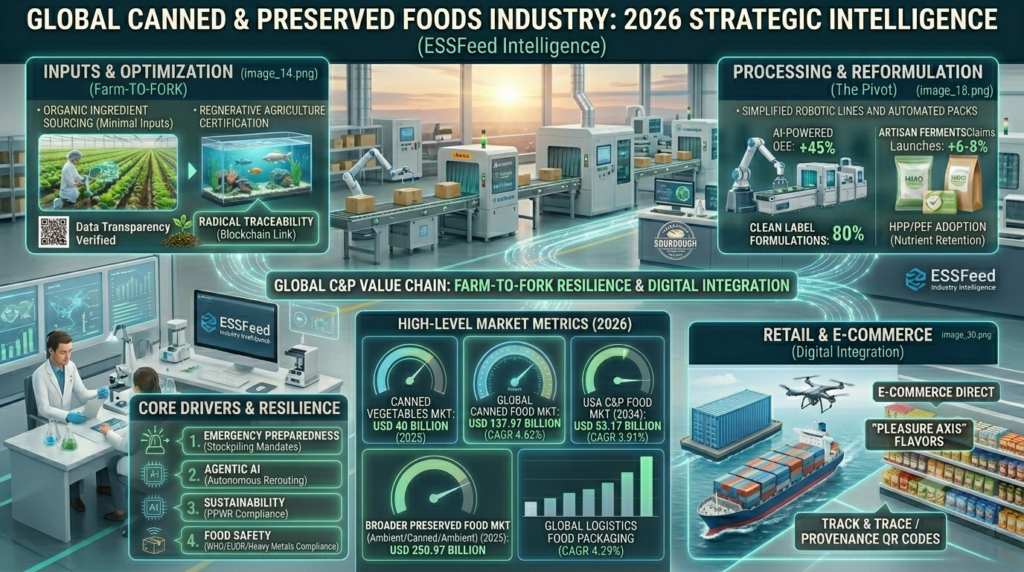
Table of Contents
1. Market Overview: Scale, Structure and Scope
What is the Canned and Preserved Foods Industry?
The canned and preserved foods industry encompasses all food products that have undergone preservation processes designed to extend shelf life significantly beyond the natural perishability of raw ingredients. This includes:
Thermally processed (canned) foods — vegetables, fruits, fish and seafood, meat and poultry, soups and broths, beans and pulses, tomatoes and sauces, and ready meals preserved through heat treatment in sealed metal or glass containers.
Pickled and acidified foods — vegetables, fruits, and condiments preserved in vinegar or brine, including gherkins, pickled onions, jalapeños, capers, olives, and kimchi-style fermented products.
Dried and dehydrated foods — fruits, vegetables, legumes, and proteins preserved through moisture removal.
Cured and smoked meats — bacon, ham, salami, and other charcuterie products preserved through salt curing, smoking, or nitrate treatment.
Preserves, jams, and fruit spreads — fruit products preserved through high sugar concentration.
Fermented foods — kimchi, sauerkraut, miso, tempeh, and other products preserved through beneficial microbial activity.
Global Market Valuation
The global canned preserved food market was valued at USD 108.63 billion in 2025, projected to reach USD 178.42 billion by 2033 at a CAGR of 6.34%. The canned vegetables segment alone was valued at USD 40 billion in 2025, representing the largest single sub-category. Western Europe was the largest region for canned and ambient food in 2025, and North America is the fastest-growing region.
The United States canned food market is projected to grow from USD 37.65 billion in 2025 to USD 53.17 billion by 2034, registering a CAGR of 3.91% during 2026–2034.
Industry Structure
Key market players include Thai Union Group, Unilever, Kraft Heinz Company, Nestlé S.A., Del Monte Foods, Conagra Brands Inc., and Seneca Foods Corporation. The industry is moderately consolidated — a small number of multinational processors dominate by volume and brand equity, while regional and artisan producers capture the fastest-growing premium segments. Private label has gained significant market share, particularly in European markets where retailer own-brand canned goods represent 40–50% of category volume in some countries.
2. Product Categories: Deep Dives
Canned Vegetables and Pulses
Canned vegetables — corn, peas, green beans, tomatoes, carrots, and mixed vegetables — represent the largest single product category in the global canned food market by volume. The category’s commercial dynamics are being reshaped by the clean label movement: consumers are increasingly seeking canned vegetables with minimal ingredients (vegetables, water, and perhaps salt), no artificial preservatives, reduced sodium, and BPA-free packaging.
The growing popularity of home cooking is fuelling demand for canned vegetables, pulses, and seafood. The global trend toward plant-based eating — driven by health consciousness, environmental awareness, and the influence of flexitarian dietary strategies — is creating sustained growth in canned pulses particularly. Chickpeas, lentils, black beans, and kidney beans are experiencing demand growth that significantly outpaces conventional canned vegetables, as they serve as both everyday cooking ingredients and protein sources in plant-forward diets.
Campbell Soup Company announced in March 2025 a strategic partnership with Bonduelle to co-develop and co-manufacture premium canned vegetables for the North American market, aiming to expand Campbell’s shelf-stable offerings in the canned vegetables category.
Canned Fish and Seafood
The canned fish and seafood category is experiencing one of its most commercially dynamic periods — simultaneously growing at the premium end (craft canned tuna, premium sardines, line-caught mackerel, octopus conservas) while maintaining its role as the most affordable source of high-quality protein in many global markets.
The Marine Stewardship Council notes that consumers are actively pursuing canned seafood products with verified sustainability claims, often at a premium. The MSC Fisheries Standard emphasises three core principles: fishing from healthy stocks, adopting long-term management practices, and minimising ecosystem impact.
The “conservas” trend — premium tinned fish from Spanish and Portuguese artisan canners — has become one of the most commercially significant movements in specialty food retail globally. Brands like José Gourmet, Nuri, Ortiz, and Ramón Peña are commanding prices of USD 10–30+ per tin in premium food retail, restaurant supply, and DTC e-commerce, fundamentally challenging the commodity perception of canned fish and demonstrating the extraordinary premiumisation potential of the category.
Thai Union Group — the world’s largest tuna processor, owner of the Chicken of the Sea brand in North America and John West in Europe — is investing heavily in sustainability certification, premium product development, and the SeaChange sustainability programme to meet retailer and consumer expectations for verifiable sourcing practices.
Canned Meat and Poultry
The canned meat category spans a wide quality range — from the iconic commodity Spam and corned beef through to premium canned confit duck, heritage-breed pork rillettes, and artisan meat pâtés. Hormel Foods announced in June 2025 a significant contract win reinforcing its dominant position in the US canned meat market through brands including SPAM, Hormel, and Mary Kitchen.
The canned meat category’s emergency preparedness dimension has become a genuine commercial driver. Consumer awareness of geopolitical instability, extreme weather events, and supply chain vulnerabilities is translating into deliberate pantry-building behaviour that directly benefits long shelf-life canned protein products.
Canned Soups and Ready Meals
The canned soup and ready meal category is experiencing a bifurcation as significant as any in the preserved foods sector. Nestlé announced in January 2025 a major product launch of new shelf-stable, plant-based canned soups targeting mid- to high-income households, as part of a broader push to modernise its canned meals portfolio.
Campbell’s acquisition of Rao’s Homemade — the premium pasta sauce brand that commands prices 3–5× above conventional alternatives — signals the strategic direction of the entire canned soups and sauces category: premiumisation, clean labels, restaurant-quality credentials, and the willingness of consumers to pay premium prices for ambient products they perceive as genuinely superior.
Fermented and Pickled Foods
The fermented foods sub-category — encompassing kimchi, sauerkraut, miso, tempeh, kombucha concentrates, fermented hot sauces, and artisan pickles — is one of the fastest-growing segments within the broader preserved foods market. Fermented and clean-label preserved options are the fastest-growing sub-segments, expanding at 6–8% annually.
The gut health megatrend — which has reshaped the beverage and dairy categories through kombucha, kefir, and probiotic yoghurt — is now driving explosive growth in commercially produced fermented vegetables and condiments. The ability to deliver credible gut health benefits through traditional fermentation processes, without artificial additives, gives fermented preserved foods a uniquely powerful positioning at the intersection of health, sustainability, and authentic food culture.
Jams, Preserves and Fruit Spreads
The jams and preserves category is experiencing its own premiumisation story — small-batch, single-origin fruit preserves made with minimal sugar and traditional techniques are capturing share from mass-market brands in premium retail. Advancements in dessert-inspired and functional canned fruit products are a key market trend.
3. Food Security: The Canned Foods Industry’s Strategic Role
Emergency Preparedness as a Growth Driver
Global food security concerns strengthen the business case for canned products in emergency preparedness. Government mandates on emergency preparedness are bolstering the stockpiling of canned foods.
In 2026, the emergency preparedness dimension of canned food demand has graduated from an occasional spike driver — triggered by specific events — to a structural growth underpinning for the entire category. A confluence of factors is creating sustained awareness of food supply vulnerability: the lingering memory of COVID-19 supply chain disruptions, the geopolitical instability in Ukraine and the Middle East that has affected global grain and commodity supplies, extreme weather events affecting food production, and government guidance in multiple markets advising households to maintain emergency food reserves.
Canned foods play a crucial role in emergency preparedness and long-term food storage. The US Federal Emergency Management Agency (FEMA) recommends households maintain a minimum three-day and ideally two-week supply of non-perishable canned food. Equivalent guidance from civil emergency authorities in Europe, Australia, and Japan is driving category-wide consumer awareness that is translating into sustained sales growth rather than episodic stockpiling spikes.
Humanitarian and Food Aid Applications
Canned and preserved foods are the backbone of global humanitarian food aid — providing the caloric density, protein content, nutritional completeness, and logistical practicality required for emergency food distribution at scale. The World Food Programme, national civil emergency stockpiles, and military ration systems globally rely heavily on canned protein (fish, meat, beans), canned vegetables, and ambient ready meals as core components of their supply chains.
Food Security in Emerging Markets
In developing economies — particularly across sub-Saharan Africa, South Asia, and parts of Latin America — canned and preserved foods play a critical food security role by making nutritious protein (canned fish, canned meat) and vegetables available year-round at affordable prices without the refrigeration infrastructure that would be required for fresh alternatives. The expansion of modern retail infrastructure in these markets is creating significant new demand for branded canned food products.
4. Technology and Innovation
High-Pressure Processing (HPP)
Advanced processes of high-pressure processing (HPP) and pulsed electric fields (PEF) can preserve and sterilise at lower temperatures than traditional canning, preserving vitamins and antioxidants better. The USDA says total retention of nutrients in canned vegetables can be up to 90% with optimised thermal processing followed by newer technologies.
The global high-pressure processing food market was valued at USD 3.21 billion in 2024 and is projected to grow to USD 6.73 billion by 2033 at a CAGR of 8.5%. HPP uses extremely high water pressure — rather than heat — to destroy pathogens and extend shelf life while preserving the fresh taste, colour, texture, and nutritional profile of food products. The technology is moving beyond its initial premium juice and deli meat applications into a broader range of preserved food categories including dips, sauces, ready meals, and plant-based products.
Retort Processing Innovation
Advanced retort processing — the thermal treatment technology fundamental to commercial canning — is being modernised with computer-controlled temperature and pressure profiles that deliver more precise heat distribution, reducing both over-processing (which degrades texture and nutrition) and under-processing (which creates food safety risk). Advancements in retort processing, vacuum sealing, aseptic canning, and smart packaging improve safety, nutrient retention, and shelf life.
Aseptic canning — where food and packaging are sterilised separately and combined in a sterile environment, eliminating the need for post-packaging heat treatment — is enabling a new generation of ambient food products with fresh-tasting quality at extended shelf life, expanding the category’s appeal to premium and health-conscious consumers.
BPA-Free Packaging Technology
The transition away from bisphenol A (BPA) — a chemical previously used in can linings that has been associated with endocrine disruption in some studies — has been one of the most significant regulatory and commercial shifts in the canned food industry in recent years. Innovations such as BPA-free cans have broadened the market appeal significantly, removing a key barrier to purchase for health-conscious consumers. The industry’s major manufacturers have transitioned to alternative lining technologies — acrylic, polyester, and oleoresin-based linings — across the vast majority of their product lines.
AI, Robotics and Smart Manufacturing
Robotics, AI, and blockchain optimise production, traceability, and inventory management. AI-driven demand forecasting is enabling canned food manufacturers to optimise production scheduling against seasonal demand cycles and emergency stockpiling events. Robotic canning lines are improving throughput, reducing contamination risk, and enabling faster changeovers between product formats. Blockchain-based traceability systems are providing end-to-end supply chain visibility from raw ingredient origin to retail shelf, enabling rapid, targeted product recalls when food safety issues arise.
Oxygen Scavengers and Advanced Sealing
Advances in packaging materials, like the use of oxygen scavengers and enhanced sealants, avoid oxidation and spoilage, increasing the shelf life of products without loss of nutrients. These technologies are extending the effective shelf life of premium canned products — including canned fish, ready meals, and high-value sauces — from 2–3 years to 5+ years without any compromise in quality, supporting both emergency preparedness stockpiling and reduced food waste.
5. The Premiumisation Revolution
From Commodity to Gourmet
The premiumisation of canned and preserved foods is perhaps the most commercially significant trend in the category in 2026. In recent times, there has been an observed trend toward premiumisation in the canned food sector as consumers are willing to pay more for higher-quality and gourmet options. The growth of international cuisines is encouraging the launch of diverse flavours in the canned food category.
The drivers of this premiumisation are multiple and reinforcing: social media’s ability to elevate artisan food products to mass awareness (the conservas trend began on Instagram); the growing expertise and adventurousness of home cooks who are willing to pay for genuinely superior ingredients; the influence of restaurant culture on home cooking occasions; and the convergence of convenience and quality that premium canned goods uniquely deliver.
The Rao’s Homemade Effect
The acquisition of Rao’s Homemade by Campbell’s for approximately USD 2.7 billion represents the defining moment of premium ambient food’s commercial coming of age. Rao’s — an Italian-American restaurant brand from New York that began selling its marinara sauce commercially — commands retail prices of USD 10–12 for a jar of pasta sauce, in a category where conventional alternatives retail at USD 2–3. Its rapid growth to over USD 1 billion in annual sales demonstrates the commercial ceiling for ambient and preserved food premiumisation when the product quality, brand story, and clean label credentials are genuinely compelling.
Clean Label and Organic Canned Foods
Organic canned foods are gaining traction among consumers, propelling market growth as more individuals seek sustainable and natural food options that cater to health and wellness preferences. The organic canned food segment is growing significantly faster than conventional canned food, driven by consumers who want the convenience of canned goods combined with the ingredient transparency and absence of synthetic inputs associated with organic certification.
Increased demand for clean-label and preservative-free products is shaping product reformulation strategies across the canned food industry. Manufacturers are removing artificial preservatives, reducing sodium levels, eliminating added sugars, and using recognisable ingredient lists that consumers can understand without a chemistry degree.
Ethnic and International Cuisine Canned Products
The globalisation of cuisine and ethnic food trends is spurring innovation in canned recipe bases and meal kits. The growing multicultural composition of consumer populations in North America and Europe, combined with the social media-driven global curiosity about food cultures from Southeast Asia, Latin America, the Middle East, and West Africa, is creating sustained demand for authentic canned ingredients — coconut milk, jackfruit, bamboo shoots, black beans, harissa, and mole bases — that enable home cooks to replicate authentic international dishes.
6. Sustainability: The Can’s Recyclability Advantage
Metal Cans as a Sustainability Asset
The shift toward sustainable and recyclable packaging is enhancing the appeal of metal cans among eco-conscious consumers. The aluminium and steel cans that dominate the canned food industry have a genuine, compelling sustainability story: they are among the most recyclable packaging formats in existence, with aluminium infinitely recyclable without quality degradation and steel recycled at very high rates globally.
In a regulatory and consumer environment that is intensely hostile to single-use plastic packaging, the metal can’s recyclability credentials are becoming a meaningful commercial differentiator — and a reason for premium positioning that the industry has historically undersold.
Sustainability Pressures on Production
Sustainability pressures shape sourcing, processing, and packaging decisions. Climate-related agricultural disruptions, metal usage, and energy-intensive processing push the adoption of recyclable, BPA-free cans and eco-friendly practices.
The carbon footprint of canned food production — encompassing agricultural production, ingredient processing, canning operations (which are energy-intensive), and transportation of heavy metal containers — represents a genuine sustainability challenge. The industry’s largest manufacturers are investing in renewable energy for production facilities, lightweight can designs that reduce metal content per unit, and supply chain optimisation to reduce transportation emissions.
Seafood Sustainability
The Marine Stewardship Council notes that consumers are actively pursuing canned seafood products with verified sustainability claims, often at a premium. The MSC Fisheries Standard emphasises fishing from healthy stocks, adopting long-term management practices, and minimising ecosystem impact. MSC certification has become the de facto minimum sustainability standard for premium canned seafood in North American and European retail, and is increasingly required by major foodservice operators and food service procurement standards.
7. Geopolitical Disruption and Tariff Impacts
US Tariffs and Global Trade Restructuring
The Trump administration’s tariffs, particularly those stemming from the US-China trade dispute and Section 232 and 301 investigations, had significant indirect effects on the global canned preserved food market. Small and mid-sized canneries were especially vulnerable, as they lacked the scale and contract leverage of multinational processors to negotiate favourable terms or diversify suppliers quickly.
Retaliatory tariffs imposed by Canada, Mexico, the European Union, and China on US agricultural products including processed and preserved foods created new barriers for exports. US canned products such as tomato paste, beans, fruit cocktails, and canned meat faced stiff competition in international markets where US goods had previously enjoyed tariff-free access. These trade restrictions forced American processors to redirect surplus inventory into the domestic market, increasing competition and price pressures at home while eroding established export relationships. Meanwhile, global competitors in Europe, Southeast Asia, and South America gained market share in these regions by offering price-stable alternatives.
Russia-Ukraine Impact on Commodity Inputs
The Russia-Ukraine conflict continues to affect the global canned food industry through its impact on key agricultural commodity inputs — particularly sunflower oil (used in the production of canned fish, vegetables, and ready meals) and wheat (used in canned pasta and soup products). Ukraine and Russia together account for approximately 60% of global sunflower oil production, making the conflict’s ongoing impact on supply and pricing a persistent cost challenge for canned food manufacturers globally.
8. Regional Dynamics
North America: Premium Growth and Emergency Preparedness
North America is the fastest-growing region in the canned and ambient food market. The US market is experiencing simultaneous growth at both ends of the value spectrum — premium and organic canned goods driven by health-conscious consumers, and value-tier canned staples driven by inflation-sensitive consumers managing household food budgets. The emergency preparedness dimension is particularly strong in North America, where awareness of food supply vulnerabilities following COVID-19 has driven sustained pantry-building behaviour.
In a country shaped by fast-paced lifestyles, emergency preparedness, and shifting dietary values, canned products now balance convenience with nutrition, sustainability, and innovation. Private label canned goods — offered at 20–30% below branded equivalents — are gaining significant share as retailers invest in premium own-brand canned product ranges.
Europe: Quality Standards and Premium Leadership
Western Europe was the largest region for canned and ambient food in 2025. Europe leads globally in the premiumisation and quality standards of canned food, underpinned by the extraordinary artisan canning traditions of Spain, Portugal, France, and Italy. The technological advantage of European manufacturers underpins a wide variety of canned foods, sustaining Europe’s leading market share by fulfilling consumer expectations of convenience and quality.
The European canned seafood market — particularly Spanish and Portuguese conservas — represents the global pinnacle of canned food premiumisation, with artisan canners producing limited-edition tinned fish, shellfish, and seafood products that are sold in specialist delicatessens and premium food halls at prices that would have been unimaginable for the category a decade ago.
Regulatory bodies like the FDA, EFSA, and Codex enforce quality, labelling, and additive standards. Regulatory shifts, like China’s stringent clean-label mandates and Europe’s push for sustainability, are nudging manufacturers towards natural ingredients, reduced artificial preservatives, and eco-friendly packaging.
Asia-Pacific: Volume Growth and Urban Expansion
Asia-Pacific prioritises urban retail expansion and branded penetration as the primary growth dynamic. China, Japan, South Korea, and Southeast Asia collectively represent the world’s largest and fastest-growing canned food consumption markets by volume.
Japan’s canned food market is culturally distinctive — a sophisticated, high-quality domestic canning industry producing premium canned seafood (canned tuna, sardines, crab), canned fruits, and ready meals for a domestic consumer base that views canned food as a genuinely high-quality convenience option rather than a compromise. The Japanese “can culture” and the premium positioning of canned food in Japanese convenience stores and supermarkets provides a compelling model for how the category can evolve in other Asian markets as incomes rise and food culture sophisticates.
India and Southeast Asia represent the most significant emerging growth opportunities, driven by urbanisation, expanding modern retail, growing disposable incomes, and the transition from traditional fresh market purchasing toward packaged food formats.
Latin America and Africa: Food Security Foundation
In Latin America and sub-Saharan Africa, canned food’s primary commercial role is food security rather than premium convenience — providing affordable, nutritious, shelf-stable protein and vegetables to rapidly growing urban populations without the cold chain infrastructure that fresh food distribution requires. Brazil and Mexico are the largest Latin American canned food markets; Nigeria, South Africa, and Kenya lead in sub-Saharan Africa.
9. Critical Risks and Challenges
Raw Material Cost Volatility
The canned food industry is exposed to multiple commodity markets simultaneously — agricultural inputs (fruits, vegetables, fish, meat), packaging materials (steel, aluminium, glass), energy (for canning operations), and water (for processing). The confluence of climate-driven agricultural volatility, geopolitical supply chain disruption, and energy price inflation creates a challenging and persistent cost environment that is difficult to pass through to consumers in a category where private label competition and price sensitivity are high.
The Ultra-Processing Perception Problem
Millennials and Gen Z favour minimally processed, clean-label options, while older consumers rely on canned foods for practicality. The growing consumer awareness of ultra-processed food concerns — driven by the NOVA food classification system and extensive media coverage of ultra-processing research — creates a perception challenge for the canned food industry, even though many canned products are minimally processed by any reasonable definition.
Canned tomatoes, canned fish in water, canned pulses, and canned vegetables with no added ingredients are genuinely minimally processed foods — equivalent in processing intensity to fresh cooking. The industry’s challenge is communicating this reality to consumers whose understanding of “processing” is often shaped more by media coverage than by food science.
BPA Alternatives and Regulatory Uncertainty
While the transition to BPA-free can linings is largely complete for major manufacturers, the regulatory environment for alternative lining chemicals is evolving rapidly. Some of the BPA replacement chemicals have come under their own regulatory scrutiny, and the industry faces the ongoing challenge of staying ahead of regulatory changes while maintaining the seal integrity, food safety, and cost performance that effective can linings must deliver.
Private Label Competition
Private label canned goods — produced by major manufacturers for retailer own-brands — represent 40–50% of the canned food category by volume in many European markets and a growing share in North America. The quality gap between branded and private label canned goods has narrowed significantly as retailers invest in premium own-brand ranges, creating pricing pressure on established brands that must justify their premium through genuine quality differentiation, marketing investment, and innovation.
10. Strategic Outlook for Stakeholders
Actionable Recommendations
Invest in the Premiumisation Opportunity Before Market Saturation: The trajectory from commodity to premium in canned foods is well-established — the conservas movement, Rao’s Homemade, and premium organic canned goods all demonstrate the commercial ceiling when quality, story, and clean-label credentials are compelling. Manufacturers who invest in genuine product quality improvement, artisan positioning, and premium packaging now will capture the most valuable consumer relationships before the category bifurcation completes.
Build a Food Security Narrative Into Brand Positioning: Food security concerns are strengthening the business case for canned products. Brands that authentically communicate the food security, long shelf life, and nutritional reliability of their products are building relevance with a consumer mindset — preparedness and pantry resilience — that is growing rather than declining. This is not a crisis-marketing opportunity; it is a structural brand positioning asset.
Lead on Sustainability Through the Can’s Recyclability Story: The metal can is among the most sustainably packaged food formats available — a fact that most of the industry has significantly undersold. In a consumer and regulatory environment that is hostile to plastic packaging, the recyclability of metal cans is a genuine differentiator that deserves prominent, evidence-based communication.
Invest in HPP and Advanced Preservation Technology: The HPP food market is growing at 8.5% CAGR through 2033, reflecting sustained demand for preservation technology that delivers food safety without heat damage. Manufacturers who invest in HPP capability are accessing the fastest-growing segment of the preserved food category — one where premium pricing, health-conscious consumers, and clean-label credentials converge.
Strategic Summary: The 2026 Canned Food Business Model
| Strategic Priority | Traditional Approach | 2026 Competitive Standard |
|---|---|---|
| Product Positioning | Affordable commodity | Premium, gourmet, clean-label |
| Consumer Narrative | Convenience and value | Food security + nutrition + sustainability |
| Packaging | Standard can with conventional lining | BPA-free, sustainable, recyclable |
| Innovation | Incremental reformulation | HPP, fermentation, functional ingredients |
| Distribution | Retail mass market | Retail + DTC e-commerce + specialty + foodservice |
| Sustainability | Minimal footprint reporting | Recyclability leadership, sustainable sourcing |
11. Leading Industry Companies
| Company | Region | Strategic Focus |
|---|---|---|
| The Campbell’s Company | USA/Global | Acquired Rao’s Homemade for ~USD 2.7 billion, anchoring premium ambient food strategy. Strategic partnership with Bonduelle for premium canned vegetables. Brands include Campbell’s, Swanson, Prego, Rao’s. |
| The Kraft Heinz Company | USA/Global | Global canned food and condiment leader. Brands include Heinz, Classico, Chef Boyardee. Significant portfolio restructuring underway. |
| Conagra Brands | USA | Leading US canned food manufacturer. Brands include Hunt’s, Ro-Tel, Libby’s, VanCamp’s, Vlasic. Investing in clean-label reformulation. |
| Nestlé S.A. | Switzerland/Global | Launched new shelf-stable plant-based canned soups in January 2025. Brands include Maggi, Stouffer’s, Lean Cuisine. |
| Thai Union Group PCL | Thailand/Global | World’s largest tuna processor. Brands include Chicken of the Sea, John West, Petit Navire. Leading SeaChange sustainability programme. |
| Hormel Foods Corporation | USA/Global | Dominant in canned meat. Brands include SPAM, Hormel, Mary Kitchen, Dinty Moore. Strong emergency preparedness category positioning. |
| Del Monte Foods | USA/Global | Leading canned fruits and vegetables. Strong in US and Philippine markets through Del Monte Pacific. |
| Bonduelle SA | France/Global | Europe’s leading canned and preserved vegetable company. Co-development partnership with Campbell’s. Strong sustainability credentials. |
| Goya Foods | USA/Latin America | Market leader in Hispanic canned foods across North and Latin America. Beans, rice, coconut milk, and ethnic specialties. |
| Bolton Group (Rio Mare, Saupiquet) | Italy/Global | Europe’s premium canned tuna leader through Rio Mare brand. Leading the Mediterranean premium canned seafood segment. |
Related: As the processed food industry grapples with stricter clean-label regulations and a massive pivot toward nutrient-dense convenience, the landscape for manufacturers is rapidly evolving. We dive into the critical production, regulatory, and market trends defining the year in our Global Processed Food Industry Report 2026.
Frequently Asked Questions (FAQ)
What is the global canned food market size in 2026?
The global canned food market is valued at approximately USD 137–138 billion in 2026, growing from USD 137.97 billion in 2025. The broader canned and ambient food market — which includes a wider range of shelf-stable preserved food products — is valued at USD 263.9 billion in 2026. The market is growing at a CAGR of 3.9–6.34% depending on the scope of measurement and research methodology, with projections ranging from USD 172–178 billion for the core canned food market by 2030–2033. Growth is driven by urbanisation, food security awareness, premiumisation, and the expanding role of canned foods in emergency preparedness stockpiling.
Is canned food nutritious? How does it compare to fresh food?
The nutritional quality of canned food is significantly better than its historical reputation suggests. The USDA says total retention of nutrients in canned vegetables can be up to 90% with optimised thermal processing followed by newer technologies. In many cases, canned vegetables are processed within hours of harvest — when their nutritional content is at its peak — and then sealed in an environment that prevents further nutrient degradation. Fresh vegetables, by contrast, can lose significant nutritional value during the days or weeks of transportation, storage, and retail display between harvest and consumption. Canned fish retains its full complement of omega-3 fatty acids, protein, and minerals. Canned pulses retain their fibre, protein, and mineral content almost completely. The primary nutritional considerations for canned food are sodium content (many canned goods contain added salt) and BPA exposure from can linings — both of which are being addressed by the industry through low-sodium formulations and BPA-free packaging.
What is BPA in canned food and why does it matter?
BPA (bisphenol A) is a chemical previously used as a component of epoxy resin can linings that prevent the metal from affecting food flavour and preventing corrosion. Some studies have associated BPA exposure with endocrine disruption effects, leading to significant consumer concern and regulatory action. Most major canned food manufacturers have transitioned to BPA-free lining alternatives including acrylic, polyester, and oleoresin-based systems. However, some of the replacement chemicals have come under their own regulatory scrutiny. For consumers concerned about BPA exposure, glass-jarred alternatives or BPA-free certified products from brands that have publicly disclosed their lining materials offer additional assurance. It is important to note that regulatory bodies including the FDA and EFSA have set BPA exposure limits that most commercially produced canned foods remain well within.
Why are canned foods experiencing a premium renaissance in 2026?
The premiumisation of canned foods in 2026 reflects several converging commercial and cultural forces. The Spanish and Portuguese conservas movement — artisan-produced tinned fish, shellfish, and seafood sold at premium prices in specialty retail — demonstrated that consumers will pay significantly above commodity prices for genuinely superior preserved food products with compelling origin stories, traditional production methods, and exceptional quality. This demonstration of premium potential has spread across the category: Rao’s Homemade pasta sauces command prices 3–5× above conventional alternatives; organic canned vegetables in premium retailers attract health-conscious consumers willing to pay meaningful premiums; and premium canned soups from brands like Pacific Foods are repositioning the entire soup category. Social media amplification, the growth of home cooking culture, and the influence of restaurant food culture on consumer expectations have all contributed to making premium canned food commercially viable at scale.
How is the canned food industry responding to food security concerns?
The canned food industry is responding to growing food security awareness through product innovation, communication strategy, and strategic positioning. Manufacturers are investing in extended shelf-life formats — some premium canned products now have 5+ year shelf life — that are specifically positioned for emergency preparedness stockpiling. Brands are incorporating food security messaging into their marketing, particularly in North America where FEMA emergency preparedness guidance specifically recommends canned food stockpiling. The category is also benefiting from government-driven demand — national civil emergency stockpile programmes, military ration procurement, and humanitarian food aid distribution all represent significant institutional demand channels for canned food manufacturers.
What is high-pressure processing (HPP) and how is it changing preserved foods?
High-pressure processing (HPP) is a food preservation technology that uses extremely high water pressure — typically 600 MPa — to destroy pathogenic bacteria, yeasts, and moulds in packaged food products without applying heat. This “cold pasteurisation” preserves the fresh taste, colour, texture, and nutritional profile of food products far more effectively than thermal processing while delivering equivalent or superior food safety. The global HPP food market was valued at USD 3.21 billion in 2024 and is projected to grow to USD 6.73 billion by 2033 at a CAGR of 8.5%. HPP is enabling a new generation of premium preserved food products — including cold-pressed juices, deli-style meats, ready-to-eat meals, guacamole, hummus, and premium sauces — that deliver the clean-label credentials consumers demand without compromising on food safety or shelf life.
Which companies lead the global canned food market?
The global canned food market is served by a combination of multinational food companies with strong canned food portfolios and specialist canned food processors. The key players include The Campbell’s Company (soups, sauces, premium ambient meals), The Kraft Heinz Company (Heinz beans, tomato products, Chef Boyardee), Conagra Brands (Hunt’s tomatoes, Libby’s vegetables, Vlasic pickles), Nestlé (Maggi soups and sauces), Thai Union Group (world’s largest tuna processor through Chicken of the Sea and John West), Hormel Foods (SPAM, canned meats), Del Monte Foods (canned fruits and vegetables), Bonduelle (European canned vegetables), and Goya Foods (Hispanic canned foods). In the premium segment, the Bolton Group’s Rio Mare brand, José Gourmet, Ortiz, and the growing craft conservas category are defining the new frontier of canned food premiumisation.
Sources and References
- Persistence Market Research: Canned Food Market Demand & Growth Forecast 2026–2033 — https://www.persistencemarketresearch.com/market-research/canned-food-market.asp
- Spherical Insights: Global Canned Preserved Food Market Size, Forecasts to 2035 — https://www.sphericalinsights.com/reports/canned-preserved-food-market
- Cognitive Market Research: Canned Preserved Food Industry Analysis 2026 — https://www.cognitivemarketresearch.com/list/food-&-beverages/canned-preserved-food
- The Business Research Company: Global Canned and Ambient Food Market Report 2026 — https://www.thebusinessresearchcompany.com/report/canned-and-ambient-food-global-market-report
- Mordor Intelligence: Canned Food Market Size, Growth Trends, Share & Overview 2025–2030 — https://www.mordorintelligence.com/industry-reports/canned-food-market
- Allied Market Research: Canned Food Market Size, Share, Trends, Growth Report 2026 — https://www.alliedmarketresearch.com/canned-food-market-A05939
- GMI Insights: Food Cans Market Size & Share, Statistics Report 2026–2035 — https://www.gminsights.com/industry-analysis/food-cans-market
- Verified Market Reports: Canned Preserved Food Market Size and Forecast — https://www.verifiedmarketreports.com/product/canned-preserved-food-market-size-and-forecast/
- Renub Research: United States Canned Food Market Size and Forecast 2026–2034 — https://vocal.media/futurism/united-states-canned-food-market-size-and-forecast-2026-2034
- IndexBox: United States Preserved Food Market Analysis & Forecast 2026 — https://www.indexbox.io/store/united-states-preserved-food-market-analysis-forecast-size-trends-and-insights/
- OpenPR: Canned Foods Market Moves Beyond Shelf-Stable Convenience 2026 — https://www.openpr.com/news/4511802/canned-foods-market-moves-beyond-shelf-stable-convenience-why
- WiseGuy Reports: Canned Preserved Food Market Report In-Depth Analysis 2035 — https://www.wiseguyreports.com/reports/canned-preserved-food-market
- IMARC Group: Canned Food Market Size, Statistics & Forecast 2033 — https://www.imarcgroup.com/canned-food-market
- Research and Markets: Canned Ambient Food Products Market Global Strategic Business Report — https://www.researchandmarkets.com/reports/6095246/canned-ambient-food-products-market-global
- Business Research Insights: High-Pressure Processing (HPP) Food Market 2025–2033 — https://www.businessresearchinsights.com/market-reports/high-pressure-processing-hpp-food-market-120622
- Straits Research: Canned Food Market Size, Share 2025–2032 — https://straitsresearch.com/report/canned-food-market
- Metatech Insights: Canned Food Market Share, Size, Trend & Growth 2025–2035 — https://www.metatechinsights.com/industry-insights/canned-food-market-3415
- Verified Market Reports: Canned Food Manufacturing Market Size, Trends 2033 — https://www.verifiedmarketreports.com/product/canned-food-manufacturing-market/
- Food Navigator: Big Food M&A Trends 2026 — https://www.foodnavigator.com/Article/2025/11/19/big-food-ma-trends-nestle-mars-unilever-and-kraft-heinz-drive-2026-industry-shake-up/
- HTF Market Intelligence: Canned Preserved Foods Market Analysis USA & Europe — https://www.htfmarketintelligence.com/report/global-canned-preserved-foods-market
