
Introduction
In 2026, the global vegetable industry stands as a cornerstone of the world’s nutrition architecture, currently valued at approximately USD 768.72 billion. As dietary preferences shift toward plant-forward nutrition and urban populations expand, the sector is undergoing a critical transition: moving from a supply-heavy commodity focus to a data-informed, quality-centric model.
Executive Summary: The 2026 Global Vegetable Industry
The global vegetable industry is currently defined by a duality: rising demand for fresh, organic, and locally-sourced produce against a backdrop of intense economic pressure and climate variability. The sector is moving toward a resilience-first architecture, where producers increasingly leverage protected agriculture (greenhouses/hydroponics), AI-driven yield optimization, and integrated cold-chain logistics to safeguard margins.
While dollar-value growth is steady, volume growth remains tempered by persistent inflation and supply chain complexity. Success in 2026 is no longer about raw production volume; it is about brand differentiation through quality, traceability, and sustainability.
Key Takeaways for Stakeholders:
- The Precision Pivot: High-performance firms are shifting focus from “least-cost” field farming to high-value, protected-environment agriculture (CEA) that offers year-round supply stability.
- Sustainability as a Commercial Requirement: Regulators and consumers are demanding transparency regarding pesticide residues and carbon footprints, turning regenerative practices into essential competitive tools.
- The Convenience Imperative: With urbanization, the highest value growth is appearing in “ready-to-use” formats (fresh-cut, snack-sized), requiring producers to integrate more deeply with food processing and modern retail channels.
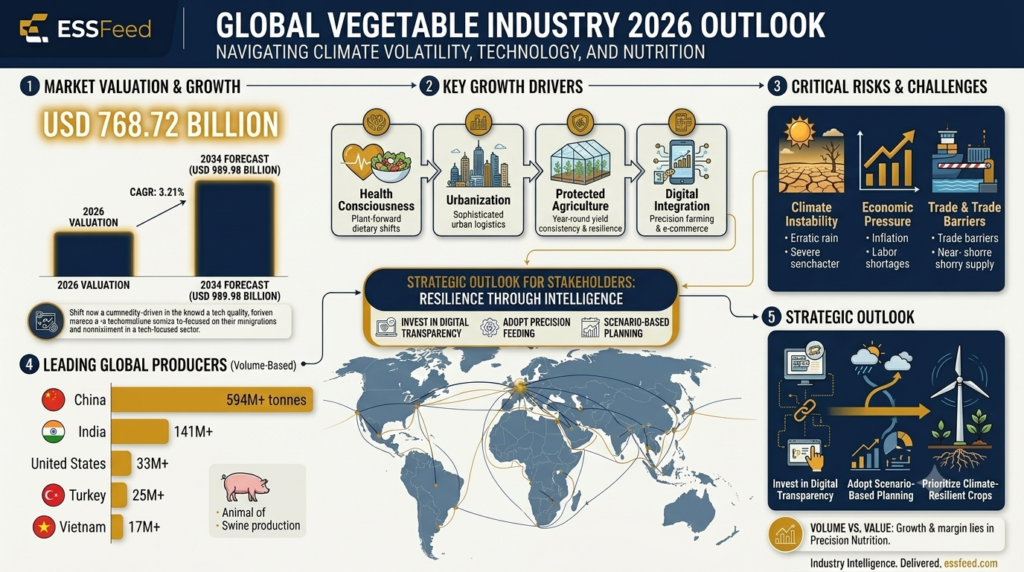
Table of Contents
1. Market Overview: The 2026 Landscape
In 2026, the global vegetable industry is characterized by:
- Industrialization of Freshness: Increased investment in large-scale, automated packing and sorting facilities to combat labor shortages.
- Modern Retail Dominance: A accelerating shift from informal “wet markets” to modern retail and online platforms, which prioritize safety and quality standards.
- Value-Added Focus: Fresh-cut and packaged vegetable solutions are outpacing raw commodity sales as consumers trade up for convenience.
2. Key Growth Drivers
- Plant-Forward Dietary Trends: The rising popularity of veganism and “flexitarian” diets is creating a consistent, long-term floor for vegetable demand.
- Urbanization: Concentrated urban populations are driving the need for sophisticated distribution networks that maintain quality from farm to city-shelf.
- Advanced Cultivation: Expansion of greenhouse and vertical farming allows for higher yields, reduced water usage, and year-round availability of staple crops.
- Health and Wellness: Increased focus on immune health and nutrient-dense, fiber-rich diets is driving demand for premium organic and specialty vegetables.
3. Critical Risks and Challenges
- Economic Pressures: Persistent inflation and volatile fertilizer/energy costs are forcing producers to prioritize operational efficiency over expansion.
- Climate Instability: Erratic weather patterns are disrupting traditional planting cycles, necessitating investment in climate-resilient genetics and protected structures.
- Regulatory Hurdles: Stricter “Maximum Residue Limits” (MRLs) in key markets like the EU are creating supply chain friction and increasing compliance costs for exporters.
- Post-Harvest Losses: In regions with inadequate infrastructure, the gap between harvest and marketable supply remains a major constraint on industry value.
4. The Shift Toward Sustainability and Innovation
Sustainability is now a core business requirement:
- Regenerative Agriculture: Adoption of soil-health-focused practices is being incentivized by both consumer demand and carbon-credit opportunities.
- Bio-solutions: A pivot toward biological crop protection (biopesticides) is accelerating as retailers demand residue-free produce.
- Circular Economy: Upcycling of vegetable trimmings and byproducts into higher-value animal feed or compost is helping to close the loop and reduce waste.
- Traceability Tech: Blockchain and IoT sensors are becoming standard in premium supply chains to provide consumers with provenance and safety data.
5. Strategic Outlook for Stakeholders
Success in the remainder of 2026 and beyond will depend on intelligence-led resilience. > “The constraint in 2026 is not demand, but the ability to deliver quality reliably amid global volatility. Firms that integrate digital technologies, optimize procurement, and ensure transparency will capture the most significant market share.”
Actionable Recommendations:
- Prioritize Digital Transparency: Utilize IoT tracking to ensure ethical, safe sourcing—a non-negotiable for modern retail partners.
- Adopt Protected Agriculture: Evaluate the transition from open-field to protected environments (greenhouses/hydroponics) to mitigate climate risk.
- Invest in Convenience: Evaluate your value-add capability. Processed, ready-to-eat vegetables are consistently outperforming undifferentiated commodity produce in margin potential.
Leading Global Vegetable Producers and Influencers
The landscape includes massive diversified fresh-produce firms and specialized innovators focused on seed and farm-tech.
| Company Name | Headquarters | Key Market Focus |
| Dole plc | Ireland | Global supply chain, fresh & packaged salads |
| Fresh Del Monte | USA | Integrated farming, fresh-cut produce |
| Greenyard | Belgium | Fresh, frozen & prepared vegetable integration |
| Keelings | Ireland | Retail distribution, quality-led logistics |
| Tanimura & Antle | USA | Large-scale field production, innovation |
| Grimmway Farms | USA | Global leader in carrots & organic produce |
| Rijk Zwaan | Netherlands | High-value, IP-protected vegetable seeds |
| East-West Seed | Thailand | Tropical vegetable genetics specialist |
Conclusion: The Path Forward
The global vegetable industry in 2026 is moving toward a future defined by precision and transparency. While macroeconomic headwinds persist, the industry is proving remarkably resilient, driven by the fundamental necessity of healthy produce. The global vegetable industry leaders of 2026 and beyond will be those who balance operational efficiency with technological innovation—using AI-driven insights to lower costs while meeting the retail demand for high-quality, sustainably grown vegetables.
Related Reports:
Are high-tech greenhouses finally outperforming traditional field farming? We examine the technological race to secure food supply chains in the face of logistical fragility in our latest Global Produce Market 2026 Report.
Valued at USD 717.8 billion, the global fruit industry is shifting from a volume-reliant commodity model toward a precision-driven, ‘quality-first’ architecture. Discover how industry leaders are using IP-protected varieties and AI-driven supply chains to mitigate climate volatility in our Global Fruit Industry Report 2026.
Frequently Asked Questions (FAQ)
What is the primary driver of the vegetable market in 2026?
The main driver is the global consumer pivot toward plant-forward, healthy, and convenient vegetable-based diets, supported by modern retail expansion.
How is technology impacting production?
There is a shift toward “controlled-environment agriculture” (CEA), where greenhouses and AI sensors provide predictable, year-round yields regardless of climate.
Why is sustainability essential?
Retailers and governments are enforcing stricter food safety and environmental standards (like residue limits), making sustainable practices a requirement for market access.
What are the main challenges for 2026?
The industry faces a “triple threat” of labor shortages, climate-induced crop unpredictability, and rising costs for inputs like energy and fertilizer.
Sources and References
- Fortune Business Insights: Fresh Vegetables Market Size, Share & Growth Report 2034.
- The Business Research Company: Vegetable Farming Global Market Report 2026.
- Future Market Insights: Global Fresh Vegetables Market Analysis 2036.
- Precedence Research: Fresh Vegetables Market Size & Trends 2026–2035.
- Mordor Intelligence: Fresh Vegetables Market Analysis & Forecast 2026–2031.
- Circana: Future of Produce Report 2026.
Here are the primary sources and references to support your Global Vegetable Industry Report 2026. You can use these to add authority to your post and provide readers with trusted data.
Primary Market Intelligence Sources
- Global Market Insights: Fresh Vegetable Market Size & Share, 2035 – Provides the core market valuation of approximately USD 1.1 trillion for 2026 and long-term CAGR projections.
- Spherical Insights: Global Fruits & Vegetables Market 2026–2035 – Offers a deeper look at the combined fruit and vegetable market, regional growth trends, and the move toward organized retail and e-commerce.
- World Population Review: Vegetable Production by Country 2026 – Excellent for visualizing the scale of production (China, India, USA) for your report’s “Leading Producers” section.
- Wikipedia: List of countries by vegetable production – A helpful cross-reference for global production rankings and tonnes produced.
Strategic & Industry Perspectives
- World Vegetable Center (WorldVeg): Global Strategy 2026–2033 – Ideal for the “Sustainability and Innovation” section; highlights the focus on climate resilience, urban food systems, and biodiversity.
- Agribusiness Global: Global Agriculture Forecast 2026 – Provides a high-level view of economic volatility, input prices, and the necessity of automation to drive efficiency.
- Rabobank: Global Greenhouse Update 2026 – A key source for your report on protected agriculture, energy transitions, and the competitive shifts between major producing regions (e.g., Spain vs. Morocco, Netherlands).
Technology & Trend Analysis
- ICL Group: 5 AgriTech Trends Driving the Future of Agriculture in 2026 – Essential for discussing “biologicals” (biopesticides), field robotics, and AI-driven advisory tools.
- DLL Group: Innovative Agriculture Trends for 2026 – Covers IoT, precision irrigation, and financing models that enable farmers to adopt these new technologies.
- EFarm: Sustainable Farming Practices to Adopt in 2026 – A strong reference for explaining regenerative practices like crop rotation and Integrated Pest Management (IPM).
