
June 9, 2026
The global foodservice market is valued at USD 4,185 billion in 2026 and is projected to reach USD 6,767 billion by 2033, exhibiting a CAGR of 7.1%. Few industries touch human experience as intimately and universally as foodservice. Whether it is a street vendor in Mumbai, a Michelin-starred restaurant in Paris, a hospital canteen in São Paulo, or a drive-through in Oklahoma — the act of preparing and serving food to people away from home is one of the oldest and most fundamental commercial activities in human civilisation.
In 2026, that ancient activity is being transformed by a convergence of forces without precedent in the industry’s modern history. Digital ordering has moved from novelty to norm. Ghost kitchens have created an entirely new category of foodservice real estate. Labour shortages are forcing a reckoning with automation that operators had long deferred. Consumer health consciousness is reshaping menus at every price point. And Asia-Pacific has emerged as the undisputed engine of global foodservice growth, with hundreds of millions of new middle-class consumers eating out for the first time.
This report provides the most comprehensive publicly available analysis of the global foodservice industry in 2026 — covering market scale, segment performance, regional dynamics, technology transformation, the ghost kitchen revolution, sustainability, key challenges, strategic outlook, leading companies, FAQ, and full sources.
Executive Summary: The 2026 Foodservice Landscape
The global foodservice industry in 2026 is defined by a structural tension between opportunity and operational pressure. Demand fundamentals have never been stronger — urbanisation, rising incomes, time-scarce consumers, and the global proliferation of digital ordering platforms are combining to drive sustained structural growth. Yet operating conditions have never been more challenging — labour shortages, food cost inflation, third-party delivery commission structures, and the capital requirements of technology investment are compressing margins at every format level.
Key Takeaways for Stakeholders:
Asia-Pacific dominates and accelerates: Asia-Pacific dominates with a 37.0% revenue share in 2025, underpinned by rapid urbanisation in China, India, and Southeast Asia. It is also the fastest-growing region, with a CAGR of approximately 4.1%, fuelled by QSR chain expansion and rising middle-class populations.
Labour is the industry’s defining crisis: 54% of foodservice outlets face labour shortages, restricting overall profitability and efficiency. Rising operational costs impact 37% of outlets.
Digital ordering has reached mainstream saturation: Online food delivery adoption has reached 58%, while plant-based menu options have expanded by 47%, shaping customer dining preferences globally.
Ghost kitchens are scaling fast: The global ghost kitchen market reached $88.42 billion in 2025 and is projected to grow to $196.69 billion by 2032.
Automation is moving from pilot to production: Self-service kiosks are now in 68% of major QSR chains, up from 22% in 2020. McDonald’s has tested voice AI at 100+ locations; Wendy’s has partnered with Google for AI ordering.
Sustainability is now commercial table stakes: 68% of consumers made more sustainable food choices in 2024. McDonald’s reports 86.7% sustainable packaging progress, while Starbucks has certified 9,000+ Greener Stores.
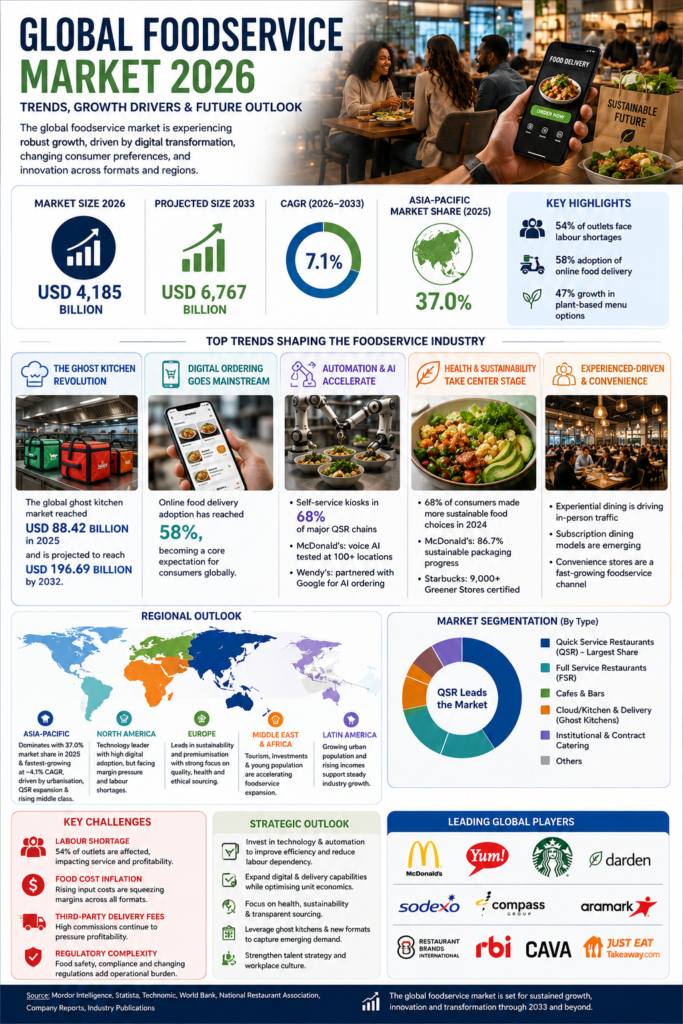
Table of Contents
1. Market Overview: Scale and Structure
Global Valuation
The global foodservice market was valued at USD 3,911.4 billion in 2025 and is projected to reach USD 4,185 billion in 2026. This vast figure encompasses every commercial and institutional operation that prepares and serves food outside the home — from global QSR chains with hundreds of thousands of locations to independent street food vendors, corporate canteens, hospital catering operations, airline meal services, school lunch programmes, and everything in between.
The market’s breadth is matched by its diversity of business models, consumer relationships, and commercial dynamics. The commercial sector leads at 72.0% of total market value, and the conventional foodservice system holds the largest operational model share at 39.0%. Key players include McDonald’s, Starbucks, Yum! Brands, Domino’s Pizza, and Restaurant Brands International.
Segment Architecture
The foodservice industry segments across multiple axes: by format (QSR, fast casual, full-service, cafés/bars, institutional/contract catering, cloud kitchens), by ownership model (chain vs. independent), by consumption occasion (dine-in, takeaway, delivery), and by end customer (commercial/consumer vs. institutional/B2B).
Cafés and Bars are valued at USD 661.3 billion in 2026, projected to reach USD 1,054.3 billion by 2033, at a CAGR of 6.9%. Cloud Kitchens are valued at USD 596 billion in 2026.
Top 10 foodservice players capture 28% of market share, while independent restaurants collectively account for nearly 61% of the market. This structural fragmentation — a small number of globally scaled chains operating alongside millions of independent operators — creates a highly bifurcated competitive environment where technology adoption, sustainability implementation, and supply chain resilience capabilities are dramatically unequal.
The QSR Juggernaut
Global fast food and QSR industry revenues exceeded USD 276.2 billion in 2025. Pizza chains, burger formats, and coffee QSRs represent a substantial share of total commercial foodservice revenues, with franchise expansion into Asia Pacific and MEA accelerating.
Quick service restaurants represent the most commercially successful, most scalable, and most technologically advanced format in global foodservice. The QSR model — standardised menus, rapid service, franchise expansion, optimised supply chains, and increasingly technology-enabled operations — has proven capable of scaling to hundreds of thousands of locations across dozens of markets while maintaining consistent brand and product standards.
QSR leads foodservice market segmentation with 40% market share, followed by Full Service Restaurant at 30%, and cafés or coffee houses at 20%.
2. The Ghost Kitchen Revolution
Market Scale and Commercial Logic
The global ghost kitchen market reached $88.42 billion in 2025 and is projected to grow to $196.69 billion by 2032, representing a strong CAGR. There were over 15,000 cloud kitchens operating globally, with major hubs in the US, India, and China. The sector is projected to generate over 20 million food deliveries per day globally.
Ghost kitchens — also called cloud kitchens, dark kitchens, or virtual restaurants — are delivery-only foodservice operations with no dine-in component. They exist entirely to fulfil digital orders through delivery platforms, eliminating the need for prime-location real estate, front-of-house staff, or the capital expenditure associated with traditional restaurant fit-outs.
The commercial logic is compelling. A ghost kitchen in an industrial or secondary location can operate at 20–30% of the real estate cost of a high-street restaurant while serving the same delivery radius. Multiple virtual brands can operate simultaneously from a single kitchen, maximising equipment and labour utilisation. And entry costs are sufficiently low to allow rapid market testing of new concepts without the risk capital of a traditional restaurant opening.
The Hub-and-Spoke Model
Creative entrepreneurs are launching micro-kitchens in high-traffic areas — compact cooking spaces strategically positioned to speed up delivery times. This hub-and-spoke model centralises food production while getting meals to customers faster than ever.
Rebel Foods, the world’s largest cloud kitchen operator, operates over 450 ghost kitchens serving 5,000 brands globally — a scale that would have been impossible to achieve through traditional restaurant development in anything like the same timeframe or with the same capital base.
QSR Brands Launching Virtual Concepts
Rather than ceding delivery-only concepts to third-party ghost kitchen operators, QSR brands are launching their own virtual concepts from existing locations. This allows chains to maximise utilisation of their kitchen capacity, particularly during off-peak hours, while testing new menu concepts with minimal capital investment. The strategy includes dual-brand operations in single footprints and daypart-specific brands that optimise kitchen use throughout the day.
3. Technology Transformation
The Digital Ordering Standard
Digital ordering — through mobile apps, web platforms, and third-party delivery marketplaces — has completed its transition from a growth driver to a baseline operational requirement for any foodservice operator seeking to remain competitive. Online food delivery adoption has reached 58% globally.
Delivery represents 14% of QSR sales, but profitability remains challenging. Third-party platforms (DoorDash, Uber Eats) take 20–30% commission, eroding already-thin margins. First-party delivery — as maintained by Domino’s and Pizza Hut — avoids third-party fees. Ghost kitchens serve as delivery-only formats for brands like MrBeast Burger, Wingstop, and Chili’s, using shared kitchen infrastructure.
The third-party delivery commission problem is one of the most significant structural challenges in foodservice economics. At 20–30% commission rates, third-party delivery platforms consume margins that many restaurant formats simply cannot afford to sacrifice. The industry response has been threefold: building first-party ordering capability to reduce platform dependency, integrating virtual kitchen concepts that generate additional revenue from existing kitchen capacity, and using delivery platforms as marketing channels while pushing the most valuable customers toward direct ordering.
AI and Automation: From Pilot to Production
Self-service kiosks are now in 68% of major QSR chains, up from 22% in 2020. McDonald’s has tested voice AI at 100+ locations; Wendy’s has partnered with Google for AI ordering. Automated beverage systems are now standardised across most major chains, reducing barista and server labour. ROI on automation remains mixed — upfront costs are high at $50K–$250K per unit — but labour savings and throughput gains can deliver an 18-month payback in high-volume locations.
The deployment of advanced kitchen management systems has been shown to reduce average ticket times by up to 20% in high-volume urban locations.
Voice AI at the drive-through represents one of the highest-ROI automation investments in QSR. McDonald’s partnership with IBM, Wendy’s collaboration with Google, and the rapid proliferation of AI ordering systems across the sector are enabling consistent order accuracy, reduced labour requirements at the ordering touchpoint, and upsell suggestion capabilities that human order-takers cannot match for consistency.
Smart Kitchen Technology and Predictive Management
Modern customer relationship management systems are collecting valuable data about dining preferences, dietary restrictions, order history, and even customer birthdays. Predictive inventory management systems allow operators to order just the right amount of ingredients, dramatically reducing spoilage.
Smart kitchen technology encompasses predictive demand forecasting that pre-positions ingredients and prep work before peak periods, automated quality control systems that use computer vision to ensure portion accuracy and food safety compliance, connected equipment that monitors cooking temperatures, timing, and energy consumption in real time, and AI-powered scheduling systems that optimise labour deployment against predicted demand curves.
AI menu planning, digital ordering, smart kitchens, and sustainability analytics are improving contract catering efficiency, reducing food waste by 20–40% and enhancing diner satisfaction.
Robotic Foodservice
Automated Retail Technologies, in partnership with Aramark, Compass Group, Sodexo, and Nestlé, is bringing 24/7 hot food access to high-traffic venues across the US. Its Just Baked robotic kiosk serves hot, brand-name meals in under two minutes without needing staff, kitchen infrastructure, or late-night labour. The model lets restaurant brands expand into new markets at 0.001% of the cost of opening brick-and-mortar locations. In four years, ART has raised over $70 million in capital and scaled to approaching 1,000 locations with 122% year-over-year revenue growth.
Robotic foodservice is transitioning from novelty to commercial scale in specific high-throughput, labour-constrained venues — airports, hospitals, universities, and corporate campuses. The economic case is most compelling where 24/7 service requirements make traditional staffing costs prohibitive.
4. Consumer Trends Reshaping Menus and Formats
Health and Wellness: The Menu Revolution
Plant-based menu options have expanded by 47% globally. The health and wellness megatrend — driven by Gen Z and Millennial consumers who scrutinise nutritional profiles, ingredient sourcing, and processing methods — is reshaping menus at every format level.
Starbucks eliminated extra charges for plant-based milk alternatives across North America in November 2024, reflecting the commercial mainstreaming of sustainable menu options and health-led consumer demand. This decision — removing the surcharge that had made plant-based milk a premium rather than a default option — signals a fundamental shift in how major foodservice operators are positioning health-forward choices: as the expected default rather than the expensive exception.
The trend extends beyond plant-based alternatives to encompass whole-food ingredients, transparent sourcing, reduced ultra-processing, allergen transparency, calorie and nutritional labelling, and the growth of functional menu items that deliver specific wellness benefits — protein-rich breakfast options, probiotic beverages, anti-inflammatory ingredients, and adaptogen-enhanced offerings.
Experiential Dining: The In-Person Resurgence
Technology did not create the dystopian vision of foodservice some expected out of COVID. In fact, in-person experiences are on the rise.
The post-pandemic resurgence of dine-in dining has been stronger and more sustained than many industry analysts predicted. Consumers — particularly younger demographics — are demonstrating that they value the social, experiential, and sensory dimensions of restaurant dining in ways that delivery and home cooking cannot replicate. Interactive experiences and experiential dining concepts like Ultraviolet Shanghai and Malibu Barbie Cafe highlight immersive dining’s growth.
The most commercially successful new restaurant concepts in 2026 are those that offer an experience that is genuinely impossible to replicate at home — whether through unique theatrical service, extraordinary ambience, chef-driven storytelling around ingredients, interactive preparation, or the social occasion of a curated tasting menu.
Subscription Dining
81% of Gen Z and 79% of Millennials would join restaurant subscriptions. The global food subscription market is projected to grow at a 9.61% CAGR, reaching USD 11.61 billion by 2032.
Restaurant subscription models — monthly fees that provide members with discounts, free items, priority booking, or exclusive menu access — are gaining traction as operators seek to build predictable revenue streams, deepen customer loyalty, and collect the consumption data that enables personalisation. Panera Bread’s unlimited coffee subscription, which at its peak had over 30 million members in the US, demonstrated the enormous appetite for subscription-based dining convenience when the price point and value proposition are right.
The Convenience Store Foodservice Opportunity
Foodservice is no longer just an add-on for modern convenience stores — it is a primary draw. Foodservice sales made up 27.7% of in-store sales at convenience stores in 2024 and 38.6% of in-store gross margin, making it one of the most important profit drivers for the channel. Leading c-store operators are developing proprietary menu items that create brand differentiation rather than relying solely on branded food partners.
The blurring of the boundary between convenience retail and foodservice represents one of the most significant structural shifts in the industry. Convenience stores in Japan — where Family Mart and 7-Eleven have long operated as de facto foodservice destinations — are the model that Western markets are rapidly emulating. Fresh bento, onigiri, hot foods, and premium coffee have transformed the Japanese convenience store into a foodservice-first retail format that now serves millions of meals daily.
5. Institutional and Contract Catering
Market Scale
The global catering services market was valued at USD 175.45 billion in 2025 and is projected to grow at a CAGR of 6.60% during the forecast period of 2026–2035, reaching USD 332.45 billion by 2035. The market is expected to be driven by the demand for outsourcing catering services, rising adoption of AI-driven menu planning, and growing focus on sustainable and health-conscious meal programmes worldwide.
Institutional and contract catering — serving employees in corporate offices, patients in hospitals, students in schools and universities, workers on remote industrial sites, passengers on airlines and rail, and inmates in correctional facilities — represents the most stable and contractually secure segment of the global foodservice market.
Compass Group, Sodexo, and Aramark collectively account for 30–35% of global contract catering revenue in 2025, driven by scale advantages, broad geographic coverage, and significant technology investments required to secure large institutional contracts.
Technology in Contract Catering
Firms like Compass Group, Aramark, and Guckenheimer are focusing on AI-driven logistics, smart inventory tools, and ESG-aligned packaging. There is a noticeable shift towards subscription catering for workplaces and co-working hubs. With clients increasingly seeking data transparency, real-time feedback loops, and customisation at scale, competitive edge lies in agility, sustainability, and storytelling.
In April 2026, Sodexo completed the acquisition of Compass Group’s mainland China business and officially began the integration process. This transaction illustrates the ongoing consolidation at the top of the contract catering market and the strategic importance of China as a growth market for global institutional catering operators.
6. Regional Dynamics
Asia-Pacific: The World’s Foodservice Growth Engine
Asia-Pacific dominates the global foodservice market with a 37.0% revenue share, underpinned by rapid urbanisation in China, India, and Southeast Asia. It is the fastest-growing region at approximately 4.1% CAGR, fuelled by QSR chain expansion and rising middle-class populations.
China is the world’s largest foodservice market in absolute terms, with a vast and rapidly evolving landscape spanning everything from traditional wet markets and street food to global QSR chains, local fast-casual brands that rival Western operators in scale and sophistication, and an online food delivery ecosystem that processes hundreds of millions of orders monthly through Meituan and Ele.me.
India is the most dynamic growth story. With a population of 1.4 billion, a rapidly expanding urban middle class, a cuisine culture of extraordinary diversity that naturally lends itself to a wide range of foodservice formats, and one of the world’s fastest-growing food delivery ecosystems (Zomato and Swiggy), India is on a trajectory to become the world’s second-largest foodservice market before 2030.
In Japan, convenience stores function as de facto foodservice hubs by offering fresh bento and onigiri. Yum China has prioritised rural expansion and tier-3 city penetration to capture underserved markets, investing heavily in delivery logistics and cloud kitchen models to meet rising demand for convenience.
North America: Margin Pressure and Technology Leadership
North America captured a revenue share of over 24.09% of the global foodservice market in 2025. The US foodservice market is the world’s most mature, most technologically sophisticated, and currently among the most operationally pressured.
Operators are turning attention to weary consumers and margins after a challenging stretch. The differentiation opportunity in 2026 isn’t another menu innovation or loyalty programme. The US market is navigating the intersection of persistent labour shortages, minimum wage increases (particularly in states like California), food cost inflation, and third-party delivery economics that erode margins at the very formats most dependent on delivery volume.
The US remains the global leader in foodservice technology adoption — self-service kiosks, AI drive-through, automated beverage systems, and ghost kitchen proliferation are all advancing faster in the US than in any other market.
Europe: Sustainability Leadership and Premiumisation
Europe leads globally in sustainable foodservice practices, regulatory standards for food safety and animal welfare, and the premiumisation of dining experiences. European foodservice operators — particularly in the UK, Germany, France, and Scandinavia — are at the forefront of plant-based menu integration, food waste reduction, sustainable sourcing, and the transparency of nutritional and provenance information.
The Europe Contract Catering Market was valued at USD 55.00 billion in 2024 and is projected to reach USD 70.73 billion by 2030, rising at a CAGR of 4.28%. Germany and the UK lead growth with their focus on health and nutrition. Major players such as Compass Group and Sodexo dominate with innovative, tech-driven solutions.
Middle East and Africa: Tourism-Driven Expansion
The Middle East — particularly the UAE and Saudi Arabia, where Vision 2030 is driving massive investment in hospitality, tourism, and entertainment infrastructure — represents one of the fastest-growing premium foodservice markets globally. The development of entertainment districts, theme parks, world-class hotels, and international events is creating sustained demand for high-end restaurant and catering concepts that international operators are rapidly filling.
7. Sustainability: From Commitment to Commercial Imperative
Waste Reduction and Circular Foodservice
Food waste is one of the most significant economic and environmental challenges facing the foodservice industry. Restaurants discard a higher proportion of food per kilogram of meals served than virtually any other part of the food value chain — through over-preparation, plate waste, spoilage, and portion inconsistency.
The United Nations has set an ambitious goal to cut global food waste in half by 2030, and forward-thinking restaurants are leading the charge. Many are now using predictive inventory management systems to order just the right amount of ingredients, dramatically reducing spoilage.
Compass Group has prioritised sustainability and digital transformation, launching its “Net Zero by 2030” initiative, which includes reducing food waste by 50% and sourcing 100% sustainable proteins in key markets. The company also introduced AI-powered menu planning tools in Australia to optimise nutrition and reduce waste.
Sustainable Packaging
McDonald’s reports 86.7% sustainable packaging progress, while Starbucks has certified 9,000+ Greener Stores. The sustainable food market is projected to exceed USD 120 billion by 2032.
The transition from single-use plastic packaging for takeaway and delivery to compostable, recyclable, and reusable alternatives is accelerating across all major foodservice formats. Regulatory pressure — particularly EU restrictions on single-use plastics and mandatory deposit return schemes for beverage containers — is driving packaging transition in Europe at a pace that is setting the de facto global standard for multinational operators.
Ethical Sourcing and Supply Chain Transparency
Consumers in 2026 increasingly demand transparency about the provenance, production methods, and ethical standards of the food they consume in restaurants. This demand is particularly acute among Gen Z and Millennial diners — the fastest-growing foodservice consumer demographics — who are willing to pay premium prices for credibly sourced ingredients and penalise brands perceived to be making misleading or unverifiable sustainability claims.
8. Critical Risks and Challenges
The Labour Crisis
61% of food service establishments are experiencing increased operational costs, with labour expenses contributing significantly to overall overhead. Staffing shortages have impacted 47% of restaurants, resulting in longer service times and reduced table turnover. 55% of urban outlets report challenges in retaining trained culinary staff due to competitive wage expectations.
The food and beverage service labour crisis in 2026 is structural, not cyclical. The food sector is experiencing a shrinking workforce due to an ageing labour pool, negative industry perceptions, and lingering effects of global health crises. Many young professionals perceive the food industry as offering low wages, limited career advancement, and physically demanding work.
Operators are facing 80% annual turnover and chronic understaffing. Voice AI is becoming a recruiting and retention tool — forward-thinking operators can tell job candidates: “Work here and you’ll never be stuck answering phones during dinner rush.”
Food Cost Volatility and Input Inflation
Margins remain tight due to fluctuating food prices, labour costs, and operational expenses. In 2024, labour costs accounted for an average of 30% of total operational expenses in the foodservice sector. Supply chain disruptions caused by geopolitical instability and natural disasters have made cost management increasingly challenging.
The combination of food cost inflation (driven by climate-affected agricultural production, energy prices, and supply chain disruption) and labour cost increases is creating a margin environment more challenging than any the foodservice industry has faced in recent decades. Menu price increases — which operators have used to partially offset cost increases — are approaching consumer resistance levels in many markets, particularly among the price-sensitive fast-casual and QSR consumer base.
Third-Party Delivery Platform Economics
Third-party platforms like DoorDash and Uber Eats take 20–30% commission, eroding already-thin margins. The structural incompatibility between the economics of delivery platforms and the economics of most restaurant formats is one of the most significant strategic challenges in the industry. At 20–30% commission, the effective profit margin on a delivered meal is negative for most restaurant categories unless menu prices for delivery are set materially higher than dine-in prices — a practice that risks consumer backlash and platform algorithmic disadvantage.
Regulatory and Food Safety Complexity
The foodservice market operates under stringent health and safety regulations. The regulatory landscape for foodservice is expanding in scope and complexity — encompassing calorie and allergen labelling requirements, front-of-pack nutritional rating systems, mandatory food waste reporting, sustainable packaging compliance, animal welfare sourcing standards, and increasingly prescriptive food safety audit regimes. For multi-market operators, managing regulatory compliance across dozens of jurisdictions with different requirements is a significant administrative burden that favours large, well-resourced chains over independent operators.
9. Strategic Outlook for Stakeholders
Actionable Recommendations
Invest in First-Party Digital Infrastructure: Every incremental shift from third-party delivery platforms to direct ordering saves 20–30 percentage points of commission. Building owned digital ordering capability — through mobile apps, web ordering, loyalty programmes, and voice AI — is the single highest-return technology investment for most commercial foodservice operators.
Treat Labour Strategy as a Core Competency: The foodservice operators winning the labour market in 2026 are those who have invested in making the job genuinely better — through automation that eliminates the most unpleasant and repetitive tasks, career development pathways that offer genuine progression, and the operational culture that makes hospitality a destination career rather than a last resort. Technology that reduces the stress of peak service — voice AI on phones, automated beverages, kitchen management systems — is becoming a recruitment and retention tool, not just an efficiency tool.
Design for Multiple Revenue Streams from Every Kitchen: The ghost kitchen model and the virtual brand strategy both reflect the same underlying economic logic — a commercial kitchen is a production asset that should be generating revenue as many hours per day as possible. Operators who design their kitchens for multi-daypart, multi-brand, and multi-channel revenue generation will achieve materially better asset utilisation than those optimising for a single format and occasion.
Build Sustainability Into Commercial Positioning, Not Just CSR Reports: 68% of consumers made more sustainable food choices in 2024. Sustainability is no longer a brand values statement — it is a commercial positioning tool that increasingly determines whether a consumer chooses one operator over another. The operators who can credibly demonstrate reduced food waste, sustainable sourcing, and lower-carbon operations will command both consumer preference and preferential access to institutional and corporate catering contracts.
Strategic Summary: The 2026 Foodservice Business Model
| Strategic Priority | Traditional Model | 2026 Competitive Standard |
|---|---|---|
| Revenue Channels | Dine-in primary | Dine-in + delivery + virtual brands + subscription |
| Ordering Technology | POS and cash | AI ordering, self-service kiosks, first-party apps |
| Kitchen Utilisation | Single brand, peak hours | Multi-brand, multi-daypart, ghost kitchen optionality |
| Labour Strategy | Hire and hope | Automate low-value tasks, invest in retention |
| Sustainability | Annual CSR statement | Commercial positioning and regulatory compliance |
| Growth Markets | North America and Europe | Asia-Pacific, Middle East, Africa |
10. Leading Industry Companies
| Company | Region | Strategic Focus |
|---|---|---|
| McDonald’s Corporation | USA/Global | World’s largest QSR by revenue. Leading AI and automation adoption — testing voice AI at 100+ drive-throughs. 86.7% sustainable packaging progress. Franchise expansion into APAC and MEA markets. |
| Starbucks Corporation | USA/Global | World’s largest specialty coffee chain. Eliminated plant-based milk surcharge in North America. 9,000+ Greener Stores certified. Heavy investment in mobile ordering and loyalty platform with 30M+ active members. |
| Yum! Brands | USA/Global | Parent of KFC, Pizza Hut, Taco Bell, and Habit Burger. One of the world’s most globally diversified QSR operators with aggressive APAC expansion. |
| Restaurant Brands International | Canada/Global | Parent of Burger King, Tim Hortons, Popeyes, and Firehouse Subs. Strong international franchise expansion programme. |
| Compass Group | UK/Global | World’s largest contract catering company. Net Zero by 2030 initiative including reducing food waste by 50%. AI-powered menu planning tools deployed across operations. Wiley Online Library |
| Sodexo | France/Global | One of the world’s largest institutional catering operators. Completed acquisition of Compass Group’s mainland China business in April 2026. Frontiers |
| Aramark Corporation | USA/Global | Major contract foodservice operator spanning education, healthcare, and business. New partnership with Suffolk University announced April 2026. Frontiers Partner in automated robotic kiosk deployment. |
| Domino’s Pizza | USA/Global | Delivery and digital innovation leader. Proprietary delivery network avoids third-party commission structures. Technology-first operational model. |
| Rebel Foods | India/Global | World’s largest cloud kitchen operator. Over 450 ghost kitchens serving 5,000 brands globally. Leading the ghost kitchen model at commercial scale. |
| Yum China | China | KFC and Pizza Hut operator in China with aggressive rural and tier-3 city expansion. Heavy investment in delivery logistics and cloud kitchen models. Towardspackaging |
Conclusion: The Path Forward
The global foodservice industry in 2026 stands at the most consequential inflection point in its modern history. The structural demand fundamentals — urbanisation, rising incomes, time-scarce consumers, and the global proliferation of digital ordering infrastructure — have never been more favourable. A market valued at USD 4.19 trillion in 2026, projected to approach USD 6.77 trillion by 2033, represents one of the largest and most sustained consumer growth opportunities on the planet.
Yet the operating environment has never been more demanding. The labour crisis is structural rather than cyclical — an ageing workforce, negative industry perception among younger professionals, and the physical demands of kitchen and service work are converging to create a persistent talent shortage that no short-term wage increase will resolve. Food cost inflation, driven by climate-affected agricultural production, energy price volatility, and supply chain disruption, is squeezing margins at the same time that consumers are approaching their limits of tolerance for menu price increases. And the economics of third-party delivery platforms — extracting 20–30% commissions from formats already operating on single-digit margins — represent a structural incompatibility that the industry has not yet fully resolved.
The operators who will define global foodservice through 2030 share a common strategic profile. They have built first-party digital infrastructure that allows them to own the customer relationship rather than renting it from a platform. They have designed their kitchens for multi-brand, multi-daypart revenue generation that maximises the return on every square metre of production space. They have invested in automation not as a cost-cutting exercise but as a workforce strategy — making their operations genuinely better places to work by eliminating the most stressful and repetitive tasks. And they have made sustainability a commercial positioning tool rather than an annual CSR obligation, understanding that 68% of consumers now make purchasing decisions based on environmental credentials.
The geography of foodservice growth is shifting irreversibly eastward. Asia-Pacific — with its 37% market share, 4.1% growth CAGR, and the extraordinary untapped potential of India’s 1.4 billion consumers and China’s ongoing premiumisation — will generate more incremental foodservice revenue over the next decade than every other region combined. Operators who establish authentic local presence, genuinely localised menus, and digital-first ordering capability in these markets now will be competing from positions of structural advantage when the full scale of APAC foodservice demand materialises.
The ghost kitchen revolution is real, but it is not the whole story. Technology did not eliminate the human experience of dining — in-person hospitality is demonstrably on the rise, and the operators who combine the operational efficiency of digital technology with the irreplaceable warmth of genuine human hospitality are discovering that this combination is the most powerful competitive advantage in the industry.
The world will always need to eat. The question for every foodservice operator in 2026 is not whether demand exists — it is whether their format, technology, workforce strategy, and sustainability credentials are positioned to capture the most valuable share of it.
Frequently Asked Questions (FAQ)
What is the global foodservice market size in 2026?
The global foodservice market is valued at approximately USD 4,185 billion (USD 4.19 trillion) in 2026, projected to reach USD 6,767 billion by 2033 at a CAGR of 7.1%. This figure encompasses the full spectrum of commercial and institutional foodservice operations globally — from QSR chains, full-service restaurants, cafés and bars, and ghost kitchens through to contract catering, institutional dining, airline catering, and street food. The market’s enormous scale reflects the fact that foodservice accounts for 45–50% of total consumer food spending in developed markets and is a rapidly growing share of spending in emerging markets as urbanisation, rising incomes, and time-constrained lifestyles drive structural demand growth.
What are the biggest trends shaping the foodservice industry in 2026?
Six trends are defining the global foodservice landscape in 2026. First, digital ordering saturation — online food delivery adoption has reached 58% globally, making digital capability a baseline operational requirement rather than a differentiator. Second, ghost kitchen proliferation — the USD 88 billion ghost kitchen market is scaling rapidly as delivery-only operations demonstrate compelling real estate and labour economics. Third, automation and AI — self-service kiosks are now in 68% of major QSR chains and AI voice ordering is moving from pilot to standard. Fourth, health and wellness menu transformation — plant-based menu options have expanded by 47% globally as consumers prioritise nutrition and ingredient transparency. Fifth, sustainability integration — 68% of consumers made more sustainable food choices in 2024, making sustainability a commercial differentiator. Sixth, Asia-Pacific dominance — the region commands 37% of global market share and is growing at 4.1% CAGR, driven by China, India, and Southeast Asia.
What is a ghost kitchen and why is it growing so fast?
A ghost kitchen — also called a cloud kitchen, dark kitchen, or virtual restaurant — is a delivery-only foodservice operation with no physical dining room. It exists exclusively to fulfil digital orders through delivery platforms like DoorDash, Uber Eats, or Deliveroo. Ghost kitchens are growing because their economics are structurally superior to traditional restaurants in the delivery channel: real estate costs are 70–80% lower than high-street locations, multiple virtual brands can operate simultaneously from a single kitchen maximising revenue per square foot, and entry costs are low enough to allow rapid market testing of new concepts. The global ghost kitchen market is valued at USD 88 billion in 2025 and projected to reach USD 197 billion by 2032. Major operators include Rebel Foods (450+ kitchens, 5,000 brands), Kitchen United, Zuul Kitchen, and a growing number of QSR chains running their own delivery-only virtual concepts from existing locations.
How is the foodservice industry addressing labour shortages?
The foodservice labour crisis — where 54% of outlets face shortages and annual turnover in QSR reaches 80% — is being addressed through four parallel strategies. First, automation of the most repetitive and stressful tasks — self-service kiosks, AI phone ordering, automated beverage systems, and robotic cooking equipment reduce the labour required for high-volume, low-skill tasks. Second, improved working conditions and career pathways — operators investing in genuine career development, competitive pay, and a less stressful working environment are achieving materially better retention. Third, menu simplification — reducing menu complexity lowers the skill and training requirement per team member, improving both labour efficiency and quality consistency. Fourth, predictive scheduling — AI-powered labour scheduling systems that match staffing levels precisely to predicted demand curves reduce over- and under-staffing, improving both cost efficiency and team satisfaction.
What is contract catering and who are the largest operators?
Contract catering — also called institutional catering or managed foodservice — refers to the outsourced provision of foodservice to institutional clients including corporations, hospitals, schools, universities, government facilities, airlines, remote industrial sites, and other large organisations that require regular food provision but do not wish to operate their own foodservice function. The global contract catering market is valued at USD 175 billion in 2025, growing at a CAGR of 6.60%. The three largest global operators are Compass Group (UK), Sodexo (France), and Aramark (USA), which collectively account for 30–35% of global contract catering revenue. These companies compete through technology investment (AI menu planning, smart kitchens, digital ordering), sustainability credentials (waste reduction, sustainable sourcing), and the operational scale to manage multi-site, multi-jurisdiction institutional contracts.
How is AI transforming restaurant and foodservice operations?
AI is transforming foodservice operations across five dimensions simultaneously. First, customer ordering — AI voice systems at drive-throughs and phone lines deliver consistent order accuracy and upselling without labour cost. Second, demand forecasting — AI analyses historical sales, weather, local events, and promotions to predict demand and optimise food preparation and ingredient ordering, dramatically reducing waste. Third, kitchen management — AI-connected equipment monitors cooking times, temperatures, and quality parameters in real time, reducing errors and ensuring consistency. Fourth, staff scheduling — AI scheduling systems match labour deployment to predicted demand with precision that manual scheduling cannot achieve. Fifth, menu engineering — AI analyses sales data, food cost, preparation time, and consumer preference signals to continuously optimise menu composition and pricing for profitability.
Which region offers the greatest foodservice growth opportunity over the next five years?
Asia-Pacific offers by far the greatest structural growth opportunity, driven by four converging forces. First, China’s vast and rapidly evolving foodservice market — the world’s largest by consumer spending — is still in the early stages of the premiumisation and format diversification that defines mature Western markets. Second, India’s extraordinary growth trajectory — with 1.4 billion people, a rapidly expanding urban middle class, and one of the world’s fastest-growing food delivery ecosystems — makes it the market with the most compelling long-term volume opportunity. Third, Southeast Asia — particularly Vietnam, Indonesia, the Philippines, and Thailand — is experiencing rapid QSR proliferation, organised retail expansion, and food delivery platform growth that is creating new foodservice demand at scale. Fourth, the Middle East’s Vision 2030-aligned hospitality investment is creating significant premium foodservice demand across the Gulf states. Companies that establish local supply chain relationships, localised menu development capabilities, and digital ordering infrastructure in these markets now will be significantly better positioned as demand accelerates through 2030.
What is the profitability challenge with food delivery platforms?
The fundamental profitability challenge with third-party food delivery platforms is their commission structure — DoorDash, Uber Eats, Deliveroo, and their equivalents charge restaurants 20–30% of the order value as a platform fee. For most restaurant formats — where food cost runs at 28–35% of revenue and labour at 25–30% — a 20–30% delivery commission leaves zero or negative margin on delivered orders unless menu prices for delivery are set significantly higher than dine-in prices. The industry responses include: building first-party delivery capability (Domino’s proprietary delivery model is the gold standard), charging higher prices for delivery orders to offset commission costs, using delivery platforms as marketing channels while converting the most valuable customers to direct ordering, and developing ghost kitchen concepts specifically designed with delivery economics in mind — where the absence of dine-in overhead creates the margin space that delivery commissions require.
Sources and References
- IMARC Group: Food Service Market Size, Share, Analysis & Trends 2026–2034 — https://www.imarcgroup.com/food-service-market
- Fortune Business Insights: Food Service Market Size, Share & Growth Report 2026–2032 — https://www.fortunebusinessinsights.com/food-service-market-106277
- Metastat Insight: Foodservice Market Size, Share, Growth 2026–2033 — https://metastatinsight.com/report/foodservice-market
- Business Research Insights: Foodservice Market 2025–2035 Regional Breakdown — https://www.businessresearchinsights.com/market-reports/foodservice-market-118224
- Global Growth Insights: Food Service Market Insights & Forecast 2026–2035 — https://www.globalgrowthinsights.com/market-reports/food-service-market-114656
- QSR Pro: State of QSR 2026 — Industry Analysis & Trends — https://qsr.pro/reports/state-of-qsr-2026
- QSR Magazine: Restaurant Trends for 2026 — Hospitality Reenters the Innovation Cycle — https://www.qsrmagazine.com/story/restaurant-trends-for-2026-hospitality-reenters-the-innovation-cycle/
- StartUs Insights: Top 10 Restaurant Industry Trends 2026 — https://www.startus-insights.com/innovators-guide/emerging-restaurant-industry-trends/
- Bite Blog: 2026 Restaurant & Retail Trends — https://blog.getbite.com/articles/2026-restaurant-retail-trends-whats-next-for-fast-casual-qsr-and-c-stores
- IMARC Group: Contract Catering Market Size & Share 2026–2034 — https://www.imarcgroup.com/contract-catering-market
- Expert Market Research: Top 9 Catering Services Companies Worldwide 2026 — https://www.expertmarketresearch.com/blogs/top-catering-services-companies
- Expert Market Research: United States Catering Market Report 2026–2035 — https://www.expertmarketresearch.com/reports/united-states-catering-market
- GlobeNewswire: Europe Contract Catering Market Research Report 2025–2030 — https://uk.finance.yahoo.com/news/europe-contract-catering-research-report-090100742.html
- Market Data Forecast: Asia-Pacific Food Service Market — https://www.marketdataforecast.com/market-reports/asia-pacific-food-service-market
- Market Data Forecast: Food Service Market Size, Share, Trends & Analysis 2033 — https://www.marketdataforecast.com/market-reports/food-service-market
- GlobeNewswire / Automated Retail Technologies: Just Baked Robotic Kiosks Launch — https://www.globenewswire.com/news-release/2026/02/25/3244236/0/en/Automated-Retail-Technologies-Launches-Reg-CF-Raise
- Yahoo Finance / Research and Markets: Fast Food and QSR Report 2026–2035 — https://finance.yahoo.com/news/fast-food-quick-restaurant-report-145600677.html
- Technavio: Food Service Market Growth Analysis 2026–2030 — https://www.technavio.com/report/foodservice-market-industry-analysis
- Folio3 FoodTech: Top 7 Challenges in Food Industry 2026 — https://foodtech.folio3.com/blog/top-7-challenges-in-food-industry/
- Medium / CherryBerryRMS: 10 Latest Restaurant Industry Trends 2026 — https://medium.com/@Cherry-berry-rms/10-latest-restaurant-industry-trends-you-should-know-in-2026-b3af9ccfc75b
- Virtue Market Research: Food Service Market Size, Share, Growth 2025–2030 — https://virtuemarketresearch.com/report/food-service-market
- Ken Research: Global Food Service Market Growth Analysis and Trends to 2030 — https://www.kenresearch.com/industry-reports/global-food-service-market
