
In 2026, the global animal protein industry acts as the primary driver of global nutritional security. While the sector remains massive, it is currently navigating a complex transition. Valued at approximately USD 329.05 billion (for animal feed protein alone) and experiencing varied growth across species, the industry is shifting from a volume-at-all-costs model to a precision-and-efficiency-driven architecture.
Executive Summary: The 2026 Global Animal Protein Industry
The Global Animal Protein Industry in 2026 is defined by a distinct “divergence.” While global production growth is slowing, demand remains robust, particularly in emerging markets. Producers are managing a delicate balance: addressing consumer price sensitivity and economic headwinds while meeting increasingly stringent sustainability, traceability, and animal welfare standards. Success in 2026 is no longer about raw production volume; it is about operational efficiency, gut health optimization, and supply chain transparency.
Key Takeaways for Stakeholders:
- The Efficiency Pivot: Rising production costs and trade volatility are forcing a shift toward “precision nutrition.” Producers are leveraging AI and advanced feed additives to maximize feed conversion ratios (FCR) and ensure animal health.
- Species-Specific Divergence: Seafood and poultry are emerging as the primary growth drivers for production, while beef and pork face structural contraction in key global markets due to rebalancing efforts and cyclical shifts.
- Sustainability as a Commercial Requirement: Regulators and consumers are demanding proof of low-carbon footprints, antibiotic-free production, and regenerative practices, turning environmental and ethical standards into essential market-access tools.
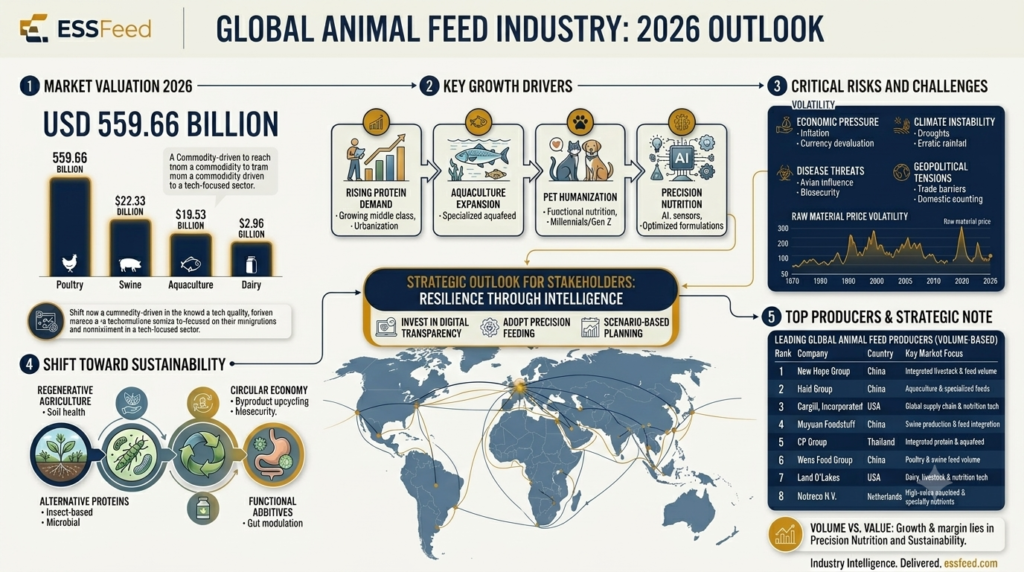
Table of Contents
1. Market Overview: The 2026 Landscape
In 2026, the global animal protein industry is characterized by:
- Precision Nutrition Dominance: A move away from generic feed towards highly specific, bioactive-enhanced nutrition tailored to the animal’s microbiome.
- Geopolitical Realignment: Trade barriers and protectionist policies are reshaping traditional supply chains, favoring regional production hubs.
- Premiumization vs. Price Sensitivity: While the mass market is trading down due to economic pressure, the “premium” pet food and “health-focused” human protein segments are showing strong growth.
2. Key Growth Drivers
- Emerging Market Expansion: Rising disposable incomes in the Asia-Pacific and Latin America are driving demand for higher-quality meat, dairy, and aquaculture products.
- Pet Humanization: The trend of treating pets as family members is driving unprecedented demand for human-grade, high-protein, and functional pet nutrition.
- Aquaculture Growth: With wild fish stocks under pressure, aquaculture is expanding rapidly as the most sustainable way to meet global protein demand.
- Scientific Advancement: AI-driven farm management and biotechnology are allowing producers to optimize health and yields in ways that were previously impossible.
3. Critical Risks and Challenges
- Margin Compression: While feed costs have stabilized, lower protein supplies and rising trade/compliance costs are putting severe pressure on producer margins.
- Climate & Disease Pressure: Erratic weather patterns and outbreaks (e.g., ASF, FMD) remain constant threats, necessitating investment in superior biosecurity and climate-resilient genetics.
- Regulatory Rigor: New legislation regarding carbon emissions, anti-obesity drug impacts on dietary demand (GLP-1s), and labeling requirements are forcing rapid operational adjustments.
- Resource Scarcity: Access to land, clean water, and high-quality raw materials remains a primary constraint on scalability.
4. The Shift Toward Sustainability and Innovation
Sustainability in the Global Animal Protein Industry is now a core business requirement:
- Regenerative Feed Systems: Focus on ingredients sourced from regenerative agriculture that restore soil health and reduce GHG emissions.
- Alternative Feed Ingredients: Growth in insect protein, microbial proteins, and upcycled agricultural byproducts to reduce reliance on traditional fishmeal and soy.
- Microbiome Engineering: Engineering the gut health of livestock to enhance immunity, reduce inflammation, and minimize the need for antibiotics.
- Digital Traceability: Widespread adoption of blockchain-verified supply chains to ensure provenance from farm-to-fork.
5. Strategic Outlook for Stakeholders
Success in the remainder of 2026 and beyond will depend on intelligence-led resilience. > “The constraint in 2026 is not demand, but the ability to deliver affordable, high-quality protein amidst global volatility. Firms that prioritize feed efficiency, embrace digital traceability, and adapt to shifting species demand will be the clear winners.”
Actionable Recommendations:
- Adopt Precision Nutrition: Transition to formulations that maximize energy/amino acid digestibility to offset volatile feed costs.
- Invest in Supply Chain Visibility: Utilize digital tools to track carbon footprints and ethical sourcing—modern retailers and regulators now require this as a baseline.
- Diversify Species Exposure: Given the contraction in beef and pork, evaluate exposure to poultry and aquaculture as growth-resilient alternatives.
Leading Global Animal Protein Industry Producers
| Company Name | Country | Key Market Focus |
| JBS S.A. | Brazil | Global leader in beef, pork, and poultry |
| Tyson Foods | USA | Large-scale beef, poultry, and pork integration |
| Cargill | USA | Global animal nutrition and protein supply chain |
| BRF S.A. | Brazil | Poultry and pork export dominance |
| Nutreco | Netherlands | Advanced animal nutrition and aquafeed |
| Alltech | USA | Biotechnology and functional feed additives |
| Charoen Pokphand (CP) Foods | Thailand | Integrated poultry, swine, and aquaculture |
| DSM-Firmenich | Switzerland/NL | Animal nutrition, health, and bioscience |
Conclusion: The Path Forward
The global animal protein industry in 2026 is moving toward a future defined by efficiency, science, and sustainability. While macroeconomic headwinds persist, the industry is proving remarkably resilient. The leaders of 2026 and beyond will be those who balance operational excellence with aggressive innovation—using biotechnology, AI, and precision nutrition to produce high-quality protein while lowering the overall environmental and economic cost of production.
Frequently Asked Questions (FAQ)
What is the primary driver of the protein market in 2026?
The main driver is the balance between growing demand in emerging markets and the urgent need for efficiency and sustainability in traditional supply chains.
What is the primary driver of the protein market in 2026?
Technology is enabling “precision farming,” where AI, robotics, and microbiome engineering optimize yields while lowering costs and environmental footprints.
Why is sustainability essential for protein producers?
Retailers, investors, and regulators now require transparency, carbon tracking, and welfare standards; producers without these certifications are losing market access.
What are the main challenges for 2026?
Producers face a “triple threat”: margin pressure from rising trade costs, persistent disease risks (like ASF), and the need to adapt to rapidly changing consumer diets (e.g., GLP-1 impacts).
Sources and References
Primary Market Intelligence Sources
- Fortune Business Insights: Animal Protein Market Size, Share & Growth Report 2034
- Research and Markets: Animal Feed Protein Global Market Report 2026
Strategic & Industry Perspectives
- Rabobank: Global Animal Protein Outlook 2026 (via The Poultry Site)
- Future Market Insights: Pet Food Ingredients Market Forecast 2026–2036
Technology & Trend Analysis
- CSG Talent: Animal Nutrition Trends 2026
- MBRF Ingredients: Animal Nutrition Trends 2026: What Will Change?
- Animal AgTech Innovation Summit: 2026 Investment & Innovation Outlook
